Saint Osmund of Salisbury
Died December 3, 1099
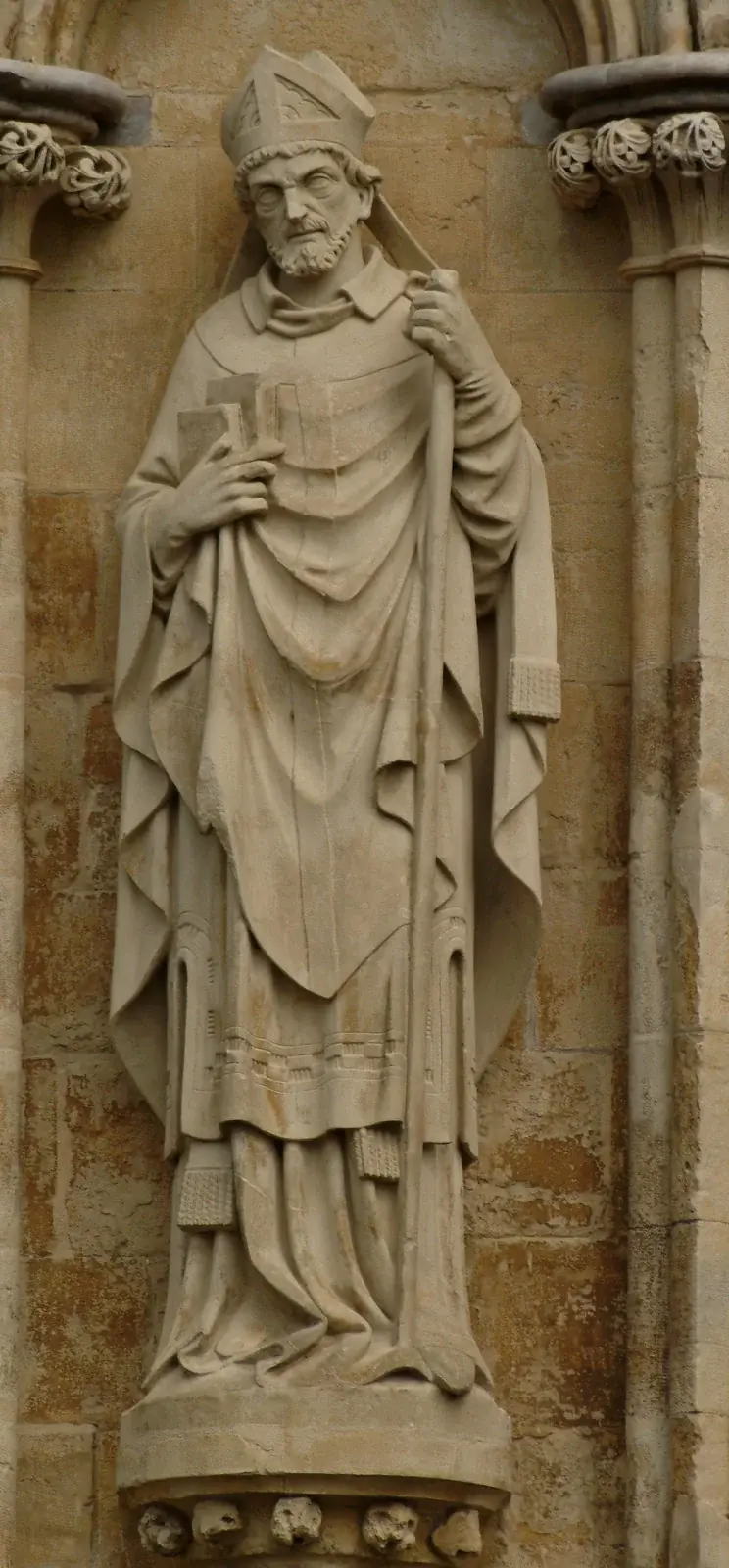
Saint Osmund was a Norman nobleman who came to England with William the Conqueror, served him as chancellor, and in 1078 became bishop of Salisbury. 12 He built the first cathedral at Old Sarum, gave it a chapter of canons, and arranged its services in the form later known as the Use of Sarum, which spread through most of England, Wales and Ireland. 12 His feast is December 4. 13
A Norman at the Conqueror's court
A. Parker, writing in the Catholic Encyclopedia in 1911, says Osmund "held an exalted position in Normandy, his native land." 1 A document from the late fifteenth century makes him the son of Henry, Count of Seez, and of Isabella, a daughter of Robert, Duke of Normandy, which would make him a nephew of William the Conqueror. 1 Alban Butler says instead that Osmund was himself count of Seez. 2
He crossed to England with William, proved a trusted counselor, and was made chancellor of the realm. 1 Butler, who gives the chancellorship on the authority of the chronicler Brompton, adds that William created him earl of Dorset; Parker says the fifteenth-century document gives him that title too. 12 Parker also names him as one of the chief commissioners for drawing up Domesday Book, and places him at the great assembly at Old Sarum in 1086 where the landholders of England swore fealty to the king. 1
Butler, characteristically, sees a saint already: "His life in the world was that of a saint in all the difficult states of a courtier, soldier, and magistrate." 2
Bishop of Sarum
He became bishop of Sarum, Parker says, "virtually William's choice," with the authority of Pope Gregory VII, and was consecrated by Archbishop Lanfranc in 1078. 1 Butler, more hagiographically, says he was "forced from his solitude." 2 The diocese covered Dorset, Wiltshire and Berkshire, and its see had only recently been moved to Old Sarum, a fortified hilltop that Peter of Blois described as "the ark of God shut up in the temple of Baal." 1
Butler says he was strict in the confessional and charitable enough to go with condemned criminals to the place of execution himself. 2 William of Malmesbury, whom Parker quotes, said much the same in his own way: "Stern he might appear to penitents, but not more severe to them than to himself. Free from ambition, he neither imprudently wasted his own substance, nor sought the wealth of others." 1
Cathedral, chapter and the Use of Sarum
Parker divides his work into three parts. The first was the cathedral at Old Sarum, consecrated on April 5, 1092; five days later a thunderstorm destroyed the roof and badly damaged the building. 1 Butler says he dedicated it in honor of the Blessed Virgin, saw it burned by lightning, and rebuilt it in 1099. 2
The second was a cathedral chapter on the Norman pattern: a dean, precentor, chancellor and treasurer, a subdean and succentor, and some thirty-two canons, in Parker's count; Butler says thirty-six. 12 They lived in their own houses but were bound to residence, to keep the full round of the liturgy with dignity, to advise the bishop, and to preach in the country round about, and there was a school for clergy under the chancellor. 1 Parker says the canons became known for their music and learning, and that other cathedrals copied the arrangement. 1
The third, and the most lasting, was the Use of Sarum. Norman clergy arriving in England had brought their own customs with them, and Butler describes the confusion that followed in places like Glastonbury. 2 Osmund, Parker writes, "invented or introduced little himself"; he chose from the practices around him and set the offices and services in order. 1 Butler says he settled the rubrics that had been left uncertain and the ceremonies that had been left to whoever was officiating. 2
Meant for one diocese, the Ordinal of Osmund was in use within a century almost throughout England, Wales and Ireland, Parker says, and reached Scotland around 1250. 1 Both writers say it held its place until the reign of Queen Mary, when so many priests obtained licenses from Cardinal Pole to say the Roman Breviary that the Roman books replaced it. 12
Books, Anselm and Aldhelm
He gathered a good library for his canons, Parker says, and "even as a bishop did not disdain to transcribe and bind books himself." 1 Butler tells the same of him and adds that he wrote a life of Saint Aldhelm. 2 Parker records his reverence for Aldhelm, his predecessor three centuries earlier as bishop of Sherborne: Osmund officiated at the translation of his relics at Malmesbury and helped Lanfranc obtain his canonization. 1
He was not always on the right side. In the investiture dispute he thought Archbishop Anselm too unyielding, and at the Council of Rockingham in 1095 he took the king's part. 12 Parker says that after the Lateran Council of 1099 he sided boldly with the archbishop, and tells how, when Anselm was on his way to Windsor, Osmund knelt before him and received his forgiveness. 1 Butler says he "soon opened his eyes, repented, begged the archbishop's absolution, and continued ever after his most steady friend." 2
He died, after a long illness by Butler's account, in the night of December 3, 1099, according to Parker, or the night before December 4, according to Butler. 12 Parker adds that the see then stood vacant for eight years. 1
Canonized after three and a half centuries
The bishop and canons of Sarum asked Pope Gregory IX to canonize him in 1228. 1 It took some two hundred years more: Parker dates the bull of Callistus III to January 1, 1457, while Butler says Callistus canonized him in 1456. 12
His remains were moved from Old Sarum to the new cathedral at Salisbury and laid in the Lady Chapel in 1457. 12 His shrine was destroyed under Henry VIII. 12 What remained, Parker writes, was a flat slab with the simple inscription MXCIX, which had lain in several places in the cathedral. 1
What is Saint Osmund the patron saint of?
Saint Osmund's feast day
Saint Osmund's feast day is December 4. Parker says that after his canonization Sixtus IV granted an indulgence in 1472 for visiting the cathedral on his feast, and a convocation held at St. Paul's in 1481 fixed December 4 as his day. 1 Butler tells his life on December 4, the 1897 English edition of the Roman Martyrology enters "In England, of St. Osmund, bishop and confessor" on that day, and the current Martyrology keeps him there, remembering the Norman who dedicated the cathedral and provided for the dignity of divine worship. 234
Praying with Saint Osmund
Osmund's great work was ordering other people's prayer, and Parker is careful to say that he invented little: he chose, arranged and settled. 1 A rite that came to be used across England, Wales and Ireland until the reign of Mary began as an effort to keep the clergy of one diocese from doing things each in his own way. 12
He was a royal official who ended up copying and binding books by hand. 12 And he was capable of being wrong in public, at Rockingham, and of saying so afterward on his knees. 12
His own cathedral was ruined by a storm five days after it was consecrated. 1 He rebuilt it, Butler says, in the year he died. 2
Saint Osmund of Salisbury, pray for us.
Sources
- 1.A. Parker, "St. Osmund," The Catholic Encyclopedia, vol. 11 (New York: Robert Appleton Company, 1911).
- 2.Alban Butler, "St. Osmund, Bishop, C.," The Lives of the Fathers, Martyrs, and Other Principal Saints, Vol. XII, December 4 (Derby: Richardson and Son, 1842), via the Internet Archive.
- 3.Roman Martyrology, entry for December 4, "Sant'Osmundo, vescovo," Santo del giorno, Conferenza Episcopale Italiana (in Italian).
- 4.The Roman Martyrology, December 4 (Baltimore: John Murphy & Co., 1897), Internet Archive.
Saints to turn to next
Others in this collection who are turned to for some of the same things.
- Saint AaronDied on Mount Hor, at the end of the years in the desertWork and vocationPrayer
- Saint Aelred of Rievaulx1109 - January 12, 1166 (or 1167)PrayerWork and vocation
- Saint Agnes of Montepulcianoc. 1268 - April 1317PrayerWork and vocation
- Saint Alphonsus Rodriguez1532 or 1533 - October 1617PrayerWork and vocation