Saint Nonnosus
Sixth century
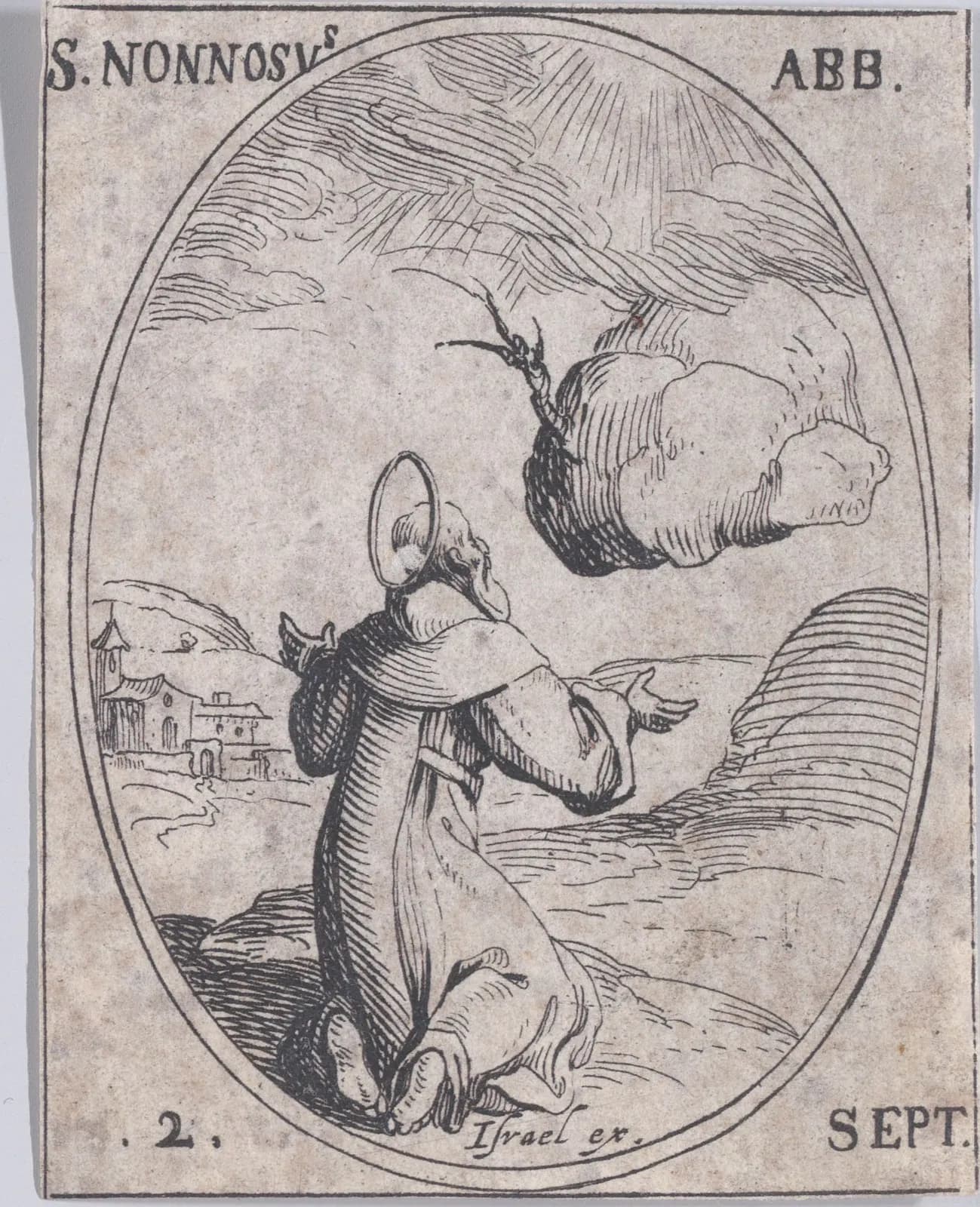
- Also called
- Nonnoso, in Italian 2
- Friend
- Anastasius, abbot of the nearby monastery of Suppentonia 1
- Feast day
- September 2 2
Saint Nonnosus was the prior of a monastery on Mount Soracte, north of Rome, in the sixth century, under an abbot so harsh that the prior spent much of his time calming him down. 12 Gregory the Great, who heard about him from two men who had known him, tells three miracles of his: a boulder moved from a garden plot, a broken lamp made whole, and empty oil jars found full. 1
How Gregory came to tell it
Everything known of Nonnosus is in one chapter of Gregory the Great's Dialogues, four books of stories about the holy men of Italy that Gilbert Huddleston, in the 1909 Catholic Encyclopedia, counts among the most important of Gregory's writings for his own life. 14 Gregory frames the book as a conversation with his deacon Peter, who had found him sitting alone, weighed down by the business of his office and longing for the quiet of his old monastery. 1 Peter says he cannot think of anyone in Italy famous for miracles, and Gregory sets out to prove him wrong. 1
Gregory promises to name his informants, "lest any in reading should have occasion to doubt whether such things as I write be true or no." 1 For Nonnosus he names two, both still living when he wrote: the reverend Bishop Maximianus, and "the old monk Laurio, one whom you know." 1 Laurio had been raised under the holy man Anastasius in the monastery near the town of Nepi, and Anastasius, Gregory says, "was daily in the company of holy Nonnosus." 1
A prior under a hard abbot
Gregory's first fact about Nonnosus is not a miracle. "This Nonnosus had for his Abbot a very sharp man, whose rough conditions notwithstanding he did always bear with wonderful patience, and did in such sweet sort govern the monks, that oftentimes by his humility he appeased the Abbot's anger." 1
The office matters. Gregory calls Nonnosus the prior, the second in the house, under an abbot. 1 The current Roman Martyrology remembers him as an abbot, on Mount Soracte on the Via Flaminia in Lazio. 2 The page keeps Gregory's word, since his is the only account there is. Edmund Gardner, the 1911 editor of the Dialogues, notes that there were several early monasteries on the mountain, and that Nonnosus's was perhaps the one traditionally linked with Saint Sylvester, refounded in the eighth century by Carloman the Frank. 1
The stone
The monastery stood on the top of a hill, and there was no level ground for a garden. 1 The only possible plot, on the side of the mountain, was taken up by a great stone that grew out of the rock. 1
Nonnosus thought that the plot would do very well "to set worts," garden vegetables, if only the stone could be moved, and also that "five hundred yoke of oxen would not be able to stir it." 1 So, Gregory says, "despairing of all human help, he betook himself to God's goodness," and prayed there in the quiet of the night. 1 In the morning the monks found the stone "removed far off, and a very fit plot of ground left to make them a garden." 1
The lamp
Another time Nonnosus was washing the monastery's glass lamps and dropped one, which broke into many pieces. 1 Gregory gives his reason for what he did next with some sympathy: "fearing the great fury of the Abbot," he gathered up every fragment, laid them before the altar, and prayed with great sighing. 1 When he raised his head, the lamp was whole. 1
In these two miracles, Gregory says, Nonnosus imitated "two notable fathers, to wit, Gregory and Donatus; the first of which removed a mountain, and the other made a broken chalice safe and sound." 1 Peter, his listener, remarks that these are "miracles after the imitation of old saints." 1
The oil
The third story, Gregory says, shows Nonnosus imitating the prophet Elisha. 1 One year the oil was used up, olive harvest was near, and the monastery's own trees had borne almost nothing. 1 The abbot decided to send the monks out to help other people with their harvest, so that "for the recompense of their labour they might bring home some oil." 1
Nonnosus, "in great humility," stopped this, afraid that monks working outside the cloister "might lose somewhat in the devotion of their souls." 1 He had the few olives on their own trees gathered and pressed, and the little oil brought to him. 1 He set it before the altar, prayed alone, and then had the monks pour a little into every vessel in the house, stopped the vessels up, and left them. 1 The next day they were full. 1
The story Gregory has in mind is in the Second Book of Kings, where a widow with nothing but a jug of oil is told by Elisha to borrow empty vessels from her neighbors, shut the door, and pour; the oil runs until there are no vessels left. 3 Peter answers Gregory with the words of Christ: "My Father even to this time doth work, and I do work." 1
Anastasius of Suppentonia
The next chapter of the Dialogues turns to Nonnosus's daily companion. Anastasius had been a notary of the Roman Church and gave up his post to become a monk, and for many years he governed the monastery called Suppentonia, beneath a great overhanging rock. 1 Gardner identifies Suppentonia as Castel Sant'Elia, between Nepi and Civita Castellana. 1
Gregory tells that one night a voice from the top of the rock called slowly, "Come away, Anastasius," and then called seven other monks by name, and after a pause an eighth. 1 Within days Anastasius died, and the others after him in the order they had been called. 1 That is the house in which Laurio, Gregory's informant, grew up. 1
What is Saint Nonnosus the patron saint of?
Saint Nonnosus's feast day
Praying with Saint Nonnosus
Nonnosus was the second man in a house run by someone difficult. Gregory does not say the abbot changed. He says Nonnosus bore him "with wonderful patience" and kept the peace among the monks. 1
His miracles are about the ordinary work of a monastery: a vegetable plot, a lamp that needed washing, a year with no oil. 1 In each he prayed first, and in two of them he prayed at night, alone. 1
The lamp story is plainly about fear. He broke something and was afraid of what the abbot would do, and he took the pieces to the altar. 1 Gregory tells it without embarrassment, and puts it beside a story of a mountain being moved. 1
Saint Nonnosus, pray for us.
Sources
- 1.Gregory the Great, Dialogues, Book I, prologue and chapters 7 and 8, with the editor's notes, translated by "P. W." (Paris, 1608), re-edited by Edmund G. Gardner (London: Philip Lee Warner, 1911); transcribed by Roger Pearse.
- 2.Roman Martyrology, entry for September 2, "San Nonnoso, abate," as printed in "Santo del giorno," Conferenza Episcopale Italiana (in Italian).
- 3.2 Kings 4:1-7, "The Widow's Oil," New American Bible, Revised Edition, United States Conference of Catholic Bishops.
- 4.Gilbert Huddleston, "Pope St. Gregory I ('the Great')," The Catholic Encyclopedia, Vol. 6 (New York: Robert Appleton Company, 1909).
Saints to turn to next
Others in this collection who are turned to for some of the same things.