Saint Mary Frances of the Five Wounds
March 25, 1715 - October 6, 1791
- Religious life
- Took the habit of the Third Order of Saint Francis with the Alcantarine friars, September 8, 1731 12
- Invoked by
- Women hoping to conceive and to give birth safely; called by L'Osservatore Romano a co-patron saint of Naples 3
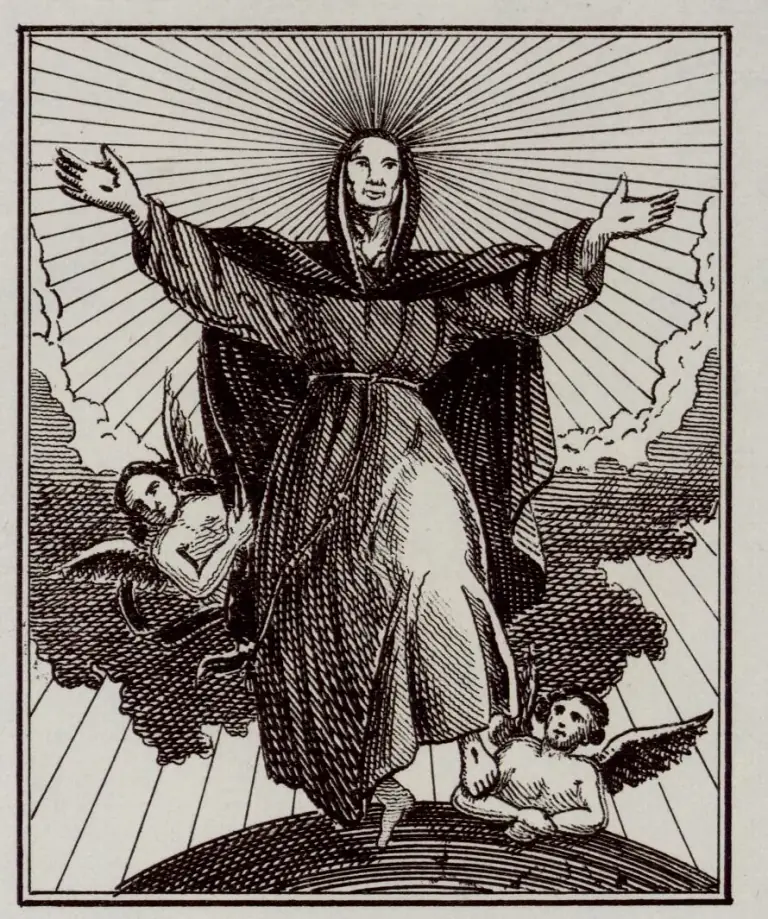
Saint Mary Frances of the Five Wounds was a Neapolitan woman who refused the marriage her father arranged, was beaten and locked in her room for it, and took the habit of a Franciscan tertiary at sixteen without ever entering a convent. 12 She spent her life in illness and poverty, the last thirty-eight years of it in a priest's house in the Quartieri Spagnoli, sought out by priests and religious for advice, and women still come to that house to sit in her chair and pray for a child. 13 She died on October 6, 1791, and October 6 is her feast. 14
A house in Naples
She was born at Naples on March 25, 1715, to Francesco Gallo and Barbara Basinsin. 1 Ferdinand Heckmann, in the Catholic Encyclopedia, calls the family middle class; Antonella Cilento, writing in L'Osservatore Romano, calls her the daughter of a merchant couple, and gives her baptismal names as Anna Maria Rosa Nicoletta. 13
Her father was the difficulty. Heckmann describes "a severe, avaricious man with a passionate temper," who subjected her to ill-treatment and "hard, incessant labour which often brought her to the verge of the grave." 1 Her mother, by the same account, was gentle and patient and bore her husband's brutality. 1 Before the child was born, Leon's Lives of the Franciscan saints says, the mother sought the prayers of Saint John Joseph of the Cross and Saint Francis Jerome, and both told her the child would be holy. 2
She was admitted to Communion at seven, which was early, because of what her confessor saw in her; afterward she was allowed to receive daily. 12
"Sister Mary Frances"
At sixteen a young man of good fortune asked for her, and her father accepted without consulting her. 2 She refused and asked to enter the Third Order of Saint Francis instead. Leon tells what followed: her father "went into a violent passion and seizing a cord beat her unmercifully until her mother came and snatched it out of his hands," and then locked her in her room on bread and water. 2
A Franciscan, Father Theophilus, brought her father round. 12 On September 8, 1731, she received the habit of the Third Order from the barefoot friars of the Alcantarine reform, and took the name "Mary Frances of the Five Wounds of Jesus," Heckmann says, out of devotion to the Blessed Virgin, to Saint Francis and to the Passion. 12 She was allowed to wear the habit in public while living at home. 2
She never entered a convent. Cilento places her among the women of Naples called "bizzoche," laywomen of little education and great devotion, guided by spiritual fathers and committed to works of charity, who lived consecrated lives in their own homes. 3 By Cilento's account she remained semi-literate all her life. 3
Suffering, and her confessors
The sources agree that her life was hard and do not soften it. "During her whole life the saint had much to suffer from bodily ills," Heckmann writes, "and to her physical suffering was added mental pain from the persecution of her father, sisters, and other persons." 1 Leon quotes Father Gaetan Laviosa, who knew her: "I have seen and heard of her suffering, with the greatest constancy, all kinds of illnesses and pains, violent fevers, interior inflammation, gangrene of the legs, which had to be lanced and cauterised." 2
Her directors added to it. Heckmann says her confessors, "to test her sanctity, made her suffer by the severity of their direction." 1 Leon preserves her own account of one of them, given years later as advice to a priest: he heard all his other penitents before her, "when I went in he often only said to me roughly, 'go to Communion.'" Her family scolded her for coming home late from church, and the neighbors talked. "I tell you this that you may be prudent and indulgent, but also that you may not spare those who need the trial." 2
On Fridays, and especially the Fridays of Lent, she felt in her body the pains of the Passion. 12 Heckmann reports that her body "is said to have been signed with the stigmata, which, at her prayer, took no outward, visible appearance." 1 Leon says the marks were left on her body; Cilento describes her sitting in her chair "afflicted by the burns of the stigmata and many illnesses." 23
Counsel, charity, and the Eucharist
People came to her. "Priests, religious, and pious persons went to her for light and counsel," Heckmann writes, and her compassion for the afflicted "knew no bounds." 1 Leon adds that she often went without necessities to give to the poor, and that "to be a benefactor it was only necessary to insult her." 2 She offered much of her penance for the souls in purgatory. 2
Her hunger for Communion runs through Leon's chapter. When her directors forbade it to test her, it was "a real agony to her." 2 Leon quotes a priest he calls "the venerable Bianchi," who testified that while she lay sick at home the archangel Raphael brought her the chalice from his Mass. 2 Cilento says that from her chair she foretold the sanctity of Francis Xavier Bianchi, "another saint to whom Naples was once very devoted." 3
For the last thirty-eight years of her life she lived in the house of a priest, Giovanni Pessiri. 1 Cilento identifies it as the house at number 13 Vico Tre Re in the Quartieri Spagnoli, three rooms that are now a small shrine. 3
Death and canonization
In her last months, Leon says, she saw troubles coming on the Church and prayed to die rather than witness them; when the news of Louis XVI's flight reached Naples in June 1791 and the city rejoiced, she knew that he had already been stopped at Varennes and taken back to Paris. 2 She died on October 6, 1791. 123 At her funeral, Cilento writes, "everyone wanted a relic of the saint and the public force was needed to stop the riots." 3
She was buried in the church of the Alcantarines, Santa Lucia del Monte, which also holds the tomb of Saint John Joseph of the Cross. 12 She was declared Venerable by Pius VII on May 18, 1803, beatified by Gregory XVI on November 12, 1843, and canonized by Pius IX on June 29, 1867; Leon adds that Leonard of Port Maurice was canonized with her. 12
The Daughters of Saint Mary Frances, founded in 1884 by Brigida Cuocolo at the request of Cardinal Guglielmo Sanfelice, still keep her house and run kindergartens, schools and workshops in the neighborhood. 3 A plaque in the shrine, Cilento notes, credits her with sparing the Quartieri Spagnoli in all of the one hundred and five bombings of the city during the Second World War. 3
What is Saint Mary Frances the patron saint of?
Saint Mary Frances is invoked above all by women who hope to have a child. Cilento writes that the cult around her "centers on miracles attributed to fertility and childbirth," and that visitors to her house sit in her chair, "which has become a symbol of hope for conception." 3 She also calls her "a co-patron saint of the city" of Naples. 3
Saint Mary Frances's feast day
Saint Mary Frances of the Five Wounds's feast day is October 6, the day she died. The current Roman Martyrology, in the text published by the Italian bishops, enters her on that day at Naples, as a virgin of the Secular Franciscan Order admirable for her patience under countless sufferings, for her penance and for her love of God and of souls. 4
Heckmann records October 6 as her feast among the Friars Minor, the Capuchins and the Conventuals, and Cilento says it is still kept every year on the day of her death as a real event for her neighborhood. 13
Praying with Saint Mary Frances
Most of what made her life hard came from the people closest to her: a violent father, resentful sisters, confessors who tested her with harshness. 12 She stayed, first in her father's house and then in a priest's. 13
Her advice to the priest who asked her about directing souls has nothing sentimental in it. She told him what had hurt her and asked him to be careful with others, and then told him not to spare those who needed the trial. 2
The women who sit in her chair today come with something they cannot arrange for themselves. 3 The sources do not promise them anything. They describe a woman who spent her life in pain, kept on praying, and was trusted by people who had nowhere else to go. 123
Saint Mary Frances of the Five Wounds, pray for us.
Sources
- 1.Ferdinand Heckmann, "St. Mary Frances of the Five Wounds of Jesus," The Catholic Encyclopedia, Vol. 9 (New York: Robert Appleton Company, 1910).
- 2.Father Leon, "St. Mary Frances of the Wounds of Jesus, Virgin," October 6, in Lives of the Saints and Blessed of the Three Orders of Saint Francis, translated from the Aureole seraphique, Vol. III (Taunton: Franciscan Convent, 1886), pp. 278-286, Internet Archive.
- 3.Antonella Cilento, "Invoking the grace of motherhood," L'Osservatore Romano, Women Church World, April 6, 2024.
- 4.Roman Martyrology, entries for October 6, Santo del giorno, Conferenza Episcopale Italiana (in Italian).
Saints to turn to next
Others in this collection who are turned to for some of the same things.