Saint Maglorius
d. c. 575, c. 586 or c. 605
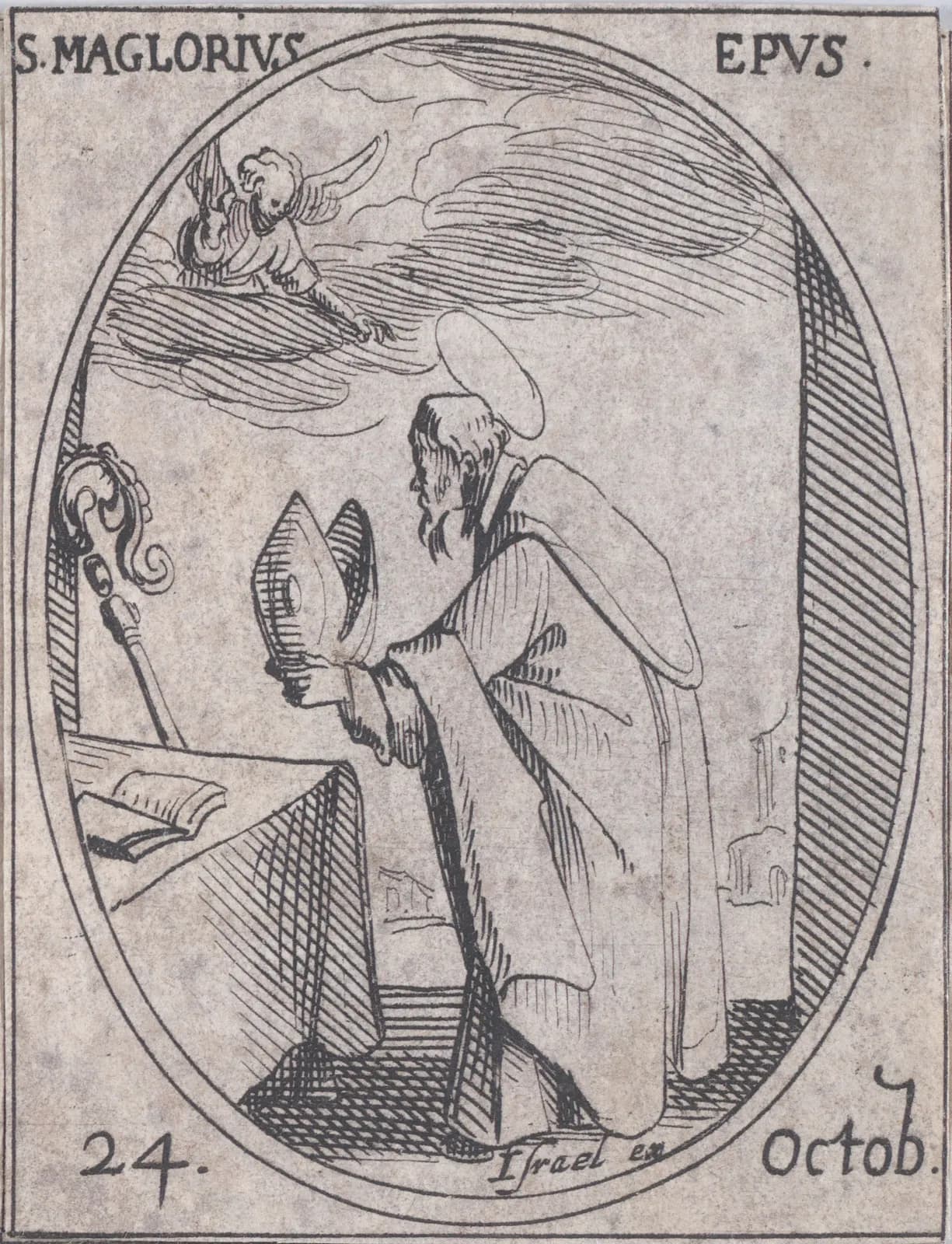
- Also called
- Magloire, Maelor; on Jersey, Mannelier 1
Saint Maglorius was a Welsh monk, a pupil of Illtyd, who is said to have followed Samson to Brittany, succeeded him at Dol, and ended his life as a hermit on the Channel island of Sark. 123 Nearly everything about him comes from a Life written some three hundred years later, and the sources say plainly that its author knew very little. 1 What is certain is his cult, which ran from Brittany to Paris and into English calendars. 1
A pupil of Illtyd
By tradition Maglorius was born late in the fifth century in Glamorgan in South Wales. 13 The Norwegian bishops' saints database (katolsk.no) says he was the eldest son of Umbrafel and Afrella, the uncle and aunt of Saint Samson of Dol on both sides, so that he was Samson's first cousin. 1 Another tradition makes him a cousin of Saint Malo instead. 1 Nominis, the French bishops' saints site, says that popular memory turned him into an Irish prince who converted the Bretons. 3
He was educated by Saint Illtyd at Llantwit Major, became a monk, and was ordained deacon by Samson. 13 F. M. Rudge, in the 1910 Catholic Encyclopedia, names him with Gildas and Samson among the scholars who "flocked" to Illtyd's school, and says their lives are the earliest source for Illtyd himself. 4 katolsk.no says that when Samson persuaded his family to leave the world, Maglorius's parents did the same, his father following Samson to the monastery on Caldey Island. 1
Samson's successor at Dol?
Maglorius went with Samson to Brittany, where they founded monasteries under the protection of King Childebert. 13 Samson became abbot of Dol, and Maglorius abbot of a house nearby, which katolsk.no names as Lammeur and another source as Kerfunt. 1 The diocese of Rennes, quoted by Nominis, records a tradition that a monastery founded by Samson near the spring that bears his name at Carfantin was afterward governed by Maglorius. 3
Nominis's quoted life says that Samson, feeling his end near, chose Maglorius as his successor, and that after three years he longed for solitude and went to a hermitage. 3 katolsk.no says tradition makes him abbot and archbishop of Dol after Samson's death about 565, until he handed the see to a monk named Budoc. 1 The Roman Martyrology, as the Italian bishops print it, is careful, and says only that by tradition Maglorius succeeded Samson. 2
katolsk.no is blunter. The title of archbishop, it says, reflects Dol's failed attempt in the 860s to become a metropolitan see, and there is reason to doubt that Maglorius was ever bishop of Dol or had anything to do with Samson, since he is not among Samson's two immediate successors named in Samson's own early Life. 1 Gilbert Huddleston, writing on Samson in the 1912 Catholic Encyclopedia, notes that Dol "did not become a regular episcopal see till about the middle of the ninth century." 5
The hermit of Sark
Even in his hermitage on the Breton coast, crowds came for advice and miracles. 13 katolsk.no tells the Life's story that in 565 the lord of Jersey, Count Loïescon, was cured of a skin disease by Maglorius and gave him land on Sark, the small island between Guernsey and France. 1 There, it says, Maglorius settled with sixty-two monks, built an oratory, cleared the land and sowed wheat, and built a water mill with a little dam to grind it. 1 The mill is gone, but a stream still runs from the place called La Moinerie down to the beach known as Le Port du Moulin. 1
According to katolsk.no he also organized the islanders against raiders, and served them through an epidemic and a famine without regard for his own safety. 1 A later Life adds that he drove a troublesome dragon off Jersey and was given land there for it. 1 The diocese of Coutances, to which the islands once belonged, remembers him as the apostle of Jersey and a monk of Sark. 3
The Life says that in his last months he would not leave the church, taking literally the psalmist's wish to dwell in the house of the Lord, and that he received viaticum from an angel. 1 He died on Sark. katolsk.no gives about 575 as the traditional date; the French text of the Martyrology says about 605, and Nominis's heading says about 586, adding that other historians think the date uncertain. 13 After his death, katolsk.no says, the sons of noblemen from England and Neustria still came to Sark to study theology. 1
The relics and the Life
About 850, katolsk.no says, Duke Nominoe of Brittany promised land for a monastery to some monks on condition that they bring to Léhon the relics of a famous saint. 1 They went to Sark and took Maglorius's body. 1 The legend, as katolsk.no tells it, has the saint making his own coffin light and a wind holding back the pursuers. 1 The priory of Saint-Magloire at Léhon, near Dinan, dates from 857. 13 About 920, fleeing the Vikings, the monks carried the relics through Sablé, Angers and Orléans to Paris, where they gave rise to the great abbey of Saint-Magloire, now vanished; the relics are said to rest still in the church of Saint-Jacques. 1
katolsk.no is plain about the evidence. There is no contemporary or near-contemporary witness to Maglorius's existence, and nearly everything told of him is problematic. 1 His first Life was written in Brittany, probably at Léhon in the late ninth or early tenth century; no manuscript holds the whole text, and its author plainly knew very little about his subject. 1 There is good reason to think that he was an ascetic on Sark, and that after his relics reached Léhon, the clergy of Dol adapted his name and cult to their own purposes. 1
None of that touches his cult, which is certain. 1 katolsk.no lists his place in the martyrologies of Bede and Ado of Vienne, in Breton calendars and in the English mystic Richard Rolle. 1 Nominis records churches in his name at Mahalon, Telgruc and Châtelaudren in Brittany, and Léhon abbey, near Dinan, is dedicated to him. 3
What is Saint Maglorius the patron saint of?
None of the sources consulted names a patronage for Saint Maglorius. 123 He is the titular saint of churches in Brittany, among them Mahalon and Châtelaudren, and Nominis calls his cult very local. 13 katolsk.no says he is remembered in the English diocese of Portsmouth, and that he is one of the few Welsh saints in the Roman Martyrology. 1
Saint Maglorius's feast day
Saint Maglorius's feast day is October 24. 13 The Roman Martyrology enters him on that day in Brittany, as a disciple of Illtyd who lived in solitude on Sark. 2 katolsk.no says the diocese of Quimper and Léon keeps him on October 27, and that the October 24 feast spread from his church in Paris to a few other churches of the Île-de-France and to a handful of late medieval English martyrologies. 1
Praying with Saint Maglorius
The sources ask a reader to hold two things at once. The Life is late and its author knew little; and yet the man was real enough to be remembered on Sark, carried off by monks who wanted his protection, and named in calendars across two countries. 1
What survives, if anything does, is a monk who kept trying to be alone and kept being found. The tradition has him give up Dol for a hermitage, and the hermitage for an island, and on the island he built a mill and fed people through a famine. 13
The last thing told of him is that he would not leave the church. 1 Whether the angel came or not, the Life remembers a man who wanted to end his days where he prayed.
Saint Maglorius, pray for us.
Sources
- 1."Den hellige Maglorius av Sark (~486?-~575)," Den katolske kirke (katolsk.no), Catholic Diocese of Oslo (in Norwegian).
- 2.Roman Martyrology, entry for October 24, "San Maglorio," as printed in "Santo del giorno," Conferenza Episcopale Italiana (in Italian).
- 3."Saint Magloire de Dol," Nominis, Conférence des évêques de France, quoting the Dioceses of Quimper and Léon, Saint-Brieuc and Tréguier, Rennes and Coutances, and the Roman Martyrology (in French).
- 4.F. M. Rudge, "St. Illtyd," The Catholic Encyclopedia, Vol. 7 (New York: Robert Appleton Company, 1910).
- 5.Gilbert Huddleston, "St. Samson," The Catholic Encyclopedia, Vol. 13 (New York: Robert Appleton Company, 1912).
Saints to turn to next
Others in this collection who are turned to for some of the same things.