Saint Linus
Birth unknown - c. 76 or 79
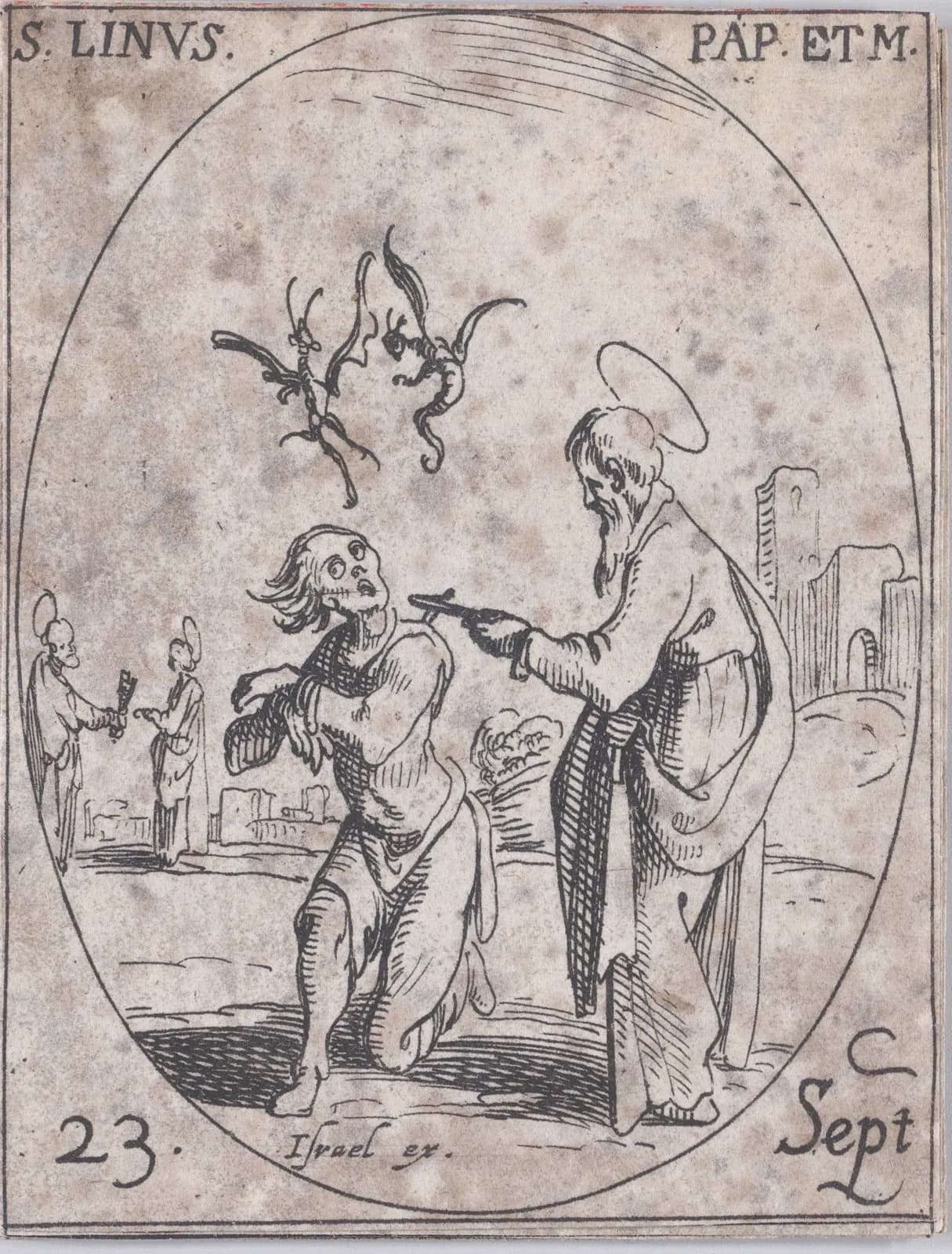
- Bishop of Rome
- The first after Saint Peter, about twelve years: about 64 or 67 to 76 or 79, says the 1910 Catholic Encyclopedia 1; about 68 to 79, says Vatican News 6
- Named in
- The Roman Canon of the Mass, Eucharistic Prayer I 2
Saint Linus was the first bishop of Rome after the apostle Peter, and every ancient list of the Roman bishops puts his name there. 12 Irenaeus of Lyon, writing in the second century, says the apostles "committed into the hands of Linus the office of the episcopate," and identifies him with the Linus whom Paul mentions in writing to Timothy; Eusebius places that mention in the greetings at the end of the Second Letter. 45 Beyond that, as the 1910 Catholic Encyclopedia shows, very little is known for certain. 1
First after Peter
The oldest records of the Roman bishops, handed down by Irenaeus, Julius Africanus, Hippolytus and Eusebius, and the Liberian Catalog of 354, all put Linus directly after Peter. 12 Johann Peter Kirsch, in the Catholic Encyclopedia, traces these back to a list of Roman bishops that existed under Pope Eleutherus, about 174 to 189, when Irenaeus was writing. 1
Irenaeus wrote the list down in Against Heresies, to show that the faith taught in Rome had come down from the apostles "by means of the successions of the bishops." 4 "The blessed apostles, then, having founded and built up the Church, committed into the hands of Linus the office of the episcopate," he says. 4 "Of this Linus, Paul makes mention in the Epistles to Timothy. To him succeeded Anacletus; and after him, in the third place from the apostles, Clement was allotted the bishopric." 4 He goes on to name every bishop down to Eleutherus, the twelfth, in his own day. 4
Eusebius, in his Church History, gives the same order. 5 "After the martyrdom of Paul and of Peter, Linus was the first to obtain the episcopate of the church at Rome." 5 Later he calls Linus Paul's "companion at Rome," and dates the end of his time in office to the second year of the Emperor Titus, when "Linus, who had been bishop of the church of Rome for twelve years, delivered his office to Anencletus." 5
Not every early writer agreed. Tertullian put Clement immediately after Peter, and some later Latin writers, Jerome among them, followed him. 1 Kirsch judges that the Roman list in Irenaeus "has undoubtedly greater claims to historical authority." 1
What is uncertain
The Linus of the Second Letter to Timothy is the first question. Paul, writing to Timothy from Rome, includes a Linus in the greetings at the end of the letter, and both Irenaeus and Eusebius take this Linus to be the bishop. 45 Kirsch says it cannot be known whether the identification goes back to a reliable early source or arose later because the names were the same. 1 katolsk.no, the saints database of the Catholic Diocese of Oslo, says the same. 2
His dates are the second. The papal lists give him twelve years, and the Liberian Catalog says exactly twelve years, four months and twelve days. 12 But it places them from 56 to 67, which Kirsch calls incorrect. 1 Those dates may be why some fourth-century writers, Rufinus among them, thought Linus led the Roman Church while Peter was still alive; Kirsch says this has "no historical foundation." 1 katolsk.no reports that he is said to have been Peter's vicar. 2 Kirsch dates the pontificate from the deaths of Peter and Paul, which are not known exactly, and gives about 64 or 67 to 76 or 79; katolsk.no about 67 to 76; Vatican News about 68 to 79. 126 katolsk.no adds a caution of its own: a single ruling bishop developed in Rome only in the middle of the second century, so that the existence and leading role of Linus are beyond dispute but his exact office is hard to picture. 2
The encyclopedia's article on his successor, Anacletus, quotes the historian Duchesne on how far any of these dates can be trusted. 7 "We can accept the list of Irenaeus," Duchesne wrote, beginning with Linus, Anacletus and Clement, and "Anicetus reigned certainly in 154. That is all we can say with assurance about primitive pontifical chronology." 7 The order of the names, in other words, is the solid part; the years attached to them are reconstruction. 17
The Liber Pontificalis, the later book of papal lives, adds more. 1 It says Linus came from Tuscany and that his father was called Herculanus; katolsk.no names his town as Volterra. 12 Kirsch says the origin of this is unknown. 1 The same book says Linus decreed, "in conformity with the ordinance of St. Peter," that women should cover their heads in church. 1 Kirsch calls the decree apocryphal, copied from Paul's First Letter to the Corinthians and attributed to Linus. 1
Martyrdom and burial
The Liber Pontificalis also says he died a martyr. 1 Kirsch says this "cannot be proved and is improbable," because there is no record of any persecution of the Roman Church between Nero and Domitian, and Irenaeus names only one of the early Roman bishops, Telesphorus, as martyred: "Telephorus, who was gloriously martyred," in the translation on New Advent. 14 katolsk.no says he is traditionally honored as a martyr in the West, but that historians think it unlikely. 2 The Roman Martyrology, as the Italian bishops print it, commemorates him as a pope without calling him a martyr. 3
He is said to have been buried on the Vatican Hill beside Peter. 12 Kirsch thinks it possible, since Peter was certainly buried there, but notes that nothing in the fourth-century liturgy proves it. 1 When the present confession of Saint Peter's was built in 1615, a sarcophagus was found bearing the letters LINUS, and some writers took it for his tomb. 1 A manuscript by Torrigio, who recorded the find, shows that there were other letters as well, so the name was probably something like Aquilinus or Anullinus, and the place of the find rules out its being Linus. 1
A letter on the martyrdom of Peter and Paul, supposedly sent by Linus to the Eastern Churches, was later attributed to him. 1 Kirsch says it is apocryphal and of later date. 1
What is Saint Linus the patron saint of?
Saint Linus's feast day
Saint Linus's feast day is September 23. 126 Kirsch notes that this is also the date given by the Liber Pontificalis, and katolsk.no says it has been kept since the eighth century, though since the 1969 revision of the calendar it is no longer obligatory for the whole Church. 12 The current Roman Martyrology commemorates him on that day as the pope to whom, as Saint Irenaeus writes, the apostles entrusted the episcopal care of the Church founded in Rome, and whom Paul remembers as his companion. 3
Praying with Saint Linus
Linus is known almost entirely as a name in a sequence. 1 Irenaeus did not record his deeds; he recorded that he came next, because the point of the list was that the teaching in Rome had been handed on, one bishop to the next, from the apostles. 4
The sources are scrupulous about the rest. Kirsch sets aside the decree, the martyrdom, the vicar, the sarcophagus and the precise dates, and keeps the one fact that the oldest witnesses agree on. 1
That fact is still said aloud. Irenaeus named him to show where the faith of Rome came from, and his name is still spoken in the Roman Canon of the Mass whenever that prayer is used. 24
Saint Linus, pray for us.
Sources
- 1.Johann Peter Kirsch, "Pope St. Linus," The Catholic Encyclopedia, Vol. 9 (New York: Robert Appleton Company, 1910).
- 2."Den hellige pave Linus ( -76)," Den katolske kirke (katolsk.no), Catholic Diocese of Oslo (in Norwegian).
- 3.Roman Martyrology, entry for September 23, "San Lino, papa," as printed in "Santo del giorno," Conferenza Episcopale Italiana (in Italian).
- 4.Irenaeus of Lyon, Against Heresies, Book III, chapter 3, trans. Alexander Roberts and William Rambaut, Ante-Nicene Fathers, Vol. 1 (Buffalo: Christian Literature Publishing Co., 1885), at New Advent.
- 5.Eusebius of Caesarea, Church History, Book III, chapters 2, 4 and 13, trans. Arthur Cushman McGiffert, Nicene and Post-Nicene Fathers, Second Series, Vol. 1 (Buffalo: Christian Literature Publishing Co., 1890), at New Advent.
- 6."s. Lino, papa," Santo del día, 23 de septiembre, Vatican News (in Spanish).
- 7.Thomas Campbell, "Pope St. Anacletus," The Catholic Encyclopedia, Vol. 1 (New York: Robert Appleton Company, 1907).
Saints to turn to next
Others in this collection who are turned to for some of the same things.