Saint Leopold III of Austria
c. 1075 - November 15, 1136
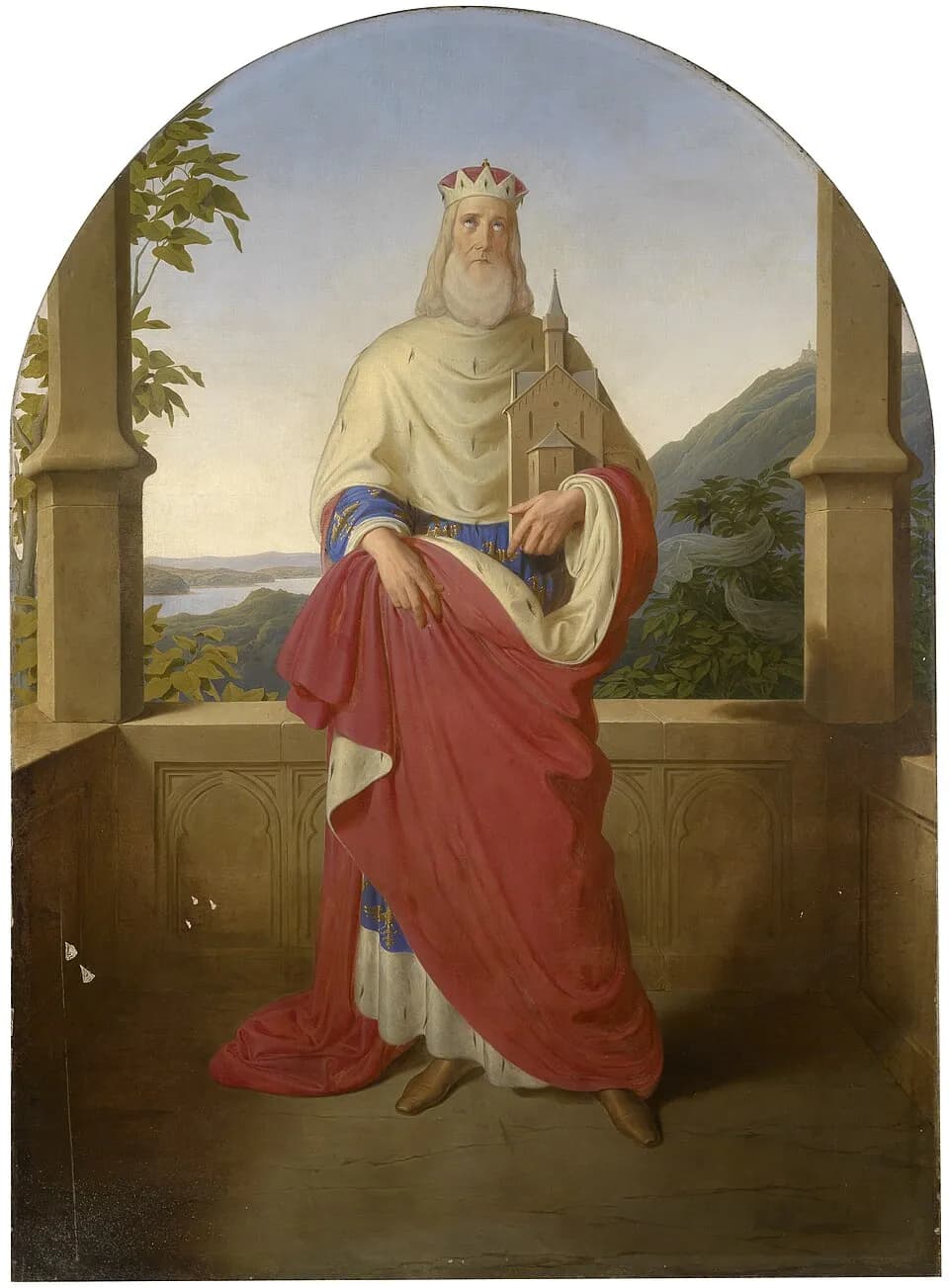
Saint Leopold III was margrave of Austria for forty years, from the 1090s until his death in 1136, when Austria was still a border march of the German empire. 23 He founded the abbeys of Klosterneuburg and Heiligenkreuz, both of which are still standing and still inhabited, and he and his wife Agnes had eighteen children. 134 He is the patron saint of Austria, and his feast is November 15. 2
A margrave on the eastern border
He belonged to the Babenberg family, which had ruled the march before him; Catholic Culture counts him its fourth margrave. 123 Klosterneuburg Abbey, which he founded and where he is buried, says he was born around 1075, "presumably in Melk"; Catholic Culture says Melk without the hedge. 23 According to the account Catholic Culture excerpts from John Delaney's Dictionary of Saints, he was educated by Bishop Altman of Passau. 2
He succeeded his father as margrave in 1095, by the abbey's date, or 1096, by Catholic Culture's. 23 Delaney says he was twenty-three. 2 The abbey describes his territory as the March of Ostarrichi, "the eastern border region" of the empire. 3
Readers who go to the Catholic Encyclopedia will find him under a different number. It has no article on him, and the passage that mentions him, in its long article on Austria, calls him "Leopold II, the Saint." 1 The abbeys he founded call him Leopold III, and so does this page. 34 The same passage adds that the Crusades began in his reign, that many of the crusading armies crossed Austria, and that his mother, Ida, joined a pilgrimage led by the archbishop of Salzburg and was taken prisoner. 1
Agnes
His early years as margrave fell in the quarrel between the emperors and the papacy known as the Investiture Controversy. The abbey says he at first stayed neutral. 3 In 1105, when the dispute between Emperor Henry IV and the papal party threatened to escalate, Leopold withdrew from the imperial army, and the abbey credits that withdrawal with ending the danger. 3
Henry V gave him his sister Agnes in marriage in recognition. 3 She was a daughter of Henry IV and the widow of the Hohenstaufen duke Frederick of Swabia, and she already had children. 123 The abbey says one of her sons by that first marriage became "the first German Staufer emperor." 3 Catholic Culture lists Leopold as a patron of step-parents. 2
Leopold and Agnes had eighteen children together. 12 One of them, Henry, became the first duke of Austria. 13 Another, Otto, became a Cistercian monk, bishop of Freising, and the author of a chronicle that the encyclopedia says made him "the most noted German historian of the Middle Ages." 1
Klosterneuburg and the veil
Agnes brought a rich dowry, and the abbey says Leopold spent it on his land. 3 He moved his residence to Neuburg on the Danube, and on June 12, 1114, he and Agnes founded an abbey beside their castle there, meant as "the religious, social and cultural centre" of the march. 3 In 1133 they handed it over to the Augustinian canons, who have it still. 3 A convent of canonesses was founded alongside it, endowed from Agnes's own property. 3
The abbey tells a story about the choice of the site, and calls it a legend. At the wedding, held at the castle on what is now the Leopoldsberg, a gust of wind carried off the bride's veil. Leopold vowed to build a monastery wherever it was found. Nine years later, hunting in the Danube floodplain, his dogs led him to an elderberry bush with the veil caught in it, undamaged. 3
A piece of cloth said to be the veil is kept in the abbey treasury. The abbey says the fabric does date from Leopold's time, "but whether it was actually Agnes's bridal veil can no longer be determined with absolute certainty." 3
Heiligenkreuz
Heiligenkreuz, in the Vienna Woods, came from his son. The Cistercians there say that Otto, sent to Paris for his education, met Cistercian monks and entered a Cistercian monastery, and that on a visit home he asked his father to build one like it in Austria. 4 The encyclopedia names the monastery Otto entered as Morimond. 1 Leopold founded Heiligenkreuz in 1133. 4
The sources add other foundations. The encyclopedia says he built a church on the Kahlenberg. 1 Catholic Culture names Mariazell as a Benedictine house of his; the abbey says "probably Kleinmariazell." 23
The crown he did not take
Henry V, his brother-in-law, died in 1125. Delaney says Leopold "refused the imperial crown." 2 The abbey puts it more exactly: German princes nominated him as a candidate in the royal election, and he declined, "in order not to be drawn into the turmoil in the empire." 3
He stayed home. The abbey calls his reign the longest period of peace in Austrian history apart from the years since 1945, and says he "laid the foundations for Austrian independence." 3 Catholic Culture says he "ruled firmly and successfully for forty years," and Delaney that his people surnamed him "the Good." 2
Death and canonization
The abbey church at Klosterneuburg was consecrated in 1136. A few months later, on November 15, Leopold died, according to the abbey as the result of a hunting accident. 3 He was buried in a small crypt beneath what is now the Leopold Chapel. 3 The tomb soon drew pilgrims; the abbey says the people mourned a "charitable" prince and that the pope sent a letter of condolence. 3
He was canonized in 1485, by the abbey's date, or 1486, by Delaney's. 23 The abbey gives the reasons as "his peace policy, his social commitment, his exemplary family life and his promotion of the Church through the founding of the monasteries." 3
What is Saint Leopold III of Austria the patron saint of?
Catholic Culture states that "St. Leopold is the patron saint of Austria." 2 The abbey traces how that came about. In 1663 the Habsburg emperor Leopold I made his namesake patron of Lower and Upper Austria, or of Lower Austria and Vienna; the press kit says both on successive pages. 3 In the 1950s he was named patron of the whole of Austria, and today, the abbey says, he is the chief patron of Lower Austria and Vienna. 3
Catholic Culture's list also names large families, step-parents and the death of children. 2 It gives no reasons, though a man with eighteen children and stepchildren besides needs little explanation. 13
Saint Leopold III of Austria's feast day
His feast is November 15, the anniversary of his death. Catholic Culture notes that he "is not on the Universal Roman Calendar but is included in the Roman Martyrology," and lists him under that date. 2 In Austria it is a bigger day. The abbey calls November 15 "St Leopold's Day" and holds its Leopold Festival around it every year, when the relic of his skull is brought out for veneration. 3 Catholic Culture adds that the day is called Goose Day in Austria and is kept with roast goose and new wine. 2
Praying with Saint Leopold III of Austria
Leopold was a layman, a husband and a ruler, and he was canonized as those things. The abbey's list of reasons puts his family life beside his politics and his monasteries. 3 Nothing in these sources shows him wishing he were a monk.
His household was complicated before it was large. Agnes came to him a widow with children, and the two of them raised those and their own. 13 One son became a duke and another a monk and bishop. 14 When Otto came home from France asking for a monastery, his father built it. 4
The best-attested act of his public life is a refusal. In 1125 he could have stood for the crown, and he chose to remain what he was. 23 The abbey gives his reason in a single phrase, that he did not want to be "drawn into the turmoil in the empire." 3
What he built has lasted. Canons still pray at Klosterneuburg and Cistercians at Heiligenkreuz, which says its life has continued "without any interruption or destruction" since he founded it. 34
Saint Leopold III of Austria, pray for us.
Sources
- 1.Cölestin Wolfsgrüber, "The Austro-Hungarian Monarchy," The Catholic Encyclopedia, vol. 2 (New York: Robert Appleton Company, 1907).
- 2."St. Leopold of Austria," Liturgical Year calendar for November 15, 2018, Catholic Culture (with an excerpt from John J. Delaney, Dictionary of Saints).
- 3.Stift Klosterneuburg, "Press kit," July 2025 (sections "History of Klosterneuburg Abbey," "Margrave Leopold III - Patron Saint," "Legend of the veil" and "Leopoldi").
- 4."English," visitor information, Stift Heiligenkreuz (Cistercian Abbey of Heiligenkreuz).
Saints to turn to next
Others in this collection who are turned to for some of the same things.