Saint Kenelm
Died young, after 811
- In the records
- Witnessed royal charters from 803 to 811 1
Saint Kenelm was a prince of Mercia, the son of King Coenwulf, who died young in the early ninth century and was buried at Winchcombe in Gloucestershire. 12 Almost nothing is known of how he died; a legend written two centuries later made him a seven-year-old king murdered in a wood at his sister's order, and made him one of the best-loved saints of medieval England. 12 The Roman Martyrology remembers him on July 17 as a prince who "is held to be a martyr." 3
A prince in the charters
The historical Kenelm, in Old English Cynehelm, is real but faint. 12 His father Coenwulf ruled Mercia, then one of the strongest kingdoms in England, from 796 to 821. 12 katolsk.no notes that Kenelm witnessed several of his father's charters between 803 and 811, and that as early as 798 Pope Leo III had confirmed to him the possession of Glastonbury. 1 Fabio Arduino, on santiebeati, concludes that he lived at least into adolescence. 2
He seems to have died before his father, which means he never became king. 12 katolsk.no suggests he may have been killed in battle, possibly against the Welsh. 1 Arduino puts his death in a battle between 812 and 821. 2 Giampietro Cattini, also on santiebeati, is more cautious: the earliest chronicles speak of neither a murder nor a martyrdom, the prince probably died in adolescence or early youth, and the circumstances are unknown. 2 He was buried at Winchcombe Abbey, which his father had founded. 12
From prince to martyr
The cult came before the story. katolsk.no says that when Saint Oswald of Worcester restored the monastery of Winchcombe in the second half of the tenth century, Kenelm was already counted a martyr there, and his name appeared as a martyr in liturgical books, among them a sacramentary written at Winchcombe and given to the abbey of Fleury, where he stands beside Saint Stephen. 1
The legend followed in the eleventh century. katolsk.no says it was used by William of Malmesbury and survives in shortened form in the Nova Legenda Angliae. 1 Cattini calls the Life of Saint Kenelm one of the most significant works of eleventh-century English hagiography, and says scholars regard it as a medieval elaboration produced at Winchcombe to promote the local cult. 2
The legend
In the legend, Coenwulf died when Kenelm was seven, and the boy succeeded him. 12 His sister Quendreda, in Old English Cwenthryth, wanted the throne. 12 She bribed his tutor, Æscberht, to take him into the woods of the Clent Hills and kill him. 2
Cattini tells the details. Shortly before his death Kenelm dreamed that a great tree was cut down and turned into a white dove, a sign of the glory to come. 2 Taken out as if for a hunt, he was beheaded while he prayed. 2 The chapel of Saint Kenelm at Clent, near Halesowen, was believed to stand on the place of the murder, and a well there is still called Saint Kenelm's Well. 12
The body lay hidden, the legend continues, until it was found by wonders. Cattini lists a heavenly light over the grave and a white cow that knelt every day on the spot. 2 The most famous story is stranger. A dove, katolsk.no says, dropped a document written in Anglo-Saxon onto the high altar of Saint Peter's in Rome, and English pilgrims translated it. 1 Cattini gives its message: "In Clent, in Worcestershire, lies the body of the holy king Kenelm." 2 The pope, in his version, sent men to recover the relics. 2
The body was carried in procession to Winchcombe. 12 As it passed, the wicked sister began to read a psalm backwards, katolsk.no says, presumably as a curse, and her eyes fell out. 1
What the legend got wrong
katolsk.no is blunt. Coenwulf, Kenelm and Quendreda were all real, but Kenelm did not die at seven and probably never reigned, and Quendreda was in fact the abbess of Minster in Kent. 1 The story of Kenelm, it says, is "a good example of how a writer with a lively imagination and a few half-digested historical facts" produced an entirely invented story about a prince who certainly existed and of whom almost nothing is known. 1
Arduino says the same in fewer words: the three figures of the legend are fictitious as the legend presents them, since Kenelm did not die at seven. 2 Cattini adds that none of the episodes of the martyrdom is documented in contemporary sources, and that the stories of the finding belong entirely to medieval hagiography. 2
Winchcombe and Kenelm's Way
None of this harmed the cult. Cattini says Winchcombe made Kenelm its most venerated saint, and that in the eleventh and twelfth centuries his shrine drew pilgrims from all over England. 2 The road between Clent and Winchcombe, Kenelm's Way, became one of the busiest pilgrim routes of the English Midlands, lined with chapels and crosses, and a modern Saint Kenelm's Trail follows part of it. 2 Chaucer mentions the boy saint in the Nun's Priest's Tale, a sign of how well known he was in the fourteenth century. 2
Most of the shrine was destroyed when Henry VIII dissolved the monasteries, but the memory of the saint lived on in local churches and customs, especially in Worcestershire and Gloucestershire. 2 katolsk.no reports that a crypt at Winchcombe has recently been identified as the site of his grave, where he lies with his father. 1 Arduino says his relics are still honored at Gloucester and Winchcombe. 2
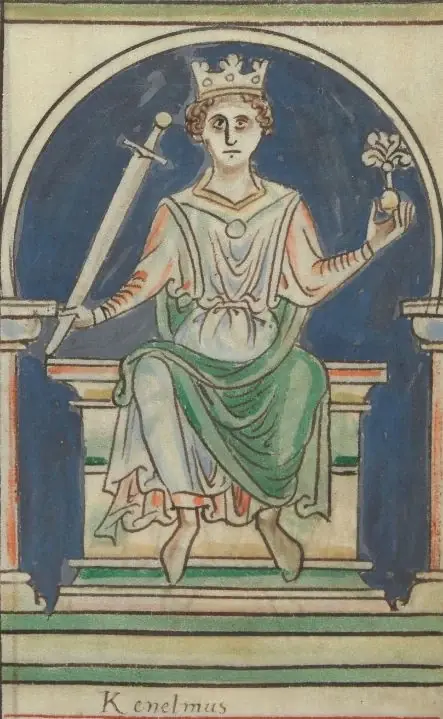
In art he is a young prince with a crown, Arduino says, often holding a flowering stem, sometimes with a dove carrying a letter in its beak. 2 The drawing by Matthew Paris at the head of this page, made in the thirteenth century, shows him that way: crowned and enthroned, with a sword in one hand and a small flowering stem in the other.
What is Saint Kenelm the patron saint of?
Saint Kenelm's feast day
Saint Kenelm's feast day is July 17. 12 The current Roman Martyrology, as the Italian bishops publish it, keeps him on that day with careful wording: "Nel monastero di Winchelcumbe nella Mercia in Inghilterra, san Chenelmo, che, principe di Mercia, è ritenuto martire," in the monastery of Winchcombe in Mercia, in England, Saint Kenelm, prince of Mercia, who is held to be a martyr. 3
Praying with Saint Kenelm
The Martyrology does not say he was a martyr. It says he is held to be one, which is the truth: a young man died, and the people who buried him honored him as a martyr long before anyone wrote down why. 13
The story they eventually told was not true, and the sources say so plainly. 12 It was told anyway, by a monastery that loved him, and pilgrims walked a long road to his grave for centuries. 2
What remains is a prince who died young and is remembered by name twelve hundred years later, mostly for things that did not happen to him. 12 The Church keeps his day with the honest phrase, and leaves the rest to God. 3
Saint Kenelm, pray for us.
Sources
- 1.Per Einar Odden, "Den hellige Kenelm av Mercia," Helgener, Den katolske kirke, katolsk.no (in Norwegian).
- 2.Giampietro Cattini and Fabio Arduino, "San Chenelmo (Kenelm), Martire," with the Roman Martyrology entry, Santi, beati e testimoni, santiebeati.it (in Italian).
- 3.Roman Martyrology, entries for July 17, Santo del giorno, Conferenza Episcopale Italiana (in Italian).
Saints to turn to next
Others in this collection who are turned to for some of the same things.