Saint Haggai
Prophesied in 520 BC
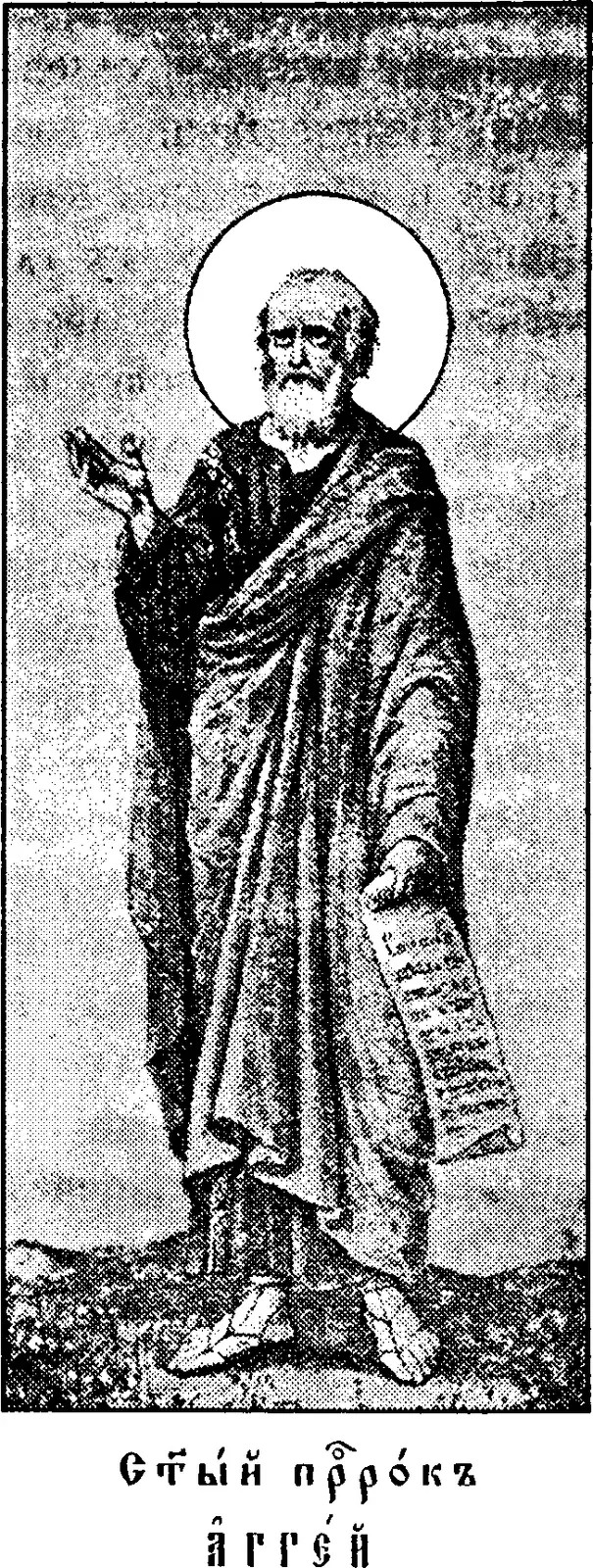
Saint Haggai was the prophet who, in the late summer of 520 BC, told the exiles returned from Babylon that it was time to stop building their own houses and rebuild the house of God. 13 Within three weeks of his first speech the work on the Temple had begun again, and the Book of Ezra says the elders "built and prospered according to the prophecy of Aggeus." 346 The Church commemorates him on December 16. 8
Who was the prophet Haggai?
Almost nothing is known of him beyond his book. Francis Gigot, writing in the Catholic Encyclopedia in 1907, says the exact meaning of his name is uncertain: perhaps "the festive one," a child born on a feast day. 1 His book, the tenth of the minor prophets, is very short and "contains no detailed information about its author." 1 It speaks of him only as the man through whom the word of the Lord came, on dated days in the second year of the Persian king Darius I. 13
Jewish tradition supplied a good deal more: that he was born in Babylon during the exile, came to Jerusalem as a young man with the returning exiles, and was buried there among the priests, along with stranger claims about his being an angel in human form or living to see Alexander the Great. 1 Gigot says plainly that these traditions "deserve but little credence." 1
An unfinished Temple
The exiles who came back from Babylon in 536 BC, Gigot writes, quickly set up an altar, restored the sacrifices and laid the foundation of a second Temple. 1 Then opposition from the Samaritans, appealing to the Persian authorities, stopped the work. 12 It stood still for sixteen years. 1 Bad harvests, the Persian invasion of Egypt and the comfort-seeking of Jerusalem's wealthier families all played their part, and in time the people gave up on the Temple altogether. 1
The New American Bible's introduction describes a community sunk in "defeatism and a certain lethargy." 2 The USCCB introduction to the revised edition adds that the people were struggling with who they were, having lost both their king and their Temple. 9
"Is it time for you to dwell in ceiled houses?"
The first message came "in the second year of Darius the king, in the sixth month, in the first day of the month," addressed to Zerubbabel, governor of Judah, and to Joshua, the high priest. 3 The people were saying the time had not yet come to build. 3 Haggai turned it back on them: "Is it time for you to dwell in ceiled houses, and this house lie desolate?" 3
He told them to look at their own lives. "You have sowed much, and brought in little: you have eaten, but have not had enough... and he that hath earned wages, put them into a bag with holes." 3 The drought was no accident, the Lord says through him: "because my house is desolate, and you make haste every man to his own house." 3 And the instruction was simple: "Go up to the mountain, bring timber, and build the house." 3
For once a prophet was obeyed. Zerubbabel, Joshua "and all the remnant of the people hearkened to the voice of the Lord their God, and to the words of Aggeus the prophet." 3 Haggai brought them one more short message, "I am with you, saith the Lord," and on the twenty-fourth day of the same month they began. 34 Gigot reckons it at three weeks. 1
The glory of the latter house
In the seventh month some who compared the new building with Solomon's Temple were gloomy about it. 24 Haggai asked them directly: "Who is left among you, that saw this house in its first glory? and how do you see it now? is it not in comparison to that as nothing in your eyes?" 4 Then he told Zerubbabel, Joshua and the people to take courage, "for I am with you, saith the Lord of hosts." 4
What follows is the passage the Church has read most closely. In the Douay, which follows the Latin Vulgate: "Yet one little while, and I will move the heaven and the earth... And I will move all nations: and the desired of all nations shall come: and I will fill this house with glory." 4 "Great shall be the glory of this last house more than of the first... and in this place I will give peace." 4
Gigot acknowledges that the original Hebrew of these verses differs somewhat from the Vulgate, and holds that they refer to messianic times all the same. 1 The New American Bible's introduction reads them as the presence of the Lord in the new Temple, its glory "enhanced by the offerings of the Gentiles." 2 The current Martyrology remembers Haggai as the prophet who urged the people to rebuild the house of the Lord, into which the riches of all nations will flow. 8 The Letter to the Hebrews takes up his "yet once more" as a promise that God will shake heaven as well as earth, so that what cannot be shaken may remain. 7
Unclean offerings and a signet ring
His third message, in the ninth month, put a question of law to the priests. 4 If holy meat touches bread, is the bread made holy? No. If a man defiled by a corpse touches it, is it defiled? Yes. "So is this people, and so is this nation before my face, saith the Lord." 4 Gigot reads it as a warning that the people's life would stay tainted as long as God's house lay unbuilt; the New American Bible's introduction suggests the people meant may be the Samaritans. 12 Either way it ended in a promise: "from this day I will bless you." 4
The last word, the same day, was for Zerubbabel alone, of the line of David. 1 "I will take thee, O Zorobabel the son of Salathiel, my servant, saith the Lord, and will make thee as a signet, for I have chosen thee." 4 The New American Bible calls Zerubbabel the "repository of the messianic hopes." 2
Gigot counts four utterances; the New American Bible's introduction divides the book into five oracles; the USCCB introduction notes six date formulas, which, it says, underline God's control over history. 129
The Temple finished
His recorded ministry ends in December 520. 9 The Book of Ezra, called 1 Esdras in the Douay, names him with the younger prophet Zechariah as the two who prophesied to the Jews and helped Zerubbabel and Joshua begin to build. 5 When Persian officials challenged the work, the matter went to Darius, and the building went on. 56
"And the ancients of the Jews built and prospered according to the prophecy of Aggeus the prophet, and of Zacharias the son of Addo." 6 The house was finished on the third day of the month of Adar in the sixth year of Darius, and dedicated with joy. 6
What is Saint Haggai the patron saint of?
Saint Haggai's feast day
Praying with Saint Haggai
Haggai spoke to people who were not wicked so much as busy. They had come home from exile, the obstacles were real, and they had decided the time was not yet right. 13 His answer was to ask them to look at their own houses and their own harvests, and to go and fetch timber. 3
He also spoke to the discouraged. Those who looked at the new Temple and remembered the old were not told they were wrong to remember; they were told to take courage, because God was with them. 4
There is little in his book about himself. He delivered his messages, and the Book of Ezra records that the work was finished. 36 Haggai seems to have wanted nothing more said of him than that the people built and prospered according to his prophecy. 6
Saint Haggai, pray for us.
Sources
- 1.Francis E. Gigot, "Aggeus (Haggai)," The Catholic Encyclopedia, vol. 1 (New York: Robert Appleton Company, 1907).
- 2.Introduction to the Book of Haggai, The New American Bible, as hosted by the Holy See.
- 3.Aggeus (Haggai) 1, Douay-Rheims Bible, Challoner revision, as hosted by drbo.org.
- 4.Aggeus (Haggai) 2, Douay-Rheims Bible, Challoner revision, as hosted by drbo.org.
- 5.1 Esdras (Ezra) 5, Douay-Rheims Bible, Challoner revision, as hosted by drbo.org.
- 6.1 Esdras (Ezra) 6, Douay-Rheims Bible, Challoner revision, as hosted by drbo.org.
- 7.Hebrews 12, Douay-Rheims Bible, Challoner revision, as hosted by drbo.org.
- 8.Roman Martyrology, entry for December 16, "Sant'Aggeo, profeta," Santo del giorno, Conferenza Episcopale Italiana (in Italian).
- 9.Introduction to the Book of Haggai, New American Bible, Revised Edition, United States Conference of Catholic Bishops.
- 10.The Roman Martyrology, July 4 (Baltimore: John Murphy & Co., 1897), Internet Archive.
Saints to turn to next
Others in this collection who are turned to for some of the same things.