Saint Eupsychius of Caesarea
Died 362
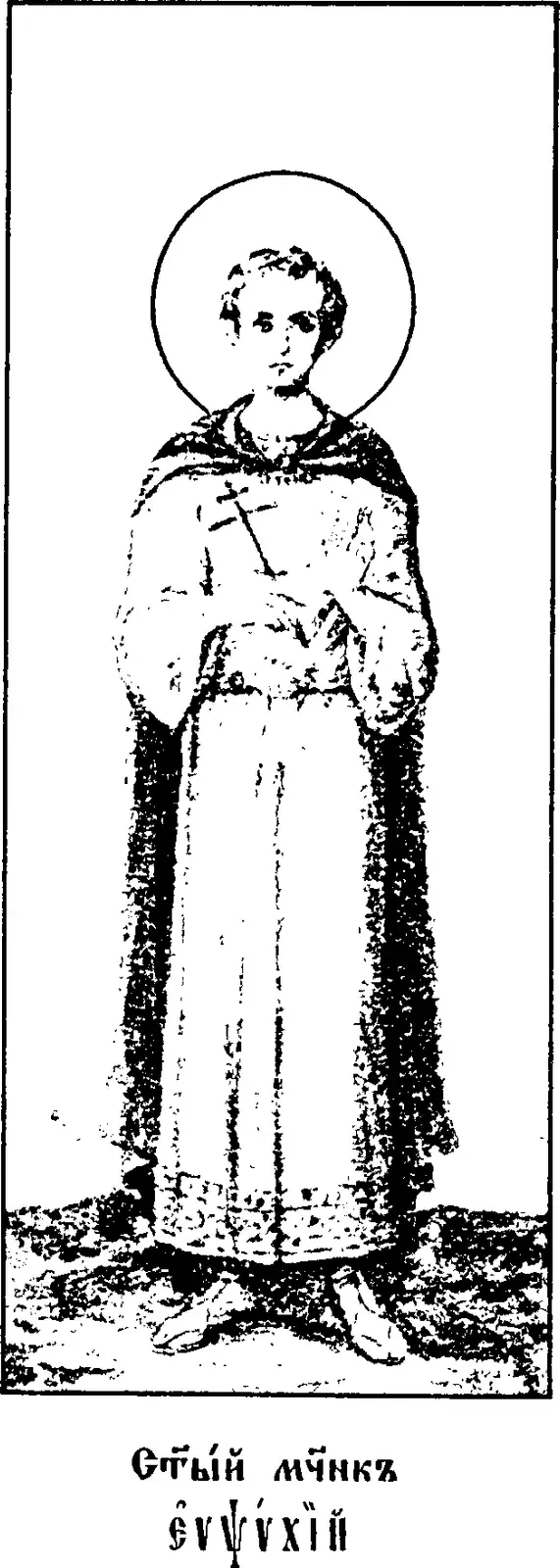
Saint Eupsychius was a young nobleman of Caesarea in Cappadocia, so lately married that Sozomen calls him "still a bridegroom," who was put to death in 362 under Julian the Apostate after the Christians of the city pulled down the temple of Fortune. 245 Ordered to rebuild the temple, they built a church in his honor instead, and Saint Basil kept his feast there every year with the bishops of the region. 134 His feast is April 9. 15
A Christian city
Caesarea was the capital of Cappadocia and, by the time of Julian, mostly Christian. 12 Sozomen says its people "were zealously attached to Christianity," and had long since destroyed the temples of Apollo and of Jupiter, the city's guardian god. 2 The temple of Fortune was the only one left. 2
After Julian came to the throne, the Christians pulled it down. 2 Butler calls it "the last pagan temple remaining there." 1 Sozomen says that when the emperor heard of it, "he hated the entire city intensely and could scarce endure it," and that he blamed the city's few pagans as well, who should have hurried to defend the temple and suffered gladly for Fortune if they had to. 2
Julian's revenge on Caesarea
Sozomen lists what followed. Julian struck Caesarea off the roll of cities and took away its name, so that it went back to being called Mazaca. 12 All the money and property of the churches of the city and its suburbs was searched out and seized, "about three hundred pounds of gold." 2 The clergy were enrolled among the troops under the provincial governor, "accounted the most arduous and least honorable service among the Romans." 12 The Christian population, women and children included, was counted and taxed like a village. 2
Julian threatened worse: unless the temples were rebuilt quickly, his anger would fall on the city until none of the "Galileans" were left. 2 Butler adds that he used torture to make the churches give up their wealth. 1 "There is no doubt," Sozomen says, "but that his menaces would have been fully executed had not death quickly intervened." 2
The martyrdom
Among those put to death, Butler writes, "the principal of which number was St. Eupsychius, a person of noble extraction, lately married." 1 Sozomen describes him as "a noble of Caesarea in Cappadocia, who had but just taken to himself a wife and was still a bridegroom." 2
The oldest source is careful about the cause. "I believe that Eupsychius was condemned in consequence of the demolition of the temple of Fortune," Sozomen writes, adding that "all the actors in this transaction were condemned, some to death, and others to banishment." 2 The Martyrology and the Norwegian bishops' database state it without hedging: he died for destroying the temple. 45
katolsk.no tells more. It calls him the leader of a group of Christians accused of the destruction, and says the authorities tried to make him sacrifice to the gods; he was stretched on the rack and torn with iron hooks over many days, refused, and was sentenced to be beheaded with the sword, in 362. 4 Sozomen tells his story in the same chapter as that of Basil, a priest of Ancyra, martyred in the same months. 2
A church instead of a temple
Julian left orders that the Christians of Caesarea rebuild the temples. 14 Soon afterward he was dead, killed on his Persian campaign in 363. 4 The Christians, Butler says, "instead of that, they erected a church to the true God, under the title of St. Eupsychius." 1 katolsk.no says they received help and healing there from his relics. 4
Saint Basil the Great, as bishop of Caesarea, made the feast a gathering of the region. 14 Writing to Eusebius of Samosata, he asked to see him "at the Synod which we hold every year, in memory of the blessed martyr Eupsychius, now about to be held on the 7th of September." 3 To the bishops of Pontus he wrote that "Eupsychius and Damas and their company are most illustrious among martyrs, and their memory is yearly kept in our city and all the neighbourhood," and asked them to keep up their "ancient custom of paying a visit." 3 He reminded Amphilochius of Iconium, "Bear in mind the memory of the blessed martyr Eupsychius," and told him to come early. 3 In another letter he mentions gathering all his country bishops "at the synod of the blessed martyr Eupsychius." 3
Two dates, and a second Eupsychius
Butler says Basil kept the feast in the new church "on the 8th of April, eight years after," and invited the bishops of Pontus by a letter still extant. 1 Basil's own letter to Eusebius of Samosata gives September 7 for the yearly synod. 3
katolsk.no explains the two. The Greek synaxaria and the Roman Martyrology keep Eupsychius on April 9, but letters of Basil and of Gregory of Nazianzus show that he was also once honored at Caesarea on September 7, together with all the martyrs of the region. 4 That second date, it says, led Cardinal Baronius, when he revised the Roman Martyrology at the end of the sixteenth century, to suppose two saints of the same name, and to enter a second Eupsychius martyred at Caesarea under Hadrian, about 130. 4
What is Saint Eupsychius the patron saint of?
Saint Eupsychius's feast day
Saint Eupsychius's feast day is April 9. The current Roman Martyrology, as the Italian bishops publish it, enters him on that day at Caesarea in Cappadocia, as a martyr who suffered under the emperor Julian the Apostate for having destroyed the temple of the goddess Fortune. 5 Butler places him on April 9, and katolsk.no says the Greek synaxaria keep the same day. 14
Praying with Saint Eupsychius
Very little of Eupsychius's own life survives: his rank, his recent marriage, and his death. 12 The oldest historian of it does not even claim to be sure of the charge. 2
What the sources do record is what happened around him. A city lost its name, its church treasure and its clergy's freedom, and was told to rebuild what it had torn down. 2 It built a church to a young man who had just been married instead. 14
And a generation later a bishop of that city wrote to his friends each year to say the day was coming, and asked them to arrive early. 3
Saint Eupsychius of Caesarea, pray for us.
Sources
- 1.Alban Butler, "St. Eupsychius, M.," April 9, in The Lives of the Fathers, Martyrs, and Other Principal Saints, Vol. IV (Dublin: James Duffy, 1866).
- 2.Sozomen, Ecclesiastical History, Book V, chapters 4 and 11, trans. Chester D. Hartranft, Nicene and Post-Nicene Fathers, Second Series, vol. 2 (1890), at New Advent.
- 3.Basil the Great, Letters 100, 142, 200 and 252, trans. Blomfield Jackson, Nicene and Post-Nicene Fathers, Second Series, vol. 8 (1895), at New Advent.
- 4."Den hellige Eupsychius av Caesarea (d. 362)," Den katolske kirke, the saints database of the Catholic Church in Norway, katolsk.no (in Norwegian).
- 5.Roman Martyrology, entries for April 9, Santo del giorno, Conferenza Episcopale Italiana (in Italian).
Saints to turn to next
Others in this collection who are turned to for some of the same things.