Saint Elizabeth of the Trinity
July 18, 1880 - November 9, 1906
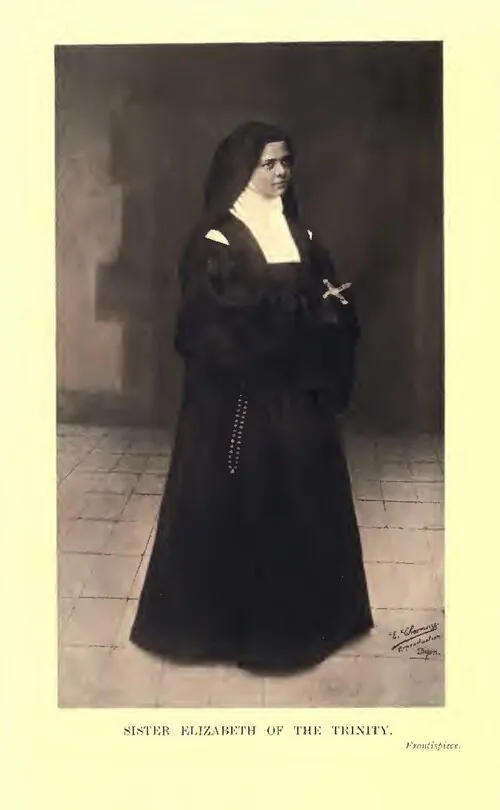
- Religious name
- Elizabeth of the Trinity, given at her clothing on December 8, 1901 1
- Beatified
- November 25, 1984, by John Paul II 4
- Patronage
- Angelus News calls her "the patron of people whose parents have died" 11
Saint Elizabeth of the Trinity was a prize-winning pianist from Dijon who entered the city's Carmel at 21 and died there five years later, in 1906, of Addison's disease. 1 Her one subject, in her letters and in the prayer for which she is best known, was God living within the soul, and the Catechism of the Catholic Church quotes that prayer in its teaching on the Trinity. 569 Pope Francis canonized her in 2016. 2
An officer's daughter with a temper
Elizabeth Catez was born on July 18, 1880, at the military camp of Avord, near Bourges, and was baptized four days later. 1 Her father, Joseph, was an army captain. 9 The sources date the family's move to Dijon differently. The Holy See biography says her father died in 1887, "a short time after the family moved to Dijon," and the Carmelites' North American province also puts the move in 1887; the Carmelite nuns of Britain say the family had moved by the time her sister Marguerite, called Guite, was born in February 1883. 189 All agree she lost her father as a child, and the British Carmelites say he died of a heart attack when she was seven. 9
She was not an easy child. The Holy See biography speaks of a "willful, fiery and impetuous temperament." 1 Loyola Press tells the family story of her shouting "Bad priest! Bad priest! That's my doll!" during Mass, when the priest had borrowed her doll for the Christ Child in his crib. 10 Her first Communion marked a turn. The Holy See biography dates it April 19, 1891, and says that from that day she began a difficult struggle to "overcome herself for love"; the Carmelites' North American province gives April 19, 1890. 18
She was also a musician of real ability. The Holy See biography calls her a "capable and prize-winning pianist," and the Carmelite nuns of Britain say she won conservatory prizes and could have made a career as a concert pianist. 19
Waiting for Carmel
In 1894, at fourteen, she made a private vow of virginity, and soon asked her mother's permission to enter the Carmel of Dijon. 110 Her mother refused. The Holy See biography says she forbade Elizabeth even to visit the monastery, and Loyola Press says she sent her daughter to parties and arranged for suitors in the hope of changing her mind. 110 The British Carmelites say it was when Elizabeth was nineteen that her mother agreed she could enter at twenty-one. 9
The waiting years were not spent apart from the world. The Holy See biography describes her as joyful and active in the parish and in the social life of the city, going to dances and spending time with friends, while learning "to discover Christ in all things." 1 Angelus adds that she visited the sick and taught the catechism to children. 11 The Carmelite nuns of Britain note that she was among the first readers of the autobiography of Therese of Lisieux. 9
Elizabeth of the Trinity
She entered the Dijon Carmel on August 2, 1901. 17 Within days the community sent her photograph to the Carmel at Lisieux with a note the British Carmelites quote: "A postulant of three days but one who has desired Carmel since the age of seven, Sr Elizabeth of the Trinity, who will turn out to be a Saint, for she already has remarkable dispositions for that." 9 She received the habit and her religious name on December 8, 1901, and made her profession on January 11, 1903. 1 The Carmelites' North American province adds that she received the veil on January 21 of that year. 8
Angelus records that the novitiate was not smooth: she went through periods of doubt and darkness serious enough that her spiritual director questioned her calling. 11 Inside the monastery she read John of the Cross closely, and the Rhineland mystic John Ruysbroeck. 9 A study published by the Order of Carmelites traces how, from the time of her profession, she also read Saint Paul with growing care, and notes that she had Galatians 2:20, "I live, no longer I, but Christ lives in me," engraved on the back of her profession crucifix. 12
Her name became her program. In a letter Loyola Press quotes, she wrote: "I am 'Elizabeth of the Trinity'—Elizabeth disappearing, losing herself, allowing herself to be invaded by the Three." 10 The Holy See biography says she grew in union with the Trinity "in the depths of her soul." 1 The British Carmelites put her message simply: God dwells within each person, and can be found there in each present moment. 9
O my God, Trinity whom I adore
Her best-known writing is a prayer to the Trinity that opens "O my God, Trinity whom I adore." The Carmelite nuns of Britain date it to November 21, 1904, written after the community had renewed its vows, and describe it as an act of self-offering that borrows phrases from Therese, from Ruysbroeck and from her spiritual director, the Dominican Father Irenee Vallee. 9
The Catechism of the Catholic Church quotes the opening of that prayer at paragraph 260, at the end of its article on the Trinity, where it teaches that "even now we are called to be a dwelling for the Most Holy Trinity." 5 Its footnote credits the words to her, then still Blessed Elizabeth. 6 The prayer itself is not reproduced on this page.
She did not think contemplation was for cloistered nuns alone. The British Carmelites say she was convinced anyone could practice contemplative prayer, and that her letters are full of advice for people trying to pray in busy lives; she wrote her last two retreats partly for her sister Guite, by then the mother of two small children. 9
Addison's disease and death at twenty-six
The sources place the start of her illness at different points. The Holy See biography says the first symptoms of Addison's disease appeared a short time after her profession in January 1903, and Loyola Press says she contracted it that year; the Carmelite nuns of Britain say her health began to decline only four years after she entered, and add that the disease was then incurable. 1910 The Holy See biography speaks of "extreme suffering," and says she accepted it peacefully, seeing in her illness a chance to be conformed to Christ crucified. 1
Near the end she wrote, in words the British Carmelites quote, that she thought her mission in heaven would be "to draw souls by helping them to go out of themselves in order to cling to God in a wholly simple and loving movement." 9 For her prioress, Mother Germaine, she left a letter whose recurring message was "Let yourself be loved." 9 She died at the Carmel of Dijon on November 9, 1906, aged 26. 17
John Paul II beatified her on November 25, 1984. 4 Pope Francis authorized the decree on a miracle on March 3, 2016, the North American province says, and canonized her in St. Peter's Square on October 16, 2016, one of seven saints that day. 28 His homily did not single any of them out, but said that "the seven witnesses who were canonized today also fought the good fight of faith and love by their prayers." 3
What is Saint Elizabeth of the Trinity the patron saint of?
Only one source consulted for this profile names a patronage. Angelus, the newspaper of the Archdiocese of Los Angeles, calls her "the patron of people whose parents have died." 11 The Holy See, the Carmelite sources and Loyola Press name none, so this page reports that one attribution and claims nothing more. 17910 Angelus gives no reason for it, and none is supplied here.
Saint Elizabeth of the Trinity's feast day
The feast of Saint Elizabeth of the Trinity is November 8. The Order of Carmelites keeps her memorial on that day, as do its North American province and the Carmelite nuns of Britain, who call her their newest Carmelite saint; Loyola Press gives the same date. 78910
She died on November 9, 1906. 1 No source consulted here prints November 9 as her feast, so this page gives it only as the day she died.
Praying with Saint Elizabeth of the Trinity
The Holy See biography begins her holiness with a temper. Her first Communion did not make her calm; it began what the biography calls a difficult struggle to "overcome herself for love." 1 Loyola Press goes as far as to offer her as hope for any parent with a strong-willed child, and says she gradually channeled her willfulness into a determination to become a saint. 10 For years that determination was spent waiting on a mother who would not let her visit the convent. 1
Her prayer was about presence, God dwelling within, and the Church took that seriously enough to put her words into the Catechism where it teaches that we are called to be a dwelling for the Trinity. 569 She also thought this was for everyone, and her advice on prayer went out in letters to a sister raising small children. 9
The sources do not make her illness tidy. She was professed in 1903, and the disease that killed her was, as the British Carmelites say, incurable at the time; the Holy See biography speaks of "extreme suffering" before her death at 26. 19 What it records is how she received it, peacefully and as a way of being conformed to Christ crucified, without suggesting that the suffering was less for that. 1
Her last counsel to her prioress was a short one, repeated through the letter she left: "Let yourself be loved." 9 It came from a woman who was dying, and who by the British Carmelites' account had spent her years in Carmel teaching that God is found within, in the present moment. 9
Saint Elizabeth of the Trinity, pray for us.
Sources
- 1."Elisabeth of the Holy Trinity Catez (1880-1906)," biography in the booklet for the Holy Mass and Canonization of October 16, 2016, Office for the Liturgical Celebrations of the Supreme Pontiff, The Holy See (English text, pp. 43-45).
- 2."Canonisations in St. Peter's Square: the saints fought not to win wars, but to win peace," Holy See Press Office Bulletin, October 16, 2016.
- 3.Pope Francis, Homily for the Holy Mass and Canonization of the Blesseds Salomon Leclercq, José Sánchez del Río, Manuel González García, Lodovico Pavoni, Alfonso Maria Fusco, José Gabriel del Rosario Brochero and Elisabeth of the Holy Trinity Catez, St Peter's Square, October 16, 2016.
- 4."List of Blesseds proclaimed during the Pontificate of John Paul II," Office for the Liturgical Celebrations of the Supreme Pontiff, The Holy See (1984).
- 5.Catechism of the Catholic Church, Part One, Section Two, Chapter One, Article 1, Paragraph 2, "The Father," no. 260. The Holy See.
- 6.Catechism of the Catholic Church, 2nd ed., p. 71, note 102 ("Prayer of Blessed Elizabeth of the Trinity"). United States Conference of Catholic Bishops.
- 7."Memorial of Saint Elizabeth of the Trinity (OCD)," Order of the Brothers of the Blessed Virgin Mary of Mount Carmel (O.Carm.).
- 8."St. Elizabeth of the Trinity (OCD), Virgin (m)," liturgical calendar, Carmelite Friars, North American Province of St. Elias.
- 9."St Elizabeth of the Trinity," Carmelite Nuns in Britain.
- 10."Saint Elizabeth of the Trinity," Saints Stories for All Ages, Loyola Press.
- 11."Saint of the day: Elizabeth of the Trinity," Angelus News, Archdiocese of Los Angeles.
- 12.Joanne Mosley, "Elizabeth of the Trinity as a Reader of Scripture," excerpted as "Elizabeth of the Trinity and St. Paul," Order of the Brothers of the Blessed Virgin Mary of Mount Carmel (O.Carm.), from Sentire Cum Ecclesia (Rome: Edizioni Carmelitane, 2018).
Saints to turn to next
Others in this collection who are turned to for some of the same things.
- Saint Aelred of Rievaulx1109 - January 12, 1166 (or 1167)PrayerSuffering and illness
- Saint Alphonsus Rodriguez1532 or 1533 - October 1617PrayerSuffering and illness
- Saint André BessetteAugust 9, 1845 - January 6, 1937PrayerSuffering and illness
- Saint Bernadette SoubirousJanuary 7, 1844 - April 16, 1879PrayerSuffering and illness