Saint Daniel the Stylite
409 - c. 493
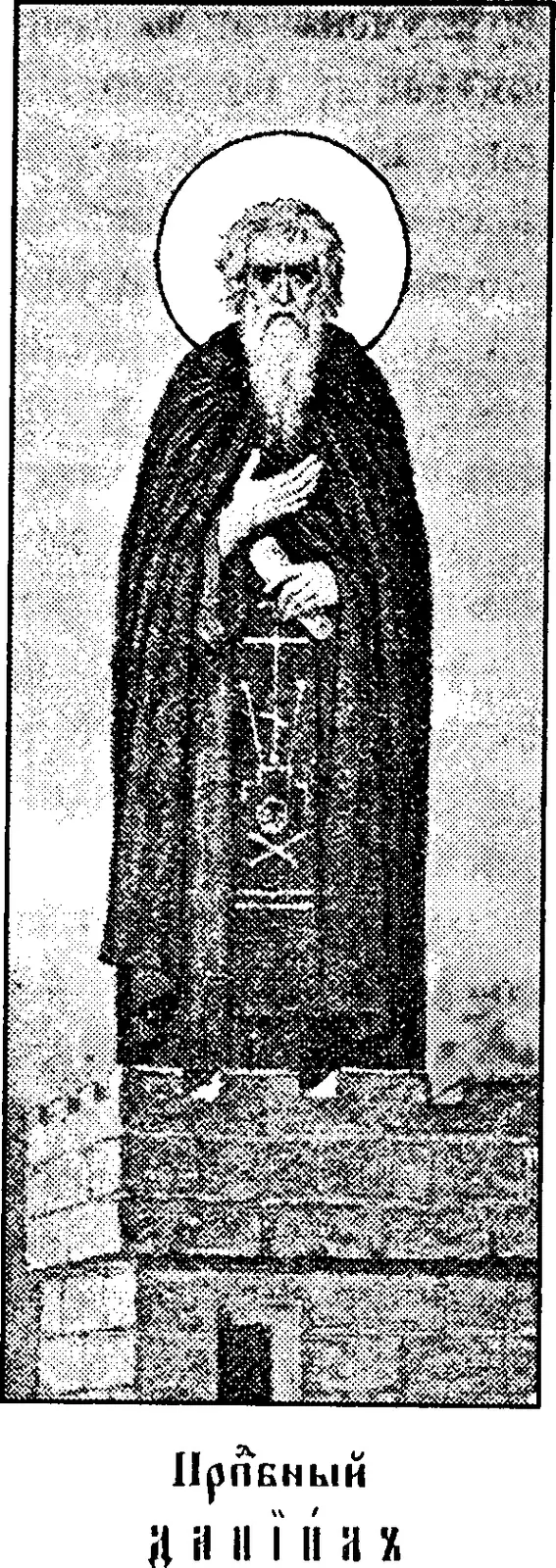
Saint Daniel the Stylite was a Syrian monk who, after the death of his teacher Simeon Stylites, climbed a pillar outside Constantinople and lived on top of it for thirty-three years and three months. 345 He was ordained a priest there, was visited by the emperors Leo and Zeno, and came down only once, to face an emperor who had taken the side of heresy. 12 His feast is December 11. 5
A boy in the monastery
He was born at Maratha, near Samosata on the upper Euphrates, in 409 by the reckoning of katolsk.no and santiebeati. 134 His parents dedicated him to God. 4 When they asked a nearby monastery to take him as a small child, the abbot refused; at twelve he went back by himself and asked again, and this time he was received. 134
Some years later the abbot took him on a journey to Antioch. 13 On the way they stayed at Telanissos, where Simeon Stylites had begun to live on top of a column. 14 Katolsk.no describes an argument among the monks there: some respected Simeon's ordeal, while visitors from Mesopotamia called it showing off and said a man could please God quietly in a monastery. 3
They went to see him. Simeon had the ladder put up and invited the visitors to climb. The older monks excused themselves; Daniel asked to go up. 3 Simeon blessed him, Butler says, and foretold that he would suffer much for Jesus Christ. 1
Nine years in a ruined temple
When the abbot died the monks wanted Daniel to succeed him, and he refused. 134 Katolsk.no dates this to 451, when he was forty-two. 3 He went back to Simeon and stayed two weeks in the monastery by the pillar, then set out for the Holy Land. 13
He did not get there. Butler says Simeon appeared to him on the road and told him to go to Constantinople; katolsk.no says he was talked out of the journey by political unrest, and santiebeati that the wars turned him aside. 134 He spent a week in the church of Saint Michael outside the city, and then nine years shut in a ruined little temple at Philempora, a place people said was haunted. 13 Katolsk.no says he spoke to the world only through a small window, and that the patriarch Anatolius protected him. 3
On the pillar
Simeon died in 459. 14 Daniel received a garment of his: a cowl, Butler says, obtained from Simeon's disciple Sergius; santiebeati says it was Simeon's mantle, meant at first for the emperor. 14 He was about fifty, and he resolved to live as his master had. 4
A friend put up the first pillar, two columns bound with iron bars with a smaller one on top, ending in a kind of half-barrel with a railing around it. 1 The country there, in the hills north of the city toward the Black Sea, had high winds and hard frosts, and Butler thought the penance harder than Simeon's. 1 He slept leaning on the rail. Standing all the time, his legs and feet swelled and broke out in sores. 1
The land belonged to an official of the emperor Leo, who at first ordered him off. 34 Katolsk.no says he changed his mind after seeing a boy said to be possessed healed through Daniel's prayers, and built him a higher pillar. 3 Butler dates a second, stronger pillar to about 463. 1
One winter the wind tore off his leather cloak and snow fell on him all night. 3 Butler says he was found so stiff with cold that his disciples climbed up with sponges soaked in warm water and rubbed him until he came to himself. 1 He would not come down. The emperor eventually persuaded him to accept a roof over the top of the pillar, though Daniel was unwilling, katolsk.no says, because Simeon had never had one. 13
Ordained on the column
Gennadius, the patriarch of Constantinople, made him a priest without his leaving the pillar. 134 Butler tells it simply: the patriarch read the preparatory prayers at the bottom, went up to the top to finish the rite, and Daniel said Mass there and gave Communion to the patriarch. 1
Katolsk.no tells a less tidy story. Gennadius had at first advised the landowner to drive Daniel away, and put off the ordination until the emperor grew angry. When he finally came, Daniel would not let him climb up; on a very hot day, with a restless crowd, the patriarch read the prayers at the foot and declared him ordained, and was then let up with the chalice. The two gave each other Communion. 3
Emperors at the foot of the pillar
In 465 a great fire destroyed eight districts of Constantinople. Butler says Daniel had foretold it and urged public prayers twice a week, and was not believed; afterward the people ran to his pillar, and he wept with them and prayed with his hands stretched out to heaven. 1
The emperor Leo asked his prayers for a son, and came to thank him when the child was born. 14 Katolsk.no says the emperor climbed the ladder and asked to touch his feet, and was amazed at how swollen and broken they were. 3 Butler adds that the son died young. 1 Leo built a small monastery beside the pillar for Daniel's disciples, and brought Gubas, king of the Lazi, to see him as the wonder of the empire; the king fell prostrate in tears, and Daniel stood witness to the treaty between them. 13
He lived on bitter herbs and roots and sometimes went days without food. 1 The sick were brought up the ladder and he laid hands on them, and his words, Butler says, turned many sinners to penance. 14
Coming down
After Leo died in 474, his son-in-law Zeno lost the throne to Basiliscus, who declared himself the protector of the Eutychians and ordered the Council of Chalcedon anathematized. 1 Daniel told the emperor's messenger that God would overthrow his rule, in words the man was afraid to repeat. 13
The patriarch Acacius begged him to come to the help of the Church, and he came down from the pillar, the only time he ever did. 13 He could not walk on his ruined feet and was carried through the city. 1 When the guards kept him out of the palace he shook the dust from his feet, and Basiliscus came to him instead, threw himself at his feet and promised to undo his edicts. Daniel told the bystanders, "This feigned humility is only an artifice to conceal designs of cruelty." 1 Then he went back up. 13
Zeno came back with an army, after twenty months by Butler's count and a few months by katolsk.no's, and Basiliscus fled. 13 One of the new emperor's first acts, Butler and katolsk.no both say, was to visit Daniel on his pillar. 13
His last words
Near the end he had a short testament written for his disciples. Butler lists what it asked of them: humility, obedience, hospitality and mortification, love of poverty, peace and unity, charity, avoidance of heresy, and obedience to the Church, "our holy mother." 1 Three days before his death he offered Mass at midnight. 1 The patriarch Euphemius was with him at the end. 134
Butler puts his death about 494, at the age of eighty. 1 Katolsk.no gives 493, at eighty-four; santiebeati gives 490, or 493. 34 He was buried in an oratory at the foot of the pillar where he had lived thirty-three years and three months. 34
Thurston's article on the Stylites in the Catholic Encyclopedia notes that Daniel may have been the first of Simeon's imitators, a Syrian by birth who settled near Constantinople and was visited by both Leo and Zeno. 2
What is Saint Daniel the Stylite the patron saint of?
Saint Daniel the Stylite's feast day
Saint Daniel the Stylite's feast day is December 11. The current Roman Martyrology enters him that day at Constantinople, as a priest who, after living as a monk and overcoming many trials, followed Saint Simeon's example and lived on top of a column for thirty-three years and three months until his death, undaunted by cold, heat and wind. 5 Butler says he died on December 11, "the day which is sacred to his memory both in the Latin and Greek Calendars," and katolsk.no and santiebeati keep the same day. 134
Praying with Saint Daniel the Stylite
Butler opens his entry with a caution: a pillar is to be admired, not copied, but the humility and devotion behind it can be imitated by anyone. 1 The page keeps the caution.
What the pillar did not do was cut him off. The city came to him: the sick, the frightened after the fire, an emperor wanting a son, a foreign king. 13 He prayed for them with his arms raised and his feet in sores. 1
He came down once, not for comfort but for the Church, on feet that could no longer carry him. 1 And at the end his last instruction to his monks was ordinary: keep peace, love poverty, be hospitable, and stay with the Church. 1
Saint Daniel the Stylite, pray for us.
Sources
- 1.Alban Butler, "St. Daniel, the Stylite, C.," December 11, in The Lives of the Fathers, Martyrs, and Other Principal Saints, Vol. XII (Derby: Richardson and Son, 1842), Internet Archive.
- 2.Herbert Thurston, "Stylites (Pillar Saints)," The Catholic Encyclopedia, Vol. 14 (New York: Robert Appleton Company, 1912).
- 3."Den hellige Daniel stylitten (409-493)," Den katolske kirke, katolsk.no (in Norwegian).
- 4.Daniele Bolognini, "San Daniele lo Stilita," with a notice from Avvenire, Santi, beati e testimoni, santiebeati.it (in Italian).
- 5.Roman Martyrology, entries for December 11, Santo del giorno, Conferenza Episcopale Italiana (in Italian).
Saints to turn to next
Others in this collection who are turned to for some of the same things.
- Saint Aelred of Rievaulx1109 - January 12, 1166 (or 1167)PrayerSuffering and illness
- Saint Albert of Trapanic. 1240 - August 7, 1307PrayerSuffering and illness
- Saint Aldegundc. 630 or c. 639 - 684Suffering and illnessPrayer
- Saint Alphonsus Rodriguez1532 or 1533 - October 1617PrayerSuffering and illness