Saints Daniel and Companions
Martyred October 10, 1227
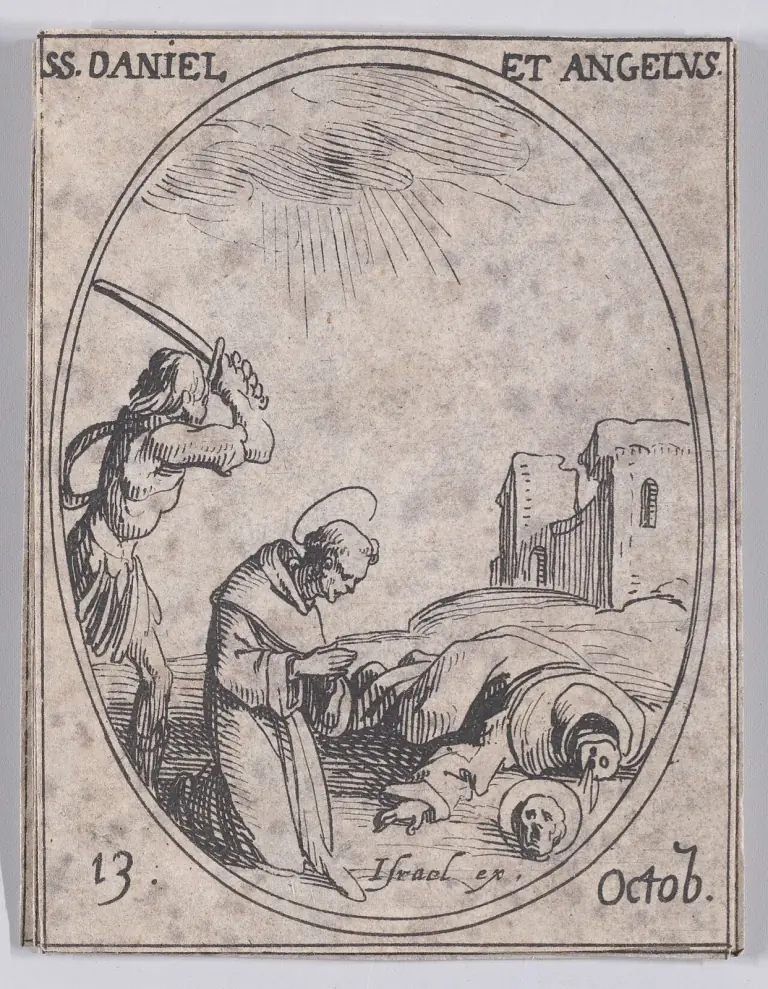
Saints Daniel and Companions were seven Franciscan friars who crossed from Spain to Ceuta, on the coast of Morocco, in the autumn of 1227, entered the city to preach Christ, and were beheaded on October 10 after refusing every offer to renounce their faith. 14 Daniel, their superior, had been provincial of Calabria; the other six came from Tuscany. 1 Their feast is October 10. 45
After Berard
The order of Saint Francis already had martyrs in Morocco. Berard and four companions had been killed at Marrakesh, in January 1220 according to Butler and katolsk.no, in 1219 according to the Catholic Encyclopedia. 123 Their deaths, the encyclopedia says, "had inflamed many of the religious of the Order of Friars Minor with the desire of preaching the Gospel in heathen lands." 1
katolsk.no sets this in the history of the order. Francis himself had preached in Egypt, and the Rule of 1221 had a chapter on those who go among the Saracens; martyrdom for Christ came to be seen as the summit of the Franciscan mission. 2 Francis died on October 3, 1226. 2
In 1227, the year after, six friars of Tuscany asked Brother Elias of Cortona, then vicar general of the order, for permission to go and preach in Morocco. 1 The Catholic Encyclopedia names them Agnellus, Samuel, Donulus, Leo, Hugolinus and Nicholas. 1 katolsk.no gives Angelus for Agnellus and Domnus, or Donulus, for the seventh; it adds that Domnus came from Montalcino and Nicholas from Sassoferrato, and that six of the seven were priests and Domnus a lay brother. 2
Daniel of Calabria
The six went first to Spain, and there Daniel joined them. 1 He was the Minister Provincial of Calabria, from Belvedere in that region according to katolsk.no, and he became their superior. 12 katolsk.no points out how dangerous the errand was: after the deaths of 1220 the authorities had forbidden all Christian preaching. 2
They sailed from Spain and reached the African coast on September 20. 14 For some days they stayed in a small settlement just outside the walls of Ceuta, inhabited mostly by Christian merchants. 1 katolsk.no names merchants of Pisa, Genoa and Marseilles, and says the friars stayed about ten days in preparation. 2 On the last Saturday, it records, Daniel washed his companions' feet, as Christ had done before his passion, and they received Communion together. 2
Into the city
Then, "very early on Sunday morning, they entered the city, and immediately began to preach the Gospel and to denounce the religion of Mahomet." 1 The Irish Franciscans date that Sunday to October 3. 4 They had no Arabic; katolsk.no says they preached in Latin and Italian, and carried a crucifix. 2
Butler tells what followed: "The populace hearing them, immediately took fire, covered them with mire and filth, and carried them before their king." 3 "From their rough habits and shorn heads he took them for madmen." 3 The Catholic Encyclopedia says the same of the sultan, who "thinking that they were mad, ordered them to be cast into prison." 1 katolsk.no names the official who first questioned them as the qadi, the judge. 2
Prison, and the last week
They stayed in prison for a week. 1 From there, katolsk.no records, Daniel wrote to the European merchants with whom they had stayed and told them what had happened. 2
On the following Sunday they were brought out again. 1 Once the authorities understood that they were Christian missionaries, they were offered their lives if they would renounce their faith and become Muslims, and both flattery and threats were tried. 12 None of them gave way, and all seven were condemned to death. 1
The Catholic Encyclopedia records one detail of the end. "Each one approached Daniel, the superior, to ask his blessing and permission to die for Christ. They were all beheaded." 1 Butler says only that "they suffered with great joy." 3 The date was October 10. 145
Canonized in 1516
Pope Leo X canonized Daniel and his companions in 1516. 14 The current Martyrology remembers them as seven martyrs of the Order of Friars Minor, sent by Brother Elias to preach the Gospel to the Moors, who after insults, prison and torture won the palm of martyrdom by beheading. 5
Butler has a different year. He writes that the seven sailed for Africa the year after the martyrdom of 1220, and that they suffered "in the year 1221, on the 10th of October." 3 The Catholic Encyclopedia, katolsk.no and the Irish Franciscans all give 1227. 124 katolsk.no adds that many churches claim relics of them, but that nothing certain is known of where they are. 2
What are Saints Daniel and Companions the patron saints of?
Saints Daniel and Companions' feast day
The feast of Saints Daniel and Companions is October 10, the day they died. The current Roman Martyrology enters them on that day, and the Irish Franciscans keep them on October 10 with their own readings at Mass, from 1 Corinthians 4 and Matthew 10. 45
October 13 is found too. The Catholic Encyclopedia says that "their feast is kept in the order on the thirteenth of October," and Butler that they are "commemorated in the Roman Martyrology on the 13th." 13 katolsk.no explains that the feast was moved to the 13th because of the octave of Saint Francis, that the Martyrology used to remember them on October 10 for the Conventuals and October 13 for the Third Order and the Capuchins, and that the Bollandists give their acts under October 13. 2
Praying with Saints Daniel and Companions
These seven men walked into a city where preaching had been forbidden, in a language nobody there spoke, and were taken for madmen. 123 The sources do not soften that, and the Church did not need them to; it canonized them for what came after.
The detail the Catholic Encyclopedia keeps is the line of friars going one by one to Daniel for his blessing before they died. 1 They had prepared together for ten days, and the night before they entered the city their superior had knelt and washed their feet. 2 Whatever else the mission was, it was a community going to its end together.
They died a year after Francis, in the first generation of his order, and the order has kept their day ever since. 124
Saints Daniel and Companions, pray for us.
Sources
- 1.Stephen Donovan, "St. Daniel and Companions," The Catholic Encyclopedia, Vol. 4 (New York: Robert Appleton Company, 1908).
- 2.Per Einar Odden, "Den hellige Daniel av Ceuta og hans seks ledsagere," Den katolske kirke (katolsk.no), Oslo Catholic Diocese (in Norwegian).
- 3.Alban Butler, "Seven Friar Minors, Martyrs," October 13, in The Lives of the Fathers, Martyrs, and Other Principal Saints, Vol. X (Derby: Richardson and Son, 1842).
- 4."Ss. Daniel and Companions," 10 October, Franciscan Saints, Irish Franciscans (Order of Friars Minor, Ireland).
- 5.Roman Martyrology, entries for October 10, Santo del giorno, Conferenza Episcopale Italiana (in Italian).
Saints to turn to next
Others in this collection who are turned to for some of the same things.