Saints Crispin and Crispinian
Martyred c. 285-288
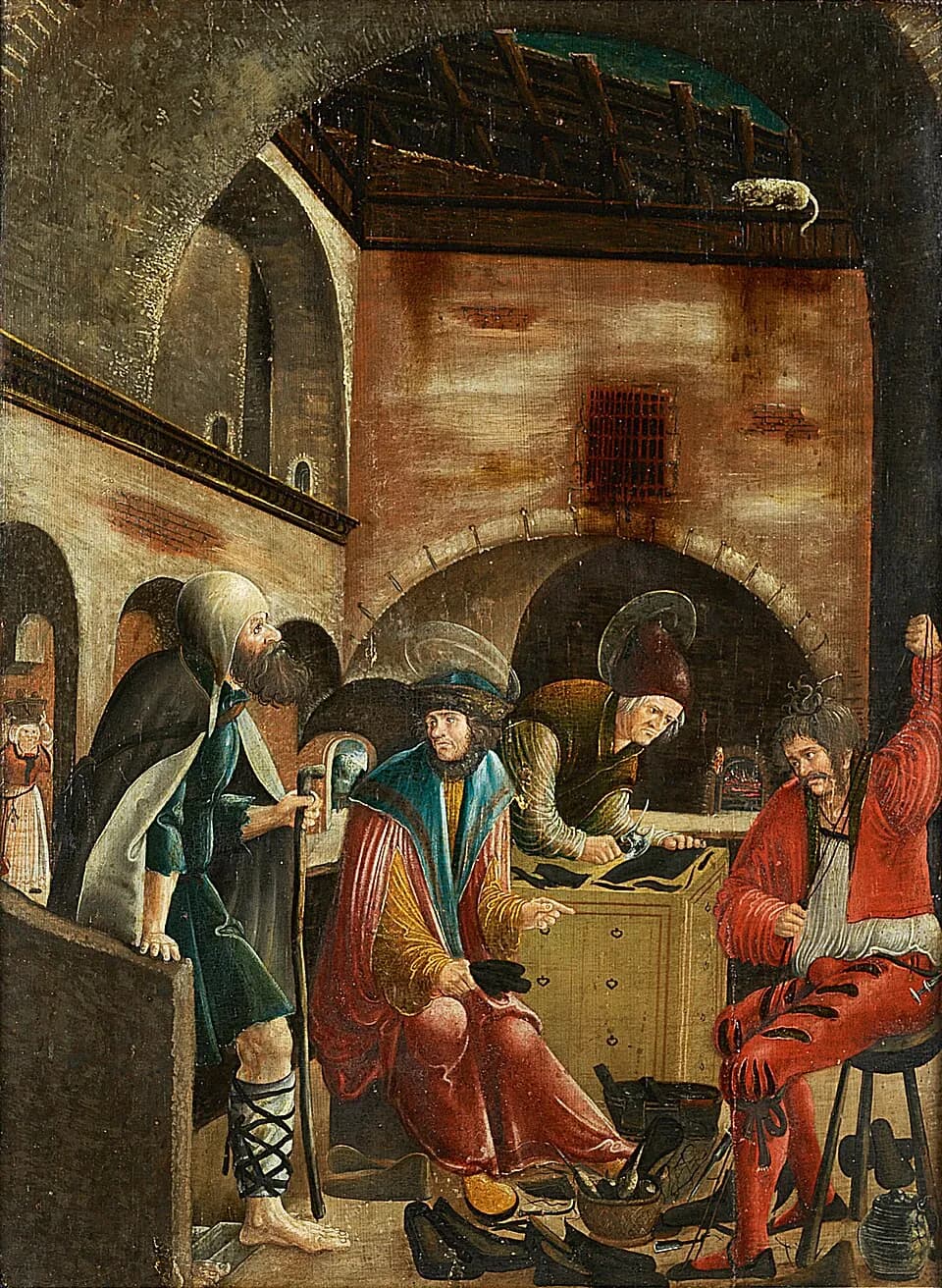
- Patron saints of
- Shoemakers, saddlers and tanners 1; shoemakers and leatherworkers 5; Catholic Culture lists cobblers, glove makers, lace makers and lace workers, leather workers, saddle makers, tanners and weavers 4
- Died
- Beheaded under Diocletian and Maximian, on 25 October 285 or 286 according to the 1908 Catholic Encyclopedia 1; "d. 286" 4; "c. 288" 2
- Patrons of
- The Diocese of Soissons, according to the 1912 Catholic Encyclopedia 2
- Relics
- At Soissons; some at San Lorenzo in Panisperna in Rome; others given by Charlemagne to the cathedral he founded at Osnabrück 16
- Shown with
- A cobbler's last, a shoe and shoemaker's tools; millstones, an awl and knife, and a rack 4
Saints Crispin and Crispinian were martyrs of the early Church, beheaded under Diocletian, who are remembered as missionaries at Soissons in Gaul who made shoes for a living and gave what they could spare to the poor. 1 The 1908 Catholic Encyclopedia tells their story and then calls it a legend of a later age, but their basilica at Soissons, their relics and their patronage of shoemakers are part of the record. 12
Two shoemakers at Soissons
The 1908 Catholic Encyclopedia begins with the little it can say plainly. They were "Martyrs of the Early Church who were beheaded during the reign of Diocletian," and the date of their execution "is given as 25 October, 285 or 286." 1 Even their relationship is uncertain: "It is stated that they were brothers, but the fact has not been positively proved." 1 Catholic Culture is more confident, calling them "brothers, possibly twins," and elsewhere on the same page "twin brother martyrs." 4
The legend, the encyclopedia goes on, "relates that they were Romans of distinguished descent who went as missionaries of the Christian Faith to Gaul and chose Soissons as their field of labour." 1 There they did something unusual for men of good family. "In imitation of St. Paul they worked with their hands, making shoes, and earned enough by their trade to support themselves and also to aid the poor." 1
Catholic Culture fills in the shape of the day: they "preached in the streets by day, made shoes by night," and their "charity, piety, and contempt of material things impressed the locals, and many converted in the years of their ministry." 4 FaithND, the University of Notre Dame's saints site, goes a step further than the encyclopedia and says they made and repaired shoes for free, since the work let them speak about Christ to customers ordering, collecting or waiting for their shoes. 5 The encyclopedia has them earning a living by the trade; Notre Dame has them giving the work away. Both are versions of the same story, and neither is history in the strict sense.
Before Maximian
When Diocletian's persecution came, the legend says they were brought before Maximian, whom Diocletian had made co-emperor. 1 He tried promises and threats in turn, and the encyclopedia gives their reply in full. It begins: "Thy threats do not terrify us, for Christ is our life, and death is our gain. Thy rank and possessions are nought to us, for we have long before this sacrificed the like for the sake of Christ and rejoice in what we have done." 1
Maximian then handed them to the governor Rictiovarus, "a most cruel persecutor of the Christians." 1 Catholic Culture calls him Rictus Varus, governor of Belgic Gaul. 4 The tortures in the encyclopedia's account are those of a shoemaker's shop turned against them: they were stretched on the rack, "thongs were cut from their flesh, and awls were driven under their finger-nails." 1 Millstones were tied to their necks and they were thrown into the Aisne, "but they were able to swim to the opposite bank of the river." 1 A great fire did not harm them either, and Rictiovarus, "in despair, sought death himself" in it. 1 In the end "the two saints were beheaded at the command of Maximianus." 1
Not every source sets the end in Gaul. Catholic Culture says they "were martyred in Rome in 286 by torture and beheading." 4 FaithND has Diocletian himself order the governor of their region to arrest them, and gives the date as "around the year 285." 5 The encyclopedia's own Soissons article dates them "c. 288." 2
What the encyclopedia believes
After telling all of that, the encyclopedia steps back. "This is the story of the legend which the Bollandists have incorporated in their great collection; the same account is found in various breviaries." 1 It then points out a problem inside the story: the narrative mentions a large church built over the saints' graves, "consequently the legend could not have arisen until a later age." 1 The account "contains, moreover, many details that have little probability or historical worth and seems to have been compiled from various fabulous sources." 1
What survives that judgment is the cult. "In the sixth century a stately basilica was erected at Soissons over the graves of these saints," and Saint Eligius, "a famous goldsmith, made a costly shrine for the head of St. Crispinian." 1 Some of their relics went to Rome, to the church of San Lorenzo in Panisperna. 1 Others were given by Charlemagne to the cathedral he founded at Osnabrück and dedicated to them. 1 The encyclopedia's Osnabrück article adds that the Romanesque cathedral of Saints Crispin and Crispinian there, built early in the twelfth century, "replaced the wooden church erected by Charlemagne." 6 At Soissons, the 1912 encyclopedia names them patrons of the diocese. 2
Soissons or Faversham
England has its own version, and FaithND calls the story "a contested legend between France and Britain." 5 In the French telling, two brothers of a noble Roman family went to Gaul with Saint Quentin to preach. 5 In the English one, the two were on the road from Canterbury to London "when they came to a shoemaker's shop in Faversham and decided to stay in this small village and share the Gospel." 5 The encyclopedia and Catholic Culture know only Soissons. 14
"Despite disagreeing about their location," FaithND observes, "both British and French legends agree on the brothers' occupation." 5
Saint Crispin's Day and Henry V
Most English speakers know these saints by one speech. Catholic Culture notes that the feast "was immortalized by Shakespeare in his play Henry V," where the king rallies his army on the eve of Agincourt, fought on October 25, 1415. 4 It adds that in England the day was a religious holiday on which commoners and serfs were given rest. 4
FaithND prints the speech, in which Henry promises that "Crispin Crispian shall ne'er go by, / From this day to the ending of the world, / But we in it shall be remember'd." 5 Notre Dame's own comment on it is plain: "Although Crispin himself is now an obscure legend, Shakespeare's brilliant writing has immortalized his name." 5 The site also notes that Saint Crispin appears in one of the stained glass windows of the Basilica of the Sacred Heart on the Notre Dame campus. 5
How they are painted
Catholic Culture lists their usual emblems: a cobbler's last, a shoe and shoemaker's tools, along with the millstones, flaying knives, rack, and the awl and knife of their martyrdom. 4 The panel on this page, painted around 1520 by an artist known only as the Master of the Crispin Legend, takes the first kind. It sets them in a working shop, with leather on the cutting table, shoes heaped on the floor and a beggar with a staff at the door, which is the encyclopedia's account of men who worked "to support themselves and also to aid the poor" put into paint. 1
What are Saints Crispin and Crispinian the patron saints of?
Crispin and Crispinian are the patron saints of shoemakers. The 1908 Catholic Encyclopedia says they "are the patron saints of shoemakers, saddlers, and tanners," and FaithND calls them "patron saints of shoemakers and leatherworkers." 15 Catholic Culture lists cobblers first, then glove makers, lace makers and lace workers, leather workers, saddle makers, tanners and weavers. 4
They also belong to a place. The 1912 Catholic Encyclopedia names them patrons of the Diocese of Soissons, where the legend sets their work and their graves. 2
Saints Crispin and Crispinian's feast day
The feast of Saints Crispin and Crispinian is October 25. The encyclopedia says, "Their feast falls on 25 October," the date it also gives for their execution. 1 Vatican News lists "Sts. Crispin and Crispinian, Martyrs" on October 25. 3
Catholic Culture places them on the same day among its "Other Commemorations," marked as entries in the Roman Martyrology rather than as a memorial of the general calendar. 4 Agincourt was fought on October 25, 1415, the day Henry V calls "the feast of Crispian." 45
Praying with Saints Crispin and Crispinian
The encyclopedia doubts nearly every detail of their Passion, and it is right to. 1 What it does not doubt is that people at Soissons were honoring these two over their graves by the sixth century, or that the trade they were remembered for was making shoes. 1
That work was ordinary. The legend has them work with their hands "in imitation of St. Paul," and use the wage to keep themselves and to help the poor. 1 Catholic Culture says the people who watched them were struck by their charity and their indifference to possessions, and that many of them became Christians. 4 Their preaching, in these accounts, did not happen apart from the bench and the customers.
Their answer to Maximian, as the encyclopedia gives it, sets rank and possessions against Christ and finds the first "nought." 1 The stories that follow, of awls, millstones and a river, end with both men beheaded. 1
For anyone who works with their hands, or who has customers rather than a congregation, these two are a picture of faith that was carried into a shop and kept there. Most of what is told about them cannot be checked. What the sources agree on is the trade, the charity and the deaths.
Saints Crispin and Crispinian, pray for us.
Sources
- 1.Gabriel Meier, "Sts. Crispin and Crispinian," The Catholic Encyclopedia, Vol. 4 (New York: Robert Appleton Company, 1908).
- 2.Georges Goyau, "Soissons," The Catholic Encyclopedia, Vol. 14 (New York: Robert Appleton Company, 1912).
- 3.Saint of the Day, 25 October, Vatican News (Dicastery for Communication).
- 4.Liturgical Year calendar, October 25, 2025, Catholic Culture (Trinity Communications).
- 5."St. Crispin," Explore the Saints, FaithND, University of Notre Dame.
- 6.Joseph Lins, "Diocese of Osnabrück," The Catholic Encyclopedia, Vol. 11 (New York: Robert Appleton Company, 1911).
Saints to turn to next
Others in this collection who are turned to for some of the same things.
- Saint Hugh of Lincolnc. 1135 or 1140 - November 16, 1200CourageWork and vocation
- Saint Andrew Kim TaegonAugust 21, 1821 - September 16, 1846CourageWork and vocation
- Saint Ansgar801 - February 865CourageWork and vocation
- Saint Anthony Mary ClaretDecember 23, 1807 - October 24, 1870Work and vocationCourage