Saint Conrad of Constance
c. 900 - November 26, 975
- Born
- About 900, at Altdorf, near Lake Constance, says katolsk.no 1
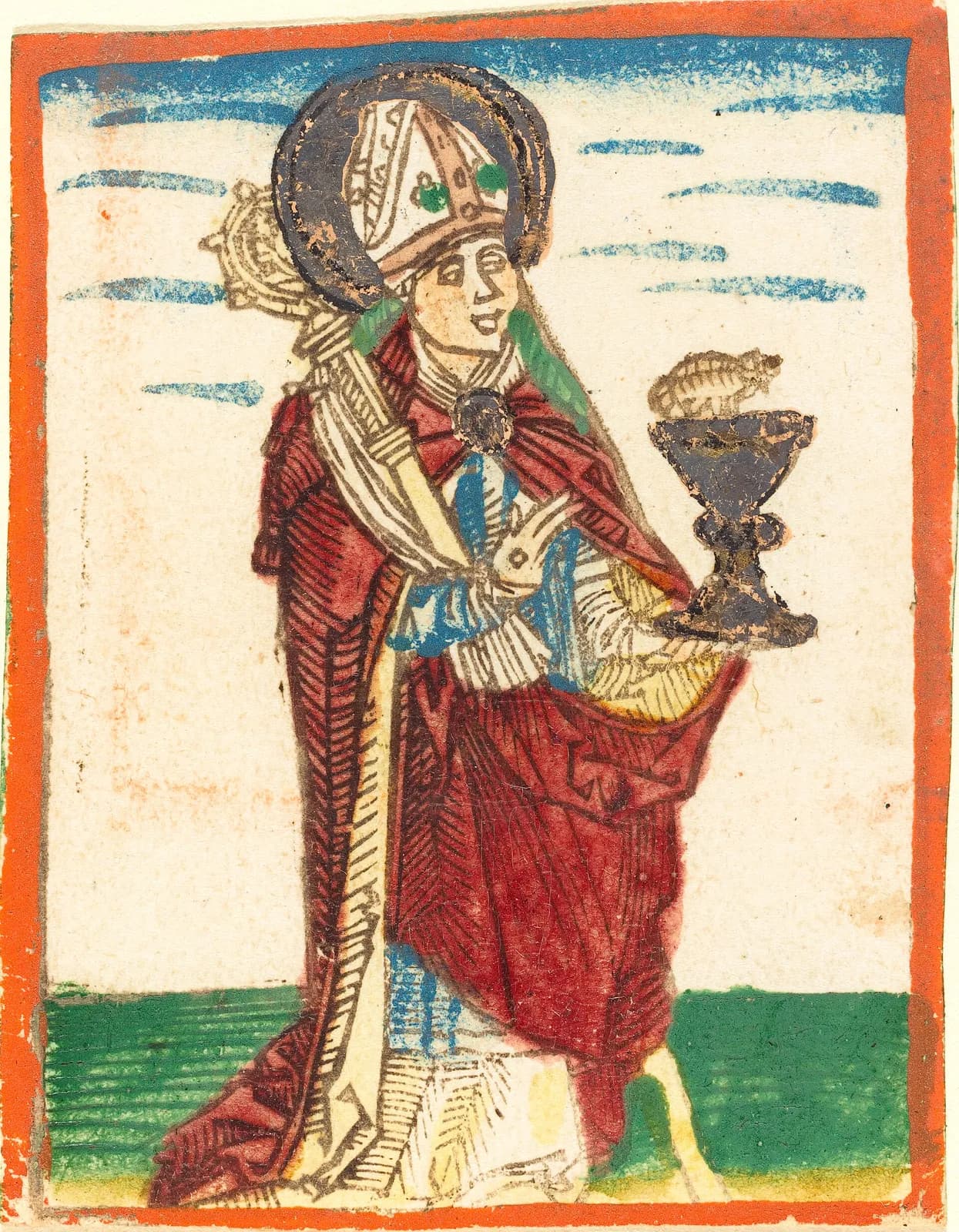
Saint Conrad of Constance was bishop of Constance, on the lake of the same name, for forty-one years in the tenth century, a nobleman who gave his inheritance to his Church and to the poor and made three pilgrimages to Jerusalem. 124 Little more about him is certain. 12 He is best known from two later stories: a spider he swallowed at Mass rather than spill the consecrated wine, and a night at Einsiedeln when he is said to have seen the abbey church consecrated by heaven. 125
What is known, and what is not
katolsk.no says plainly that no reliable details of Conrad's life survive apart from an unsatisfactory biography written about a century after his death by Udalschalk of Maissach. 1 Alban Butler, whose life Catholic.net publishes in Spanish, says the same in his own way: after telling of the pilgrimages, he remarks that this is practically all the saint's biographies say for certain, and that they were written long after he died. 2
The Catholic Encyclopedia gives him a few lines in its history of the diocese, and they agree with the rest: "St. Conrad (934-975) was a great friend of the poor, made three pilgrimages to the Holy Land, built three new churches and renovated many old ones." 4 What follows keeps to that outline and marks the later stories as stories.
A son of the Welfs
katolsk.no says he was born about 900 at Altdorf, near Constance, into the powerful Welf family; his father, Count Henry of Altdorf, founded the abbey of Weingarten, which still exists. 12 Butler calls him the count's second son. 2 katolsk.no says he went to school at the abbey of Saint Gall and then to the cathedral school at Constance, where he was ordained and became provost of the cathedral. 12
His diocese was no small charge. Michael Ott, writing on Constance for the encyclopedia, says there was "not a diocese in Germany which surpassed Constance either in area or population," and that most of its bishops in the tenth century "were great and holy men." 4 When the bishop died, Conrad was elected to succeed him, in December 934 by katolsk.no's date. 12 Saint Ulrich of Augsburg, who had favored his election, became a close friend and often came to visit him, Butler says. 12
Bishop for forty years
katolsk.no says Conrad had taken a vow of poverty, and solved the problem of the estates he inherited by exchanging them with his brother for lands near Constance. 12 With their income he built and endowed three new churches, in honor of Saint Maurice, Saint John the Evangelist and Saint Paul, restored many old ones, and gave the rest to his diocese and to the poor. 124 katolsk.no adds hospitals and monasteries to the list. 1 The Roman Martyrology sums up his life in a sentence: an excellent shepherd of his flock, he provided generously from his own goods for the Church and for the poor. 3
Unlike many bishops of his day, katolsk.no says, he kept out of worldly politics and gave himself to the affairs of the Church. 12 He was nevertheless a close friend of the emperor Otto I, and went with him to Italy in 962. 12 He made three pilgrimages to Jerusalem, where one was the usual number, and Butler says he made each of them a true journey of penance and devotion. 124
Einsiedeln, 948
katolsk.no says Conrad consecrated the first church of Einsiedeln in 948, and then tells the legend attached to it. 1 The night before he was to consecrate the new abbey church, he had a vision in which he saw the Mother of God come down with angels and consecrate the building; and so, says katolsk.no, he called off his own consecration, judging the angels' far more effective. 1
The Catholic Encyclopedia tells the abbey's side of it without naming Conrad. "The church was miraculously consecrated, so the legend runs, in 948, by Christ Himself assisted by the Four Evangelists, St. Peter, and St. Gregory the Great." 5 It adds that the event was investigated and confirmed by Pope Leo VIII and ratified by many of his successors, the last of them Pius VI in 1793, and that September 14, the anniversary, is still one of the abbey's chief pilgrimage days. 5
The spider in the chalice
The other story is the one painters chose. katolsk.no and Butler both tell it as legend: one Easter Day, as Conrad was saying Mass, a spider fell into the chalice. 12 People then believed that all or most spiders were poisonous, but out of reverence for the sacrament he swallowed it with the wine, and it did him no harm. 12 katolsk.no says he is always shown in a bishop's vestments, and often with a chalice and a spider in his hand. 12
Death, canonization and relics
Conrad died at Constance on November 26, 975, after more than forty years as bishop. 12 katolsk.no says he was buried in the church of Saint Maurice, which he had founded, and that in 1089 one of his successors moved his bones into the cathedral. 1 He was canonized in 1123, at the First Lateran Council, by Pope Callistus II. 124 Ott says he then became patron of the diocese. 4
The Reformation came hard to Constance; Ott says the city adopted the new teaching in 1526. 4 katolsk.no says that at that time Conrad's relics were thrown into the lake, but that his head was saved and is now among the greatest treasures of the cathedral. 1 The diocese itself outlived the Reformation by three centuries. Pope Pius VII dissolved it in 1821 and joined what remained to the new archdiocese of Freiburg. 4
What is Saint Conrad of Constance the patron saint of?
The sources name places rather than causes. The Catholic Encyclopedia says Conrad became patron of the diocese of Constance after his canonization, and that his successor Saint Gebhard II became patron of the city. 4 katolsk.no names him patron of the archdiocese of Freiburg, which took over the old diocese's territory in 1821, and of the cities of Constance and Freiburg im Breisgau. 14 Neither names him patron of any group of people.
Saint Conrad of Constance's feast day
Saint Conrad of Constance's feast day is November 26, the day of his death. 13 The Roman Martyrology enters him on that day at Constance in Swabia. 3 katolsk.no adds that in the German-speaking lands he is kept on that day together with Saint Gebhard II, another bishop of Constance, who died in 996. 1
Praying with Saint Conrad of Constance
Most of what is certain about Conrad concerns what he did with what he had. He inherited land and turned it into churches, and gave what was left to his diocese and the poor. 124 The Martyrology remembers him for little else. 3
He was close to an emperor and went with him to Italy, but he kept his attention on his own Church. 12 Three times he went to Jerusalem, and Butler says he made the journeys as penance and devotion rather than travel. 2
The spider story says what his people believed about him: that he would rather risk his life than treat the sacrament carelessly. 12 It is a legend, and katolsk.no and Butler both tell it as one. What it remembers is of a piece with the record, which shows a bishop who put his Church and the poor ahead of himself. 123
Saint Conrad of Constance, pray for us.
Sources
- 1."Den hellige Konrad av Konstanz (~900-975)," Den katolske kirke (katolsk.no), Catholic Diocese of Oslo (in Norwegian).
- 2.Alban Butler, "Conrado, Santo," from Vida de los Santos, with the Roman Martyrology entry for November 26, Catholic.net (in Spanish).
- 3.Roman Martyrology, entry for November 26, "San Corrado, vescovo," as printed in "Santo del giorno," Conferenza Episcopale Italiana (in Italian).
- 4.Michael Ott, "Constance," The Catholic Encyclopedia, Vol. 4 (New York: Robert Appleton Company, 1908).
- 5.George Cyprian Alston, "Abbey of Einsiedeln," The Catholic Encyclopedia, Vol. 5 (New York: Robert Appleton Company, 1909).
Saints to turn to next
Others in this collection who are turned to for some of the same things.
- Saint Agnes of Bohemiac. 1200-1205 - March 1281 or 1282Poverty and simplicityPrayer
- Saint Aidan of Lindisfarnec. 590 - August 31, 651Poverty and simplicityPrayer
- Saint Alexius of RomeFifth century, by traditionPoverty and simplicityPrayer
- Saint André BessetteAugust 9, 1845 - January 6, 1937PrayerPoverty and simplicity