Saint Chromatius of Aquileia
c. 345 - c. 407
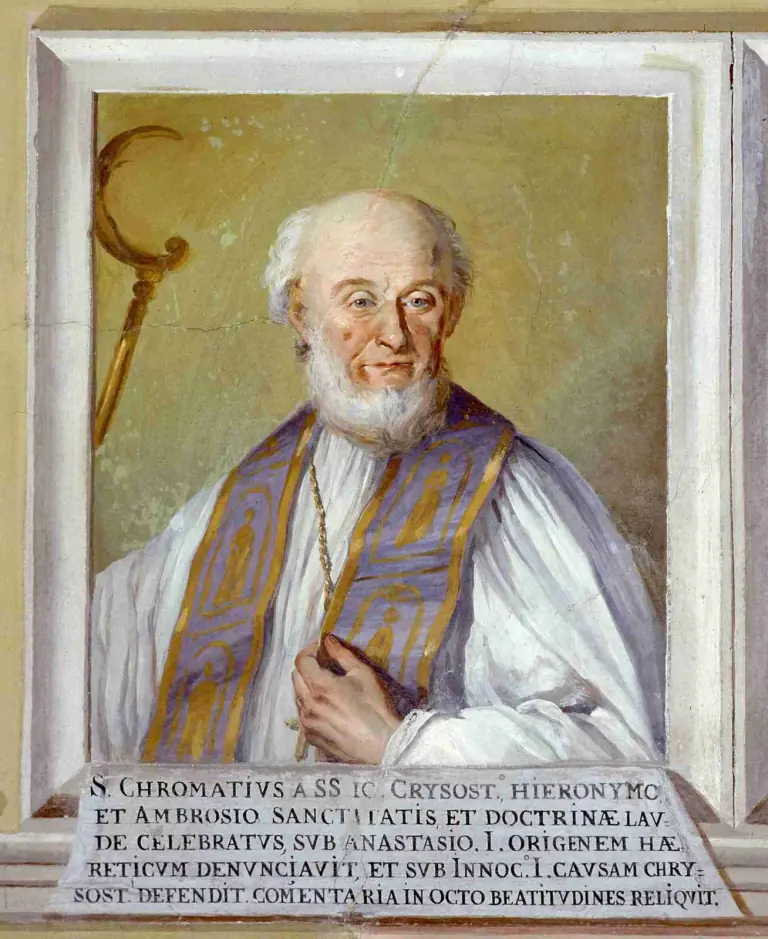
- Consecrated by
- Saint Ambrose of Milan 2
Saint Chromatius was bishop of Aquileia, at the head of the Adriatic, from 388 until his death around 407, in the years when Goths and Huns were threatening the city. 12 He was the friend who pressed Ambrose, Jerome and Rufinus to write, the peacemaker in the quarrel between the last two, and one of the three Western bishops to whom John Chrysostom appealed from exile. 12 His feast is December 2. 14
A household in Aquileia
Aquileia was, in Benedict XVI's description, the fourth city of the Italian peninsula and the ninth of the Roman Empire, the center of a church that had lost many martyrs under Decius, Valerian and Diocletian and had then held out against Arianism. 2 Athanasius himself had once taken refuge there. 2 Chromatius was born in the city around 345, Benedict says; Johann Peter Kirsch, writing in the Catholic Encyclopedia in 1908, says only that he was probably born there and certainly grew up there. 12
The earliest picture of him comes from Jerome, who had lived in Aquileia in the early 370s among a circle of young ascetics he later called "like a choir of blesseds." 2 Writing from the Syrian desert in 374 to Chromatius, his brother Eusebius and their friend Jovinus, Jerome complained cheerfully that their letter had been too short and then sent greetings to the whole house. 3 "I salute your mother and mine," he wrote, and her daughters, and he called the home "a home of a widowed Anna, of virgins that are prophetesses, and of twin Samuels bred in the Temple." 3
The same letter credits the household with something public. "Although you confess Christ every day by keeping His commandments, yet to this private glory you have added the public one of an open confession; for it was through you that the poison of the Arian heresy was formerly banished from your city." 3 Benedict XVI quotes Jerome on the two brothers as well: "brothers by blood, no less than by the identity of their ideals." 2
Priest, synod and bishop
Chromatius was ordained deacon and then priest of Aquileia. 2 In September 381 the city hosted a synod of about thirty-five bishops from Africa, the Rhone valley and northern Italy, called to put an end to what remained of Arianism in the West, and Chromatius attended as the expert adviser of his bishop, Valerian. 2
When Valerian died, Chromatius succeeded him: in 388, Benedict XVI says, or "about 387 or 388," in Kirsch's more cautious words. 12 He was consecrated by Ambrose of Milan. 2 The diocese he took on was enormous. The jurisdiction of Aquileia, Benedict says, stretched from what is now Switzerland, Bavaria, Austria and Slovenia as far as Hungary. 2 Kirsch adds that he opposed Arianism "with much zeal and rooted it out in his diocese." 1
The friend who asked for books
Kirsch calls him "one of the most celebrated prelates of his time," in active correspondence with Ambrose, Jerome and Rufinus, and a scholarly theologian in his own right who "urged these three friends to the composition of many learned works." 1 Ambrose was encouraged by him to write on Scripture. 1 Jerome dedicated to him translations and commentaries written at his suggestion, among them the books of Chronicles, Tobit and the books of Solomon, and a commentary on the prophet Habakkuk. 1 Benedict XVI adds that Chromatius gave Jerome considerable help with the revision and Latin translation of the Bible itself. 2
Then Jerome and Rufinus, the two old friends from Aquileia, fell out bitterly over the teaching of Origen. Chromatius rejected Origen's errors, Kirsch writes, but "attempted to make peace between the disputants." 1 He stayed in communion with Rufinus and persuaded him not to answer Jerome's last attack, and to spend his energy instead on new work, above all a Latin translation of Eusebius's Ecclesiastical History. 1
Chrysostom's appeal
When John Chrysostom was driven from his see at Constantinople, he wrote from exile, Benedict XVI says, to the three bishops of the West he thought most important: the Bishop of Rome, the Bishop of Milan, and Chromatius. 2 Chromatius took up his cause. Kirsch says he wrote in Chrysostom's favor to Honorius, the Western emperor, who passed the letter to his brother Arcadius in the East. "This intercession, however, availed nothing." 1
His own last years were troubled too. The barbarian invasions had begun, and Benedict XVI thinks Chromatius in all likelihood died in exile at Grado, trying to escape the barbarians, in 407, the same year Chrysostom died. 2 Kirsch dates his death to about 406 or 407. 1 The current Martyrology remembers him as a true builder of peace who relieved the sufferings of his people and of the monasteries of Italy laid waste by Alaric. 4
His writings, lost and found
The invasions scattered the episcopal library, and with it his works. 2 His writings, Benedict XVI explains, ended up attributed to others: to John Chrysostom, partly because the two names begin alike, or to Ambrose, Augustine or Jerome. 2 Kirsch, in 1908, knew seventeen treatises on Matthew's Gospel and a homily on the eight Beatitudes. 1 A century later Benedict could speak of more than forty homilies and more than sixty treatises on Matthew, a corpus pieced together only in recent years. 2
Benedict found in them a pastor who always started from the Word of God, and returned again and again to the Trinity, the Holy Spirit and the mystery of Christ, true God and true man. 2 He called Mary "the evangelical Virgin capable of accepting God," and the "immaculate and inviolate ewe lamb" who conceived the "Lamb clad in purple." 2 His favorite image of the Church was a ship in a storm: "There is no doubt that this ship represents the Church." 2
He also preached plainly. Benedict says he knew the polished Latin of the schools but preferred the everyday speech of his people, full of pictures they could grasp, and gives an example: fish that are caught and landed die, while those whom the Gospel catches are drawn out of the waters of death into life. 2
What is Saint Chromatius the patron saint of?
Saint Chromatius's feast day
Saint Chromatius's feast day is December 2. Kirsch gives that date in the Catholic Encyclopedia, the 1897 English edition of the Roman Martyrology enters him on it, and the current Martyrology, as the Italian bishops publish it, keeps him there. 145 Benedict XVI spoke about him on December 5, 2007, at the start of Advent. 2
Praying with Saint Chromatius
Much of what Chromatius did, he did through other people. He asked his friends for books and they wrote them; he asked Rufinus to let a quarrel drop and turn to work that would last, and Rufinus did. 1 It is a kind of holiness that leaves few traces of its own, and for centuries his own writings went about under other men's names. 2
He was not always successful. His letter for Chrysostom changed nothing, and he seems to have died a refugee from his own city. 12
Benedict XVI closed his catechesis with a sermon Chromatius preached in a time of invasion: "Let us pray to the Lord with all our heart and with all our faith," asking him to "deliver us from all enemy incursions, from all fear of adversaries. Do not look at our merits but at his mercy." 2 Chromatius ended it with the words of Moses: "The Lord will fight to defend you, and you will be silent." 2
Benedict drew one lesson from it for the start of Advent: that it is a time of prayer, of contact with God, who "knows me" and "will not abandon me." 2
Saint Chromatius of Aquileia, pray for us.
Sources
- 1.Johann Peter Kirsch, "St. Chromatius," The Catholic Encyclopedia, vol. 3 (New York: Robert Appleton Company, 1908).
- 2.Benedict XVI, General Audience, "Saint Chromatius of Aquileia," December 5, 2007, Libreria Editrice Vaticana.
- 3.Jerome, Letter 7, to Chromatius, Jovinus and Eusebius (374), trans. W. H. Fremantle, Nicene and Post-Nicene Fathers, Second Series, vol. 6 (Buffalo: Christian Literature Publishing Co., 1893), as revised by New Advent.
- 4.Roman Martyrology, entry for December 2, "San Cromazio," Santo del giorno, Conferenza Episcopale Italiana (in Italian).
- 5.The Roman Martyrology, December 2 (Baltimore: John Murphy & Co., 1897), Internet Archive.
Saints to turn to next
Others in this collection who are turned to for some of the same things.
- Saint Abercius of HieropolisSecond century; died at seventy-two or laterPrayerStudy and teaching
- Saint Aelred of Rievaulx1109 - January 12, 1166 (or 1167)PrayerStudy and teaching
- Saint Ambrosec. 340 - April 4, 397PrayerStudy and teaching
- Saint Anselm of Canterbury1033 or 1034 - April 21, 1109Study and teachingPrayer