Saint Basil of Amasea
Died 321-324 (Jerome) or about 322
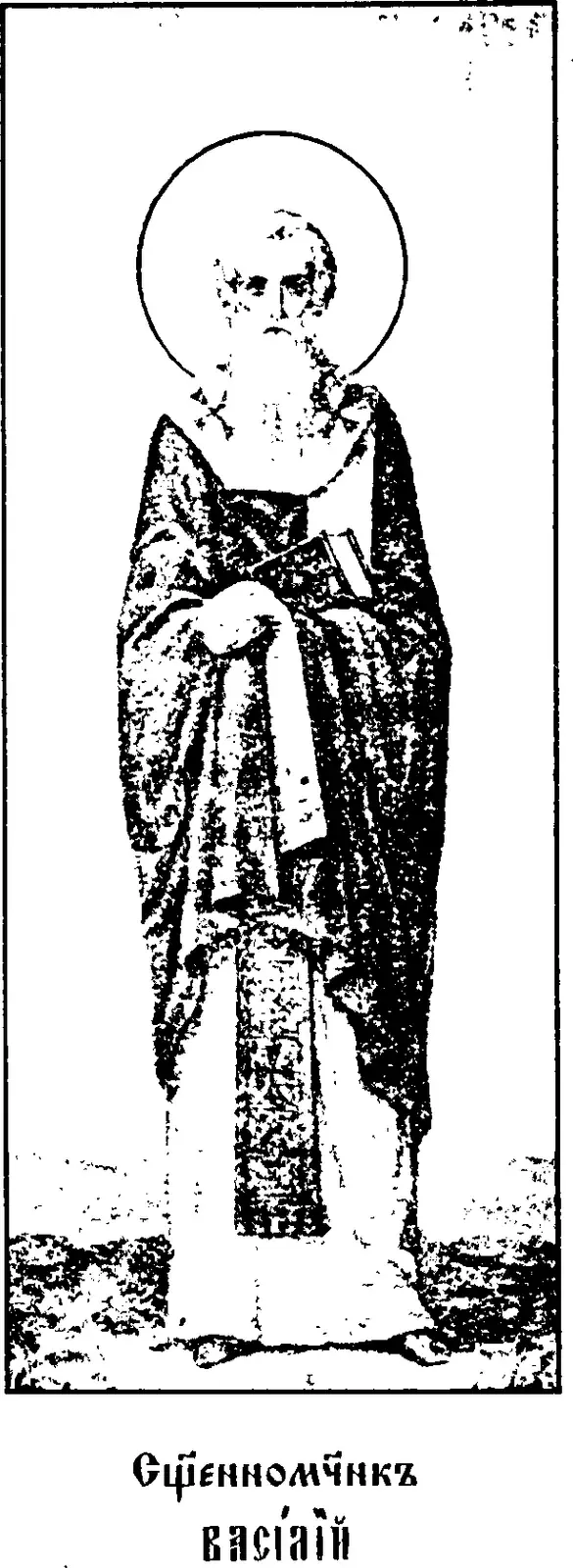
Saint Basil of Amasea was a bishop in Pontus, on the Black Sea, who signed the canons of the councils of Ancyra and Neocaesarea in 314 and was put to death a few years later under the emperor Licinius. 12 The Catholic Encyclopedia finds "no reason for doubting" the notice of his martyrdom, and calls the later story of how it happened "entirely legendary." 1 His feast is April 26. 7
What is known
Kirsch, writing in the Catholic Encyclopedia, builds the bishop's life from a handful of firm notices. 1 Among the signatures of the bishops at the councils of Ancyra and Neocaesarea in 314 is the name of Basileus of Amasea. 12 santiebeati adds that he was born at Amasea and was made bishop there at the start of the fourth century. 3
In Saint Jerome's Latin version of the Chronicle of Eusebius, under the 275th Olympiad (321-324), stands the statement that Basileus, bishop of Amasea in Pontus, suffered martyrdom in the reign of Licinius. "There is no reason for doubting the trustworthiness of this information," Kirsch writes. 1
Saint Athanasius, Kirsch adds, names "the great Basileus of Pontus" among the bishops of the early fourth century who held firmly that the Son is of the same substance as the Father, and the reference is evidently to the martyr bishop of Amasea. 1 katolsk.no follows him, and calls Athanasius's reverence for the martyr evident. 2
One later claim does not fit. The historian Philostorgius says Basileus attended the Council of Nicaea in 325. Kirsch and katolsk.no both set this aside: among the signatures at Nicaea, the bishop of Amasea is Eutychianus. 12
Licinius and the churches of Pontus
Licinius ruled the eastern half of the empire while Constantine ruled the west, and katolsk.no says he signed the edict of toleration at Milan in 313 without meaning it. 2 Eusebius describes what followed, and twice singles out Amasea. He does not name Basil. 45
Licinius, Eusebius writes, first drove every Christian from his household, then dismissed soldiers who would not sacrifice, and forbade anyone to bring food to prisoners or show them kindness, on pain of sharing their punishment. 4 Then "he reached such a pitch of madness that he attacked the bishops," not openly, for fear of Constantine, but through governors who brought charges against the most distinguished of them. 4
"The deeds which he performed at Amaseia and in the other cities of Pontus surpassed every excess of cruelty," Eusebius continues. "Some of the churches of God were again razed to the ground, others were closed." 4 Governors eager to please made some bishops suffer the penalties of criminals: "having their bodies cut into many pieces with the sword, and after this savage and most horrible spectacle, being thrown into the depths of the sea as food for fishes." 4
He tells it again in his Life of Constantine, under a chapter heading that names the city: the Christians fled to the fields and the deserts once more, and the persecution would have become general had Constantine not marched east. 5 Kirsch points to this passage as part of the case for Basil's martyrdom: in the time of Licinius, Christians were treated with great cruelty "especially in Amasea and the other cities of Pontus," and several bishops were punished like evildoers. 1
The passio
A later account of his martyrdom survives, said to have been written by an eyewitness, a priest named John. 12 Kirsch is plain about it: the Acts "are not authentic and the narrative is entirely legendary." 1 katolsk.no and santiebeati both call the passio somewhat legendary and retell it as such. 23
In the story, Basil sheltered a young Christian woman named Glaphyra, a servant of the empress. katolsk.no says she was being sought by the empress; santiebeati says she was desired by the emperor himself. 23 When Licinius learned that the bishop had interfered, he had him brought to Nicomedia and condemned him to be beheaded. 23
His head and his body, the passio says, were thrown separately into the sea, and fishermen found them near Sinope and brought them back to Amasea. 23 katolsk.no adds that the older edition of the Roman Martyrology named a disciple, Elpidiphorus, who was told by an angel where to recover the body and gave it Christian burial. 2 It also reports another tradition, that Basil was drowned in the sea at Nicomedia in 319. 2
santiebeati places the martyrdom about 322, and the Byzantine Catholic Menaion says the same: under Licinius, "he was cast into the sea and martyred." 36
What is Saint Basil of Amasea the patron saint of?
None of the sources consulted for this page names Saint Basil of Amasea as the patron saint of anything, and the page does not supply a patronage. 123 The Byzantine Catholic troparion of his day calls him a bishop who "found access to contemplation in the active life" and "struggled for the faith to the shedding of your blood." 6
Saint Basil of Amasea's feast day
Saint Basil of Amasea's feast day is April 26. The current Roman Martyrology, as the Italian bishops print it, enters him that day: at Amasea in Pontus, Saint Basileus, bishop and martyr under the emperor Licinius. 7 Kirsch notes that the date is the same in the Greek synaxaria and menaea and in the Roman Martyrology. 1
santiebeati and katolsk.no give April 26, and the Byzantine Catholic Menaion keeps him on April 26 with his own troparion and kontakion. 236 katolsk.no adds that the Orthodox also keep a feast of the uncovering of his relics on April 30. 2
Praying with Saint Basil of Amasea
What can be said of him for certain is short: a name among the bishops at two councils, a line in a chronicle, a word of praise from Athanasius. 1 Around it Eusebius sets churches torn down at Amasea, prisoners left to starve because feeding them was forbidden, and bishops thrown into the sea. 4
He was a bishop in the years just after Christians in the west had been given peace, in a city where they had not. 24 He signed the canons of two councils in 314, and within a few years the persecution had been kindled again. 15
The passio that grew up later is about a bishop who gave shelter to a young woman an emperor's household wanted. 23 The sources warn that it is legend, and the page has told it as legend. 1
The kontakion of his day says he gained heaven by disobeying the edict of the king. 6 Eusebius would have recognized the edicts. 4
Saint Basil of Amasea, pray for us.
Sources
- 1.Johann Peter Kirsch, "Basil of Amasea," The Catholic Encyclopedia, Vol. 2 (New York: Robert Appleton Company, 1907), New Advent.
- 2.Per Einar Odden, "Den hellige Basileus av Amasea (d. 319)," Den katolske kirke (Catholic Diocese of Oslo) (in Norwegian).
- 3.Franco Dieghi, "San Basileo di Amasea," Santi, beati e testimoni (santiebeati.it) (in Italian).
- 4.Eusebius, Church History, Book X, chapter 8, trans. Arthur Cushman McGiffert, Nicene and Post-Nicene Fathers, Second Series, Vol. 1 (1890), New Advent.
- 5.Eusebius, Life of Constantine, Book II, chapters 1-2, trans. Ernest Cushing Richardson, Nicene and Post-Nicene Fathers, Second Series, Vol. 1 (1890), New Advent.
- 6."Menaion - April 26," Metropolitan Cantor Institute, Byzantine Catholic Archeparchy of Pittsburgh.
- 7.Roman Martyrology, entries for April 26, Santo del giorno, Conferenza Episcopale Italiana (in Italian).
Saints to turn to next
Others in this collection who are turned to for some of the same things.