Saint Athanasius the Athonite
c. 920 - c. 1003
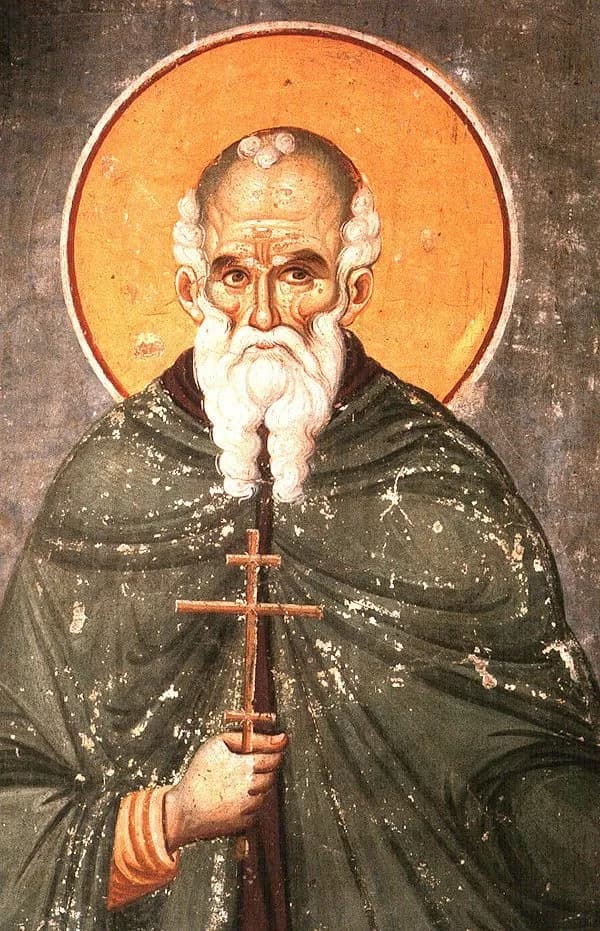
Saint Athanasius the Athonite founded the Great Lavra on Mount Athos in 961 and gave the Holy Mountain the shape of a monastic republic that it has kept for a thousand years. 124 He was a teacher in Constantinople who became a monk, ran from honors more than once, and was tracked down each time by his friend Nicephorus Phocas, who became emperor. 14 He died around 1003, crushed with five of his monks when the dome of the church they were building fell in. 1
Abraham of Trebizond
He was born Abraham, about 920, at Trebizond on the Black Sea, to well-off parents from Antioch. 14 He is a different man from Athanasius of Alexandria, the fourth-century bishop. Orphaned young, he was taken in by a tax collector and then by a general, according to the Norwegian bishops' saints database (katolsk.no), and he studied in Constantinople and became a teacher there. 14
While he was teaching he met Michael Maleinos, abbot of a monastery at Kymina in Bithynia, and Michael's nephew Nicephorus Phocas, a soldier who would become emperor and Athanasius's protector. 14 A safe career in the imperial service was open to him. He took the monk's habit from Michael at Kymina instead, and with it the name Athanasius. 14
Kymina was a lavra, a monastery in which the monks lived in separate cells grouped around a church under one abbot. 14 He stayed there until about 958. When Michael died, Athanasius saw that the monks meant to elect him abbot, and he left. 14
Hiding on Athos
He went to Mount Athos, the easternmost of the three peninsulas that run into the Aegean from Chalcidice. 24 The 1907 Catholic Encyclopedia says hermits had probably lived there since the fourth and fifth centuries, and that in 885 the emperor Basil the Macedonian gave the mountain to the monks as their property. 2 Xiropotamos, the oldest of the principal monasteries, was built soon after under the rule of Saint Basil, and Saracen pirates harried the monks through the ninth and tenth centuries. 2 Athanasius called himself Dorotheus, passed himself off as unlettered, and hid near Karyes, in a cave by katolsk.no's account. 14
Nicephorus Phocas found him. He was about to sail against the Saracens on Crete, and in 960 he persuaded Athanasius to come and help organize the expedition and support it with his blessing and prayers. 14 Athanasius went very unwillingly. The expedition succeeded, and when he asked leave to go back to Athos he was made to accept a large sum of money to build a monastery. 14
The Great Lavra
Building began in the spring of 961, and the church two years later. He dedicated the monastery to the Mother of God, but it came to be called after him, or simply the Lavra. 14 katolsk.no and Catholic.net call it the first monastery on Athos in the full sense, though the encyclopedia counts Xiropotamos as older. 124 The encyclopedia says he founded it "by the seashore," with several companions from Asia Minor. 2 katolsk.no adds that he spent part of the money on an aqueduct from a spring twelve kilometers away. 1
In 963 Nicephorus became emperor, and Athanasius, afraid of being called to court, ran away again, this time to Cyprus. Nicephorus found him a second time, told him to go home and govern his monastery in peace, and gave him more money, which built a harbor for the mountain. 14
The sources do not describe his rule the same way. katolsk.no calls the Lavra a new kind of house in which hermits, wandering monks and monks living in community could all have a place, a deliberate step back from the monasticism of Basil the Great and Theodore the Studite toward the old tradition of Egypt; yet the written rule, it says, rested mainly on Theodore's. 1 The encyclopedia says he "raised the monastic life to a high degree of perfection," and that the community life was eventually "imposed on the hermits scattered in the valleys and forests." 2 The Roman Martyrology calls him a humble and gentle man who established a rule of cenobitic life at the Great Lavra. 3
katolsk.no records what he insisted on: unity among the monks, so that a quarrelsome monk could be said to have been tonsured with Satan's scissors; study; and a hard diet, chiefly of raw vegetables and oil. 1 It judges that his influence on Byzantine monasticism was very great. 1
Opposition, and the end
The hermits already on Athos did not want him. They had been there for generations and resented a newcomer who built monasteries, churches and a harbor and imposed rules on them; katolsk.no and Catholic.net both concede they had some reason. Twice someone tried to kill him. 14 Then John Tzimisces, who had taken the throne by murdering Nicephorus, stepped in. He confirmed his predecessor's gifts, forbade opposition to Athanasius, and recognized his authority over the whole mountain. 124
Athanasius became superior over the fifty-eight communities of hermits and monks then on Athos, and the encyclopedia uses the title protos. 12 The monasteries of Vatopedi, Iviron and Esphigmenou date from this time. 124 The encyclopedia notes that newly converted Slavs soon sought admission as well, and calls the mixing of nations that followed "a cause of internal conflict that has never been removed." 2
His death, as katolsk.no tells it, came in 1003. He preached to his monks for the last time wearing a cloak Michael Maleinos had given him, then climbed the scaffolding to inspect work on the church. The keystone of the dome gave way, and the dome fell, killing five monks outright; Athanasius was dug out three days later, dead. 1 Catholic.net says he died about the year 1000 with five other monks, and the Martyrology it quotes gives about 1004. 4
What is Saint Athanasius the Athonite the patron saint of?
Saint Athanasius the Athonite's feast day
Praying with Saint Athanasius
Few saints ran from responsibility as often as he did, and few were given so much of it. He left Kymina to escape being abbot, hid on Athos under a false name, went to Crete only under protest, and fled to Cyprus when his friend became emperor. 14 Each time he was brought back, and each time the burden was larger. The humility the Martyrology praises was not the kind that avoided work. 3
He also built. An aqueduct, a harbor, a church, a monastery that still stands at the head of the Holy Mountain: these are not the usual marks of a hermit. 1 He seems to have believed that a life given to prayer still needed water, a landing for boats, and walls, and that providing them was part of the same vocation.
His life is not a story of easy success. The men he came to organize tried to kill him, his patron was murdered, and the monks of Athos would later, as the encyclopedia notes, set themselves against reunion with Rome. 12 He died under the dome of the church he was finishing, in the middle of the work. 1 What he left behind was a place where people have gone on praying for a thousand years. 24
Saint Athanasius the Athonite, pray for us.
Sources
- 1."Den hellige Athanasius av Athos (~920-~1003)," Den katolske kirke (katolsk.no), Catholic Diocese of Oslo (in Norwegian).
- 2.Thomas J. Shahan, "Mount Athos," The Catholic Encyclopedia, Vol. 2 (New York: Robert Appleton Company, 1907).
- 3.Roman Martyrology, entry for July 5, "Sant'Atanasio, egúmeno," as printed in "Santo del giorno," Conferenza Episcopale Italiana (in Italian).
- 4."Atanasio el Atonita, Santo," Catholic.net, with the Roman Martyrology entry (in Spanish).
Saints to turn to next
Others in this collection who are turned to for some of the same things.
- Saint Aelred of Rievaulx1109 - January 12, 1166 (or 1167)PrayerWork and vocation
- Saint Agnes of Montepulcianoc. 1268 - April 1317PrayerWork and vocation
- Saint Alphonsus Rodriguez1532 or 1533 - October 1617PrayerWork and vocation
- Saint André BessetteAugust 9, 1845 - January 6, 1937PrayerWork and vocation