Saint Remigius of Reims
c. 437 - January 13, 533, or January 10, 535
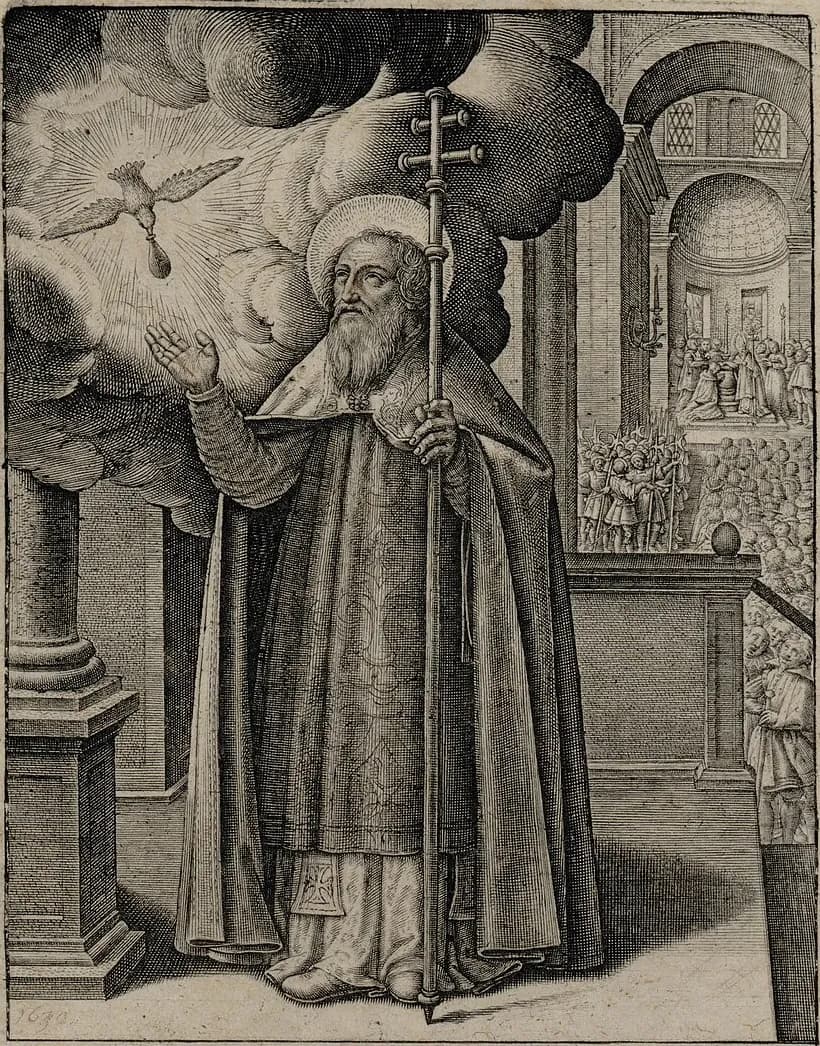
- Patron saint of
- France, according to Catholic Culture, which calls him "one of the patrons of France" 8
- Born
- 437, at Cerny or Laon, according to Dedieu-Barthe 1; about 440 according to Goyau 2; 438 according to Catholic Culture 8
- Baptized Clovis
- December 24, 496 12; at Christmas 496 according to Kurth 3; Christmas Eve of the year 500 according to Vatican News 5
- Relics
- The Abbey of Saint-Remi at Reims 1
Saint Remigius was the bishop of Reims who baptized Clovis, king of the Franks, at the end of the fifth century, an event John Paul II called one of those that brought France into being. 16 He was made bishop at twenty-two and, by the reckoning of Vatican News, spent more than seventy years as "a tireless evangelizer." 15 The encyclopedia calls him the Apostle of the Franks. 1 The best-known story about him, a dove bringing a vial of holy oil from heaven for the baptism, appears first in a life written three and a half centuries later, and the Church's own historians have long said so. 23
A bishop at twenty-two
According to the 1911 Catholic Encyclopedia, Remigius was born in 437 at Cerny or Laon, the son of Emile, Count of Laon. 1 Georges Goyau, writing the encyclopedia's article on Reims, puts his birth at about 440 and calls his family a distinguished Gallo-Roman one. 2 Catholic Culture dates him from 438, and names his mother as Saint Celina. 8
He studied literature at Reims and became known so quickly for learning and holiness that he was elected bishop of the city in his twenty-second year. 1 Catholic Culture dates his appointment to 459 and says he became known first for his preaching. 8 Sidonius Apollinaris admired his sermons, according to Dedieu-Barthe, and thought highly of him as a rhetorician, according to Goyau; none of the sermons survives. 12
From then on, the encyclopedia says, his chief aim was to spread Christianity among the Franks. 1 Goyau describes him organizing the evangelization of the surrounding country, sending Antimond toward Thérouanne and Boulogne and Saint Vaast into the region of Arras, and creating the bishopric of Laon. 2 Dedieu-Barthe credits him with founding bishoprics at Tournai, Cambrai, Thérouanne, Arras and Laon, where he placed his nephew. 1
Remigius and Clovis
Clovis came to the throne of the Franks of Tournai in 481 as a pagan, and Godefroid Kurth's article on him says he received "a most cordial letter of congratulation" from Remigius at the start of his reign. 3 Four of Remigius's letters survive, two of them written to Clovis. 1 Goyau credits him with bringing about the king's marriage to Clotilda, a Catholic. 2
One story from these years is the vase of Soissons. Frankish soldiers had carried off a precious vessel while plundering a church, and Clovis tried to have it returned. 13 A soldier who resented the claim split it with his battle-axe; the next year, reviewing his troops, the king found fault with that soldier's arms and killed him in the same way. 3 Dedieu-Barthe tells it as a sign of friendship between Clovis and Remigius. 1 Kurth is less sure whose church it was, and says the vase was claimed by "the bishop (St. Remigius?)." 3
Kurth gives the conversion this way. Clotilda had won her husband's consent to baptize their son and urged him to become a Catholic himself; he hesitated for a long time. 3 In a battle against the Alemanni, with his troops close to breaking, he called on the God of Clotilda and promised to become a Christian if he won. 3 He won, and he asked Remigius to baptize him at Reims. 13 Catholic Culture adds that Remigius, with Saint Vedast, instructed the king and his chieftains first. 8
The sources do not agree on the date. Dedieu-Barthe and Goyau give December 24, 496; Kurth gives Christmas 496; Vatican News says Christmas Eve in the year 500. 1235 Kurth, drawing on Gregory of Tours, records what Remigius said to the king: "Bow thy head, O Sicambrian," and "Adore what thou hast burned and burn what thou hast adored." 3 Kurth says the king's sister Albofledis and three thousand of his warriors were baptized with him; Catholic Culture says two sisters and three thousand followers. 38
Goyau is plain about why it mattered. The Gallo-Roman population, he writes, would not have submitted to Clovis if he had stayed a pagan, and the conversion made him the protector of the Catholics in kingdoms whose own princes were Arians. 2 Kurth argues that the conversion was sincere and not merely political. 3
The legend of the Holy Ampulla
According to a legend found in the life of Remigius written by Hincmar, a ninth-century archbishop of Reims, the chrism for the baptism was missing, and a dove brought it down from heaven in a small vessel, an ampulla. 3 Goyau tells the legend slightly differently, with the dove arriving while Remigius was crowning Clovis. 2 Goyau adds that Saint Avitus, who witnessed the baptism of Clovis, knew nothing of it in the fifth century, and that "the first trace" of it is in Hincmar. 2 The 1907 article on ampullae says only that it was "popularly believed" to have come from heaven. 4
Whatever its origin, the vial itself was real and was treated with great reverence. 4 Goyau describes a small crystal vial of balm kept at the abbey of Saint-Remi and brought to the cathedral when a king was to be crowned. 2 Kurth says it was used at the coronations of the kings of France from Philip Augustus to Charles X. 3 It was broken in a public square of Reims in 1793, and, by Goyau's account, a priest had saved some of the balm a few days earlier, which was used to anoint Charles X. 2
Bishop of Reims
Remigius held a synod in 517 at which, after a heated discussion, he brought a bishop of Arian views back to the Catholic faith. 1 In 523 he wrote to congratulate Pope Hormisdas on his election, and in 530 he consecrated Saint Medard as bishop of Noyon. 1 Clovis gave him land, on which he built and endowed churches. 1
Not everything he did was admired. His fellow bishops rebuked him over a priest named Claudius, whom they thought should be removed from the priesthood. 1 Dedieu-Barthe says Remigius had overlooked Claudius's offenses; Catholic Culture says the complaint was that he had ordained him at all. 18 His reply survives, and Dedieu-Barthe calls it "able and convincing." 1
He is said to have left a will, the Testament of Saint Remigius. Goyau calls it apocryphal. 2 Dedieu-Barthe says several biographers agree, but that the scholars Mabillon and Ducange argued for its authenticity. 1 A commentary on Saint Paul's epistles once attributed to him is, in the encyclopedia's words, "entirely without foundation." 1 Goyau notes that his life is known from a short biography falsely attributed to Fortunatus and from Hincmar's longer one, which he calls "of a legendary character." 2
He died at Reims, on January 13, 533, by Dedieu-Barthe's account, or on January 10, 535, by Goyau's. 12 His relics were kept in the cathedral, carried to Épernay by Hincmar during the Norse invasions, and later moved to the abbey of Saint-Remi. 1
What is Saint Remigius the patron saint of?
Catholic Culture names France as his patronage and calls him "one of the patrons of France." 8 The encyclopedia and Catholic Culture both give him the title Apostle of the Franks, which describes his work rather than a patronage. 18
When John Paul II went to France in September 1996 for the fifteenth centenary of the baptism of Clovis, he told President Jacques Chirac at Tours: "During my journey, I will recall in Reims the figures of St. Remigius, St Clotilde and Clovis." 6 He said in the same address that the baptism of Clovis "is one of the events that brought it into being," meaning France. 6 Three days later he celebrated Mass at Reims for the anniversary; in his homily, published by the Vatican in French, he named Remi with Clotilde, Vaast and Geneviève among those who had borne witness before Clovis to the Christian message he had long reflected on, and named him again beside Martin of Tours among the country's great pastors. 7
Saint Remigius's feast day
His feast is October 1. 1 Goyau records that Pope Leo IX, who came to Reims in September 1049 to consecrate the church of Saint-Remi, decreed that the feast be kept on that day "throughout the whole kingdom." 2 October 1 is also the day the Church celebrates Saint Thérèse of Lisieux, and it is she, not Remigius, whom Vatican News lists on that day. 9
He is also remembered on January 13. Vatican News includes him among the saints of that day, after Saint Hilary of Poitiers, and Catholic Culture says the Roman Martyrology commemorates him then. 58 January 13 is the date Dedieu-Barthe and Catholic Culture give for his death. 18
Praying with Saint Remigius
Most of what is told about Remigius concerns other people. A king hesitated for years, a queen pressed him, a battle went one way rather than the other, and a bishop who had long been on good terms with a pagan ruler was there when the ruler asked to be baptized. 13 The sources show a patient relationship more than a sudden victory: a letter of welcome at the start of a reign, a stolen church vessel claimed back, instruction before the font. 138
The words at the font are hard ones. "Adore what thou hast burned and burn what thou hast adored" asks a king to reverse everything he had honored. 3 The conversion that followed changed a people, and Goyau and Kurth both write that it bound the Gallo-Roman population to its Frankish king. 23
His long life as a bishop also included a quarrel with his brother bishops over a priest they thought unworthy, and a written defense of what he had done. 1 The sources disagree about exactly what he did, and they agree that he answered for it. 18
The dove and the vial are a legend, and the Church's own encyclopedia said so a century ago. 234 What remains under the legend is a baptism at Reims, a bishop who spent his life, by one count more than seventy years, preaching to the Franks, and an abbey at Reims that took his name and received his relics. 15
Saint Remigius of Reims, pray for us.
Sources
- 1.Joseph Dedieu-Barthe, "St. Remigius," The Catholic Encyclopedia, Vol. 12 (New York: Robert Appleton Company, 1911).
- 2.Georges Goyau, "Reims," The Catholic Encyclopedia, Vol. 12 (New York: Robert Appleton Company, 1911).
- 3.Godefroid Kurth, "Clovis," The Catholic Encyclopedia, Vol. 4 (New York: Robert Appleton Company, 1908).
- 4.Maurice Hassett, "Ampullæ," The Catholic Encyclopedia, Vol. 1 (New York: Robert Appleton Company, 1907).
- 5."13 January," Saint of the Day, Vatican News.
- 6.John Paul II, Address at the meeting with Mr. Jacques Chirac, President of the Republic, Tours, September 19, 1996.
- 7.John Paul II, Homily at the Mass for the fifteenth centenary of the baptism of Clovis, Reims, September 22, 1996 (French text).
- 8."St. Remigius," Liturgical Year calendar for January 13, 2025, Catholic Culture, drawing on John J. Delaney, Dictionary of Saints.
- 9."1 October," Saint of the Day, Vatican News.
Saints to turn to next
Others in this collection who are turned to for some of the same things.