Saint Maurus
c. 510 - 584
- Died
- 584 2
- Earliest source
- Gregory the Great, Dialogues, Book II, the life of Saint Benedict 1
- Historical record
- The later Life that sends him to France "has been severely attacked" as a forgery; it has also been defended 2
- Patron saint of
- Charcoal-burners and coppersmiths, and in Belgium shoemakers; invoked against gout and hoarseness 2
Saint Maurus was one of the first disciples of Saint Benedict, a Roman boy given to him at Subiaco who grew into the monk Benedict leaned on most. 12 He is remembered above all for a single afternoon: sent running to the lake to save the young Placid from drowning, he reached him, pulled him out by the hair, and only on the shore realized he had been running on the water. 1 Gregory the Great, who told the story, made it a lesson in obedience. A later tradition sent Maurus to France as the founder of Glanfeuil, and how far that tradition can be trusted has been argued for more than a century. 2
A boy given to Benedict
Everything certain about Maurus comes from the second book of the Dialogues of Gregory the Great, the life of Saint Benedict. 1 Gregory says that as Benedict's reputation spread at Subiaco, "many noble and religious men of Rome came unto him, and committed their children to be brought up under him, for the service of God." 1 Among them, a father named Evitius brought his son Maurus, and the senator Tertullus brought Placidus. Of the two, Gregory writes, Maurus, "growing to great virtue, began to be his master's coadjutor; but Placidus, as yet, was but a boy of tender years." 1
The spelling of the father's name wanders. The 1608 translation has Evitius, and its 1911 editor notes the forms Equitius, Evitius and Euticius; the 1911 Catholic Encyclopedia calls him Equitius, "a nobleman of Rome," and adds that Fondi, Gallipoli and Lavello have all claimed Maurus as their own. 12 The Order of Saint Benedict, following the later Life, puts his birth about 510 and says he was about twelve when his father brought him to Subiaco. 7
What Gregory tells
Maurus turns up in the Dialogues as the man standing next to Benedict. When a monk in one of the twelve monasteries kept drifting out of the oratory during prayer, Benedict came to see for himself, and saw "a little black boy" drawing the monk out by the hem of his habit. He asked the abbot of that house, Pompeianus, and Maurus whether they could see it too. They could not. Benedict prayed that they might, and two days later Maurus saw it; Pompeianus never did. 1
When a poor Goth working by the lake lost the iron head of his brush hook in deep water, it was to Maurus that he ran to confess, and Maurus who took the matter to Benedict, who drew the blade back up from the bottom. 1 And when a hostile priest named Florentius was killed by the collapse of his own room, it was Maurus who sent word after Benedict, who had already left the district, telling him he could come back. Benedict grieved for the dead man and gave Maurus a penance for rejoicing at the death of an enemy. 1 Gregory includes that episode without softening it.
Walking on the water
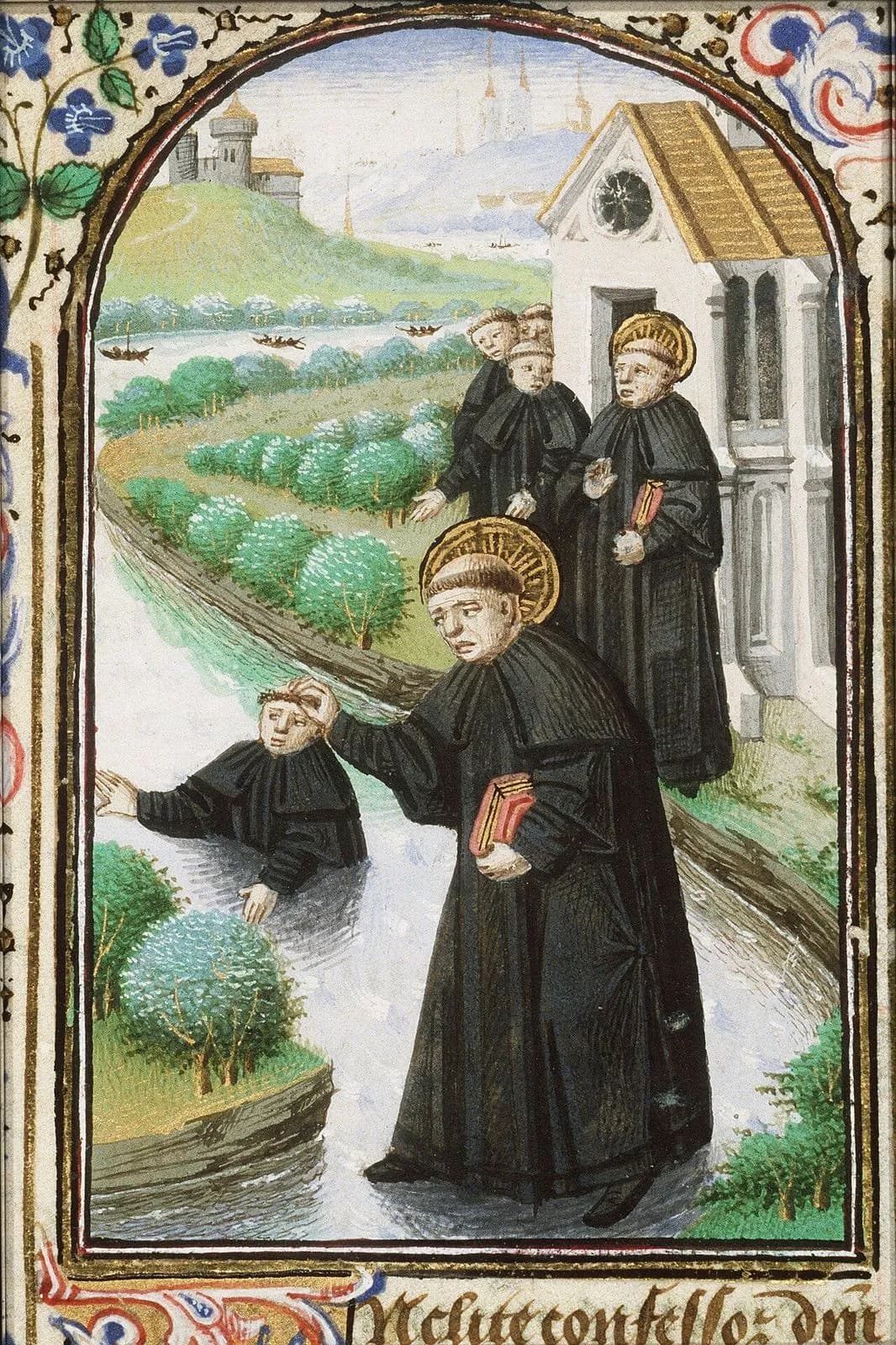
The story everyone knows is in chapter seven. Placidus, still a boy, went down to the lake below the monastery to draw water. 13 He dropped his bucket, fell in after it, and was carried out "so far as one may shoot an arrow." 1 Benedict, in his cell, knew it at once and called: "Brother Maurus, run as fast as you can, for Placidus, that went to the lake to fetch water, is fallen in, and is carried a good way off." 1 Maurus asked his blessing and ran. He reached the boy, took him by the hair, and brought him back, "thinking that he had all that while gone upon the land." Only on the shore did he look behind him and understand, and then, Gregory says, "he both marvelled, and was afraid at that which he had done." 1
What follows is the part Gregory cares about. Benedict credited the miracle to Maurus's obedience; Maurus insisted it was Benedict's command and that he had not known what he was doing. The rescued boy settled what Gregory calls this "friendly contention" by saying that as he was pulled from the water he had seen the abbot's garment over his head. 1 In the dialogue, Gregory's listener Peter hears the story and says, "in the walking of Maurus upon the water, I perceive Peter." 1
Glanfeuil, and the trouble with the Life
Gregory says nothing more about Maurus after Subiaco. The rest of the story comes from a Life of Maurus attributed to Faustus, a monk of Monte Cassino said to have traveled with him. 2 According to that Life, Maurus went to France in 543 and became founder and superior of the abbey of Glanfeuil, on the Loire, which later took his name. 2 The Order of Saint Benedict, retelling it, says he ruled there for thirty-eight years, resigned in 581 to live in a small cell near the church of Saint Martin, and died two years later, lying on sackcloth before the altar, on January 15, 584. 7
The same Life fills the journey north with healings. A messenger from the bishop of Le Mans, Ardenard, crushed in a fall at Vercelli, is cured when Maurus signs his swollen arm with a relic of the Cross that Benedict had sent with him; a servant named Sergius, whose leg is shattered on a rock in the Alps, is healed by the sign of the Cross; a man born blind is given his sight at the door of the church of Saint Maurice. 7 The OSB page tells these without comment, and notes that the Life and its book of miracles, "purportedly ancient," spread his cult through France in the ninth century. 7
The 1911 Catholic Encyclopedia is less trusting. It says this Life "has been severely attacked," that the scholar Delehaye called it a forgery by Abbot Odo of Glanfeuil in the ninth century, and that Adlhoch "makes a zealous defence" of it. 2 The encyclopedia does not decide between them, and neither does this page. What can be said is that the founder of Glanfeuil and the boy at Subiaco are joined by a document whose date and author are both in dispute. 2 The Church's current list of saints, the Roman Martyrology, nonetheless remembers him as Saint Maurus, abbot, at Glanfeuil on the Loire, in the territory of Angers. 4
Vatican News, in its Spanish calendar, calls him Benedict's favorite disciple and abbot of Subiaco, says he founded a monastery in France, and connects him with the Maurists. 5 Gregory, for his part, calls Maurus only Benedict's coadjutor. 1
The Maurists and the blessing of Saint Maurus
His name outlived the argument. In 1618 reformed Benedictine houses in France were gathered into a new body called the Congregation of Saint-Maur, approved by Pope Gregory XV on May 17, 1621; the encyclopedia's article on the Maurists says the name was chosen "to obviate any rivalry between its component houses." 8 By the end of the seventeenth century it counted more than 180 monasteries, and its monks, Jean Mabillon and Bernard de Montfaucon among them, produced editions and histories that the encyclopedia called "indispensable" to modern scholars. 8 The congregation was suppressed with the other religious orders in 1790 and never revived. 8
A blessing of the sick also carries his name. The encyclopedia mentions the Signum S. Mauri, given in the appendix of the Roman Ritual. 2 The Order of Saint Benedict explains that because Maurus was remembered for healing by the sign of the Cross and a relic of the Cross, Benedictine monasteries long blessed the sick with a relic of the Cross in his name; at the request of Dom Maurus Wolter of the Beuronese Congregation, the Congregation of Rites approved a single shortened formula that priests and deacons may use. 7
What is Saint Maurus the patron saint of?
The 1911 Catholic Encyclopedia names Saint Maurus as the patron of charcoal-burners and coppersmiths, and in Belgium of shoemakers, and says he is invoked against gout and hoarseness. 2 He is pictured as an abbot with a crozier, or with a book and a censer, or holding the weights and measures for food and drink that his master gave him. 2
Saint Maurus's feast day
Praying with Saint Maurus
Gregory tells the story of the lake as a contest of humility, and the details are worth staying with. Maurus asked for a blessing before he ran. He did not test the water. He found out what he had done only after it was done, and then he was afraid. 1 Nothing in the account suggests he set out to do anything remarkable; he was told to go, and he went quickly.
The argument afterward is the other half. Benedict gave the credit to the disciple, the disciple gave it back, and neither would keep it. 1 It took the boy who had been under the water to end it, and he settled it by what he had seen: the abbot's garment over his head. 1 The miracle belongs, in Gregory's telling, to a community in which each one is looking at someone else.
There is also the penance. The same Maurus who walked on the lake sent his master good news about the death of an enemy and was corrected for it. 1 Gregory set both stories down in one book and did not trouble to reconcile them. The obedience that sent Maurus across the water did not make him incapable of a mean thought, and Benedict did not pretend it had.
Saint Maurus, pray for us.
Sources
- 1.Gregory the Great, Dialogues, Book II (the Life of Saint Benedict), chapters 3, 4, 6, 7 and 8, in the 1608 English translation, ed. Edmund G. Gardner (London: Philip Lee Warner, 1911).
- 2.Francis Mershman, "St. Maurus," The Catholic Encyclopedia, Vol. 10 (New York: Robert Appleton Company, 1911).
- 3.Gilbert Huddleston, "St. Placidus," The Catholic Encyclopedia, Vol. 12 (New York: Robert Appleton Company, 1911).
- 4.Roman Martyrology, entry for January 15, "San Mauro, abate," as printed in "Santo del giorno," Conferenza Episcopale Italiana (in Italian).
- 5."s. Mauro, abad," Santo del día, January 15, Vatican News (in Spanish).
- 6."ss. Plácido y Mauro, discípulos de s. Benito," Santo del día, October 5, Vatican News (in Spanish).
- 7."Life of St. Maurus and the Blessing over the Sick," Order of Saint Benedict, Saint John's Abbey, Collegeville, Minnesota.
- 8.Leslie Toke, "The Maurists," The Catholic Encyclopedia, Vol. 10 (New York: Robert Appleton Company, 1911).
Saints to turn to next
Others in this collection who are turned to for some of the same things.
- Saint Aelred of Rievaulx1109 - January 12, 1166 (or 1167)Work and vocationSuffering and illness
- Saint Alphonsus Rodriguez1532 or 1533 - October 1617Work and vocationSuffering and illness
- Saint André BessetteAugust 9, 1845 - January 6, 1937Suffering and illnessWork and vocation
- Saint Andrew Kim TaegonAugust 21, 1821 - September 16, 1846Suffering and illnessWork and vocation