Saint Hugh of Cluny
1024 - April 28, 1109
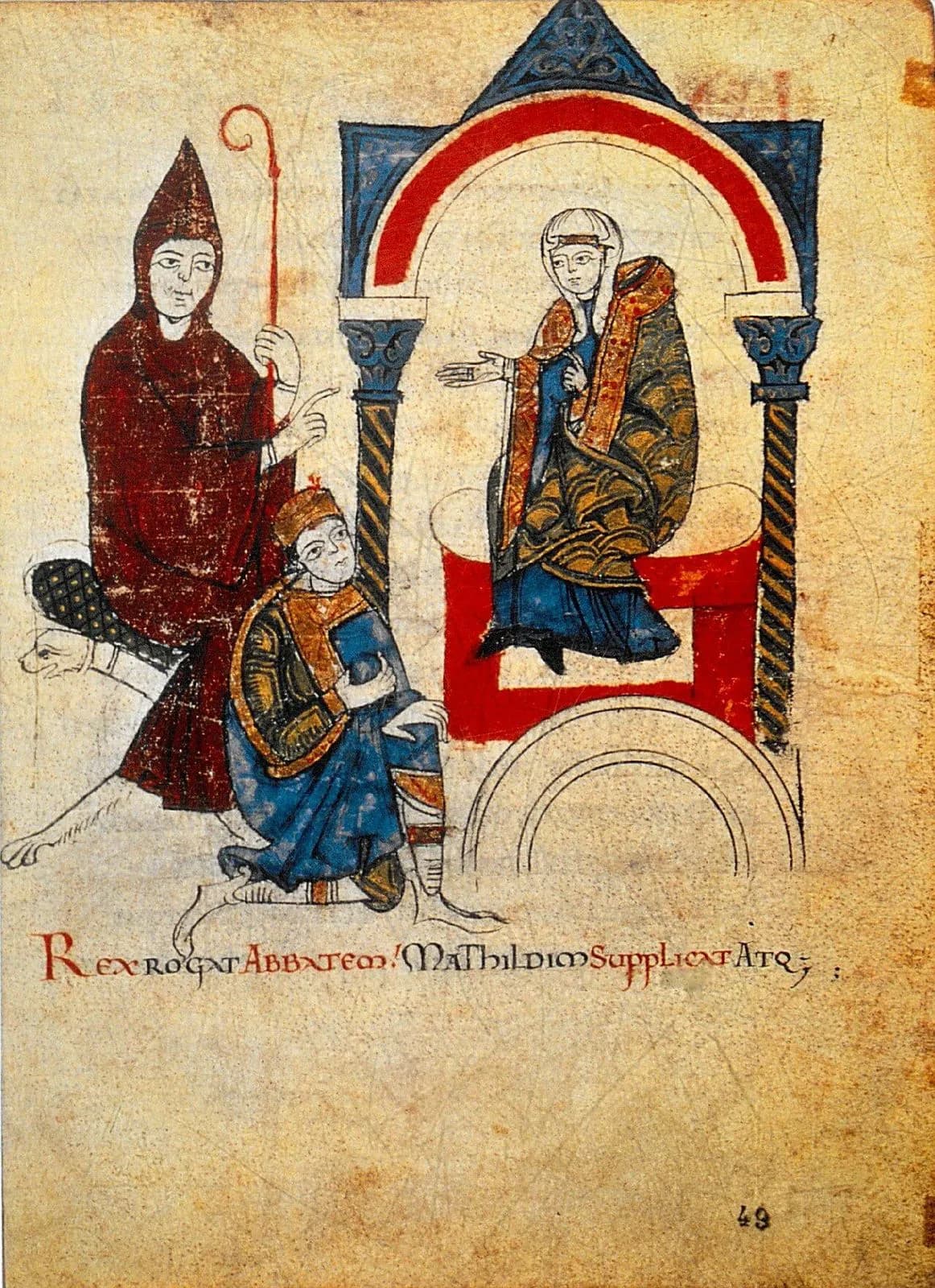
- Born
- 1024, at Semur in Burgundy, eldest son of Count Dalmatius of Semur 1
- Died
- April 28, 1109, Easter Monday, at Cluny 1
- Canonized
- By Callistus II, January 6, 1120 1
- Built
- The great abbey church of Cluny, begun in 1089 4
Saint Hugh of Cluny, called Hugh the Great, was elected abbot of the Burgundian monastery of Cluny at twenty-five and ruled it until his death sixty years later, in 1109. 1 In those decades Cluny was the center of a network of monasteries across Europe, and its abbot was a counselor to popes, the godfather of an emperor, and the man who stood beside Gregory VII and Matilda of Tuscany at Canossa. 13 The Roman Martyrology remembers him as a tireless guardian of monastic discipline, given to almsgiving and prayer. 2
A knight's son who would not be a knight
Hugh was born in 1024 at Semur, in the Brionnais district of the Diocese of Autun, the eldest son of Count Dalmatius of Semur and of Aremberge of Vergy. 1 His father, "devoted to war and the chase," wanted him to take up the knightly life and inherit the estates; his mother wanted him given to God. 1 The boy settled it himself. Kennedy, in the 1910 Catholic Encyclopedia, says he showed such "aversion from the so-called gentle pursuits" that his father handed him to a great-uncle, Hugh, Bishop of Auxerre, to be prepared for the priesthood. 1
At fourteen he entered the novitiate at Cluny, and was allowed to take his vows the following year without completing the usual severe novitiate. He was a deacon at eighteen and a priest at twenty, and was soon made grand prior, running the house in the abbot's absence. 1 When Abbot Odilo died on January 1, 1049, after nearly half a century in office, the monks elected Hugh unanimously. He was installed on February 22. 1
Cluny
The monastery he inherited had been founded in 910 by William the Pious, Duke of Aquitaine, who gave it his entire domain and placed it under the direct protection of Rome. 14 Benedict XVI, speaking about Cluny in 2009, explained what made it different: its monasteries were exempt from the local bishops and answered to the pope, and its abbots were chosen "without any interference from the civil authorities." 3 Cluny also departed from older Benedictine custom by keeping its daughter houses under the mother abbey, their priors named by the abbot of Cluny. 4 Löffler's encyclopedia article on Odilo says it was Hugh who completed this union of monasteries. 5
Under Hugh it grew to its height. Kennedy writes that he put the election of superiors in all the houses subject to him "into spiritual hands" and so saved "hundreds of cloisters from the cupidity of secular lords." New houses opened in France, Germany, Spain and Italy, and in England the priory of St. Pancras at Lewes. 1 Alston calls Lewes the earliest Cluniac foundation in England and dates it to 1077. 4 How large the network became is disputed. Benedict XVI put it at almost 1,200 monasteries at the start of the twelfth century. 3 Alston, in the encyclopedia's article on the congregation, counts some 314 in the twelfth century and calls the often-quoted figure of 2,000 "an exaggeration." 4
Hugh also built. In 1089, Alston says, he began the abbey church known since as Cluny III, 555 feet long and, until the new St. Peter's in Rome, the largest church in Christendom. 4 Pope Urban II consecrated its high altar on October 25, 1095. 1 The church was sold off after the Revolution and almost entirely destroyed; Alston, writing in 1908, says a road ran through the site of the nave. 4
Counselor to popes
Kennedy's article reads at times like a list of councils. In 1049, at twenty-five, Hugh spoke so forcefully against the abuses of the day at the Council of Reims, before Pope Leo IX, that the pope took him to Rome for the council of 1050. 1 Stephen IX made him his traveling companion and died in his arms at Florence in 1058. Hugh took part in the Roman council of 1059 that regulated papal elections, and was sent to France to carry out its decrees. 1 Two of the popes of his later years, Urban II and Paschal II, had been his own monks. 1
The friendship that mattered most was with Hildebrand, who became Gregory VII. Kennedy calls them alike in their "burning zeal" against simony, lay investiture and an unchaste clergy. 1 Gregory wrote to Hugh often, and in one letter described him as a man "whom no imprecation, no applause or favours, no personal motives can divert from the path of rectitude." 1 At the Council of Clermont in 1095, where the First Crusade was proclaimed, Hugh helped draft and publish the decrees and was thanked by the pope. 1
Canossa
Hugh was also the Emperor Henry IV's godfather. Henry's father, Henry the Black, had written to the abbot crediting his prayers for his own recovery and for the birth of his son, and asked him to stand sponsor for the child. 1 When that son, as king, came to open conflict with Gregory VII in 1076, Hugh found himself between the two. He hurried to the pope at Canossa, and with the help of Countess Matilda of Tuscany brought about a reconciliation between pope and king, which Kennedy calls "unfortunately of short duration." 1 When the quarrel broke out again, Hugh set out for Rome, was seized on the road and brought before Henry, and urged him once more to submit. 1 He kept at it for the rest of Henry's life; in 1106, the year he died, the emperor wrote to his "dearest father" asking for his prayers. 1
Other rulers sought him too. Alfonso VI of Castile adopted the Roman rite in place of the Mozarabic at his request, and in 1081 the Christian kings of Spain chose him to arbitrate their succession. 1 William the Conqueror asked for Cluniac monks to serve his court and offered bishoprics to twelve of them; Hugh, Kennedy writes, "disabused his mind on the subject of ecclesiastical appointments," and when he founded Lewes a little later he took every precaution to secure its freedom of election. 1 Kennedy's order of events puts that founding after William's second request in 1078; Alston's date is 1077. 14
The abbot at home
For his monks Kennedy calls him "a model of fatherly forethought." 1 He gave great care to the solemnity of the liturgy, and one of his customs, singing the Veni Creator at Terce on Pentecost, was later extended to the whole Roman Church. 1 He brought strict enclosure to the nuns of Marcigny, where his sister became the first prioress in 1061 and his mother took the veil. 1 He built a hospital for lepers and served in it himself, taught in the monastery school, and loved the Scriptures above other study. 1 Kennedy notes his devotion to the Virgin and to the souls in purgatory, and says nearly all his letters and his Life of the Blessed Virgin are lost. 1
In the spring of 1109, feeling the end approaching, he received the last sacraments, gave each of his monks the kiss of peace, and asked to be carried to the chapel of Our Lady, where he lay in sackcloth and ashes before the altar. He died there on the evening of Easter Monday, April 28. 1 Miracles were reported at his tomb, Pope Gelasius came to it on pilgrimage in 1119 and died at Cluny, and his successor Callistus II, elected in the monastery, declared Hugh a saint on January 6, 1120. 1 His shrine was lost in the Huguenot rising of 1575, except for a few relics. 1
What is Saint Hugh of Cluny the patron saint of?
None of the sources read for this page names a patronage for Saint Hugh of Cluny, and this page does not invent one. The Roman Martyrology remembers him instead for what he did: devoted to almsgiving and prayer, keeper and tireless promoter of monastic discipline, and a zealous servant of the Church. 2
Saint Hugh of Cluny's feast day
Praying with Saint Hugh of Cluny
It is easy to read Hugh's life as a career: councils, legations, kings. 1 Benedict XVI, speaking of Cluny, put the liturgy first. The monks believed their worship was "participation in the liturgy of Heaven," and that they were responsible "for interceding at the altar of God for the living and the dead." 3 Everything else Cluny did, its schools, its care for travelers and the poor, its part in the Truce of God, grew from that. 3
Canossa is worth thinking about because Hugh did not win there. He brought a pope and a king to peace, and the peace fell apart. 1 He tried again, was arrested for his trouble, and kept working for peace with a godson who had made war on the Church, until that godson wrote asking for his prayers at the end. 1 Faithfulness, in his case, looked like staying in a conversation long after it had stopped going anywhere.
And then the last scene, which is a monk's death and not a statesman's. The abbot who had sat with popes asked to be laid on sackcloth and ashes before Our Lady's altar, after saying goodbye to each of his brothers in turn. 1
Saint Hugh of Cluny, pray for us.
Sources
- 1.Thomas Kennedy, "St. Hugh the Great," The Catholic Encyclopedia, Vol. 7 (New York: Robert Appleton Company, 1910).
- 2.Roman Martyrology, entry for April 29, "Sant'Ugo, abate," as printed in "Santo del giorno," Conferenza Episcopale Italiana (in Italian).
- 3.Benedict XVI, General Audience on the Cluniac reform, November 11, 2009, Libreria Editrice Vaticana.
- 4.George Cyprian Alston, "Congregation of Cluny," The Catholic Encyclopedia, Vol. 4 (New York: Robert Appleton Company, 1908).
- 5.Klemens Löffler, "St. Odilo," The Catholic Encyclopedia, Vol. 11 (New York: Robert Appleton Company, 1911).
Saints to turn to next
Others in this collection who are turned to for some of the same things.
- Saint Aelred of Rievaulx1109 - January 12, 1166 (or 1167)PrayerWork and vocation
- Saint Agnes of Montepulcianoc. 1268 - April 1317PrayerWork and vocation
- Saint Alphonsus Rodriguez1532 or 1533 - October 1617PrayerWork and vocation
- Saint André BessetteAugust 9, 1845 - January 6, 1937PrayerWork and vocation