Saint Erconwald of London
c. 630 - c. 693
- Also called
- Erkenwald, Earconwald, Eorcenwald; Erconvaldus in Latin 2
- Died
- April 30, 693, at Barking, by katolsk.no, which notes that 686 is also given 2; "about 690" in the 1909 Catholic Encyclopedia 1
Saint Erconwald was a wealthy Anglo-Saxon who founded two monasteries on either side of the Thames, Chertsey for men and Barking for women, and in 675 became bishop of London. 12 In his own century he was known for holiness and for making peace; Bede reported that the sick were cured by touching the litter he was carried in. 12 For the rest of the Middle Ages he was the great saint of London, and his shrine in St. Paul's was one of the cathedral's treasures and a favorite place of pilgrimage until it was broken up at the Reformation. 2
What can be known
The Norwegian bishops' saints database, which gathers the older scholarship, is frank about the evidence. Almost nothing reliable is known of Erconwald except what Bede writes, a few references in the Life of Wilfrid of York, a letter from one of Boniface's correspondents, and what can be read from the charters and laws connected with him. 2 It gives his birth as about 630, in East Anglia or in Lindsey a little farther north, and makes him the brother of Saint Ethelburga of Barking. 2
His family is where the sources part. The 1909 Catholic Encyclopedia says he "belonged to the princely family of the East Anglian Offa." 1 The Diocese of Brentwood's notes say he was born in Lincolnshire and was "a member of the royal house." 4 katolsk.no regards that royal descent as an invention of the later biographers, and suggests that if the family was royal at all it was more likely the house of Kent, where the names Æthelburh and the prefix Earcon both turn up. 2 What every source agrees on is that he was rich. 12
Chertsey and Barking
He spent a large part of his inheritance on two monasteries. 1 Chertsey, in Surrey, was for monks, and he founded it with the help of King Egbert of Kent and governed it himself as abbot, from about 664. 12 A charter of Frithuwald, sub-king of Surrey under Wulfhere of Mercia, enlarged its lands a great deal, including a stretch of land along the river in the port of London. 2 The other house, at Barking in Essex, was for nuns, and he put his sister Ethelburga over it as abbess. 124
Brother and sister stayed close all their lives. katolsk.no says that when he was bishop she used to go with him on his journeys. 2 Chertsey had a harder future: the Danes later burned it and killed its ninety monks with their abbot. 2
Bishop of London
In 675 Bishop Wini of London died. 12 King Sebbi of the East Saxons put Erconwald forward, and Theodore, archbishop of Canterbury, consecrated him bishop of the East Saxons with his seat in London, a diocese that took in Essex and Middlesex. 12 The encyclopedia says he went on living as a monk until that call came. 1
He was trusted on both sides of the line between Church and crown. He was present in 686 at the reconciliation between Archbishop Theodore and Wilfrid. 1 When King Ine of Wessex issued his laws, the preface called Erconwald "my bishop," for the part he had taken in them. 12 Brentwood's notes describe him as an influential adviser on lawmaking and charters to the king of Wessex. 5 He enlarged his cathedral church of St. Paul's, increased its income, and obtained privileges for it from the king. 12 katolsk.no adds that he could persuade rich benefactors to give large estates for religious purposes, and that his holiness and his peacemaking earned him a lasting place in the hearts of Londoners. 2
In his last years he suffered from gout and was carried about his diocese on a litter. 2 Bede, who was nearly his contemporary, recorded that the sick were cured by touching it; the encyclopedia cites that testimony, and katolsk.no says such miracles were being reported in Bede's own time. 12 The Brentwood notes remember him instead as a bishop "in a small chariot, which he used for travelling around his diocese." 4 Either way, both traditions remember a bishop who had to be carried.
Death and the shrine at St. Paul's
An old epitaph says he governed the diocese for eleven years. 12 He is said to have retired at the end to his sister's monastery at Barking and to have died there on April 30. 12 katolsk.no gives the year as 693, noting that some sources say 686; the encyclopedia says about 690; Brentwood says 693. 125 Waldhere succeeded him as bishop. 2
katolsk.no tells how the nuns of Barking, the monks of Chertsey and the clergy of London all claimed his body. A storm broke and the river flooded, and then the sun came through the clouds and seemed to lay a golden path toward the cathedral, and London had him. 2 He was buried in St. Paul's, and his tomb became known for miracles. 12
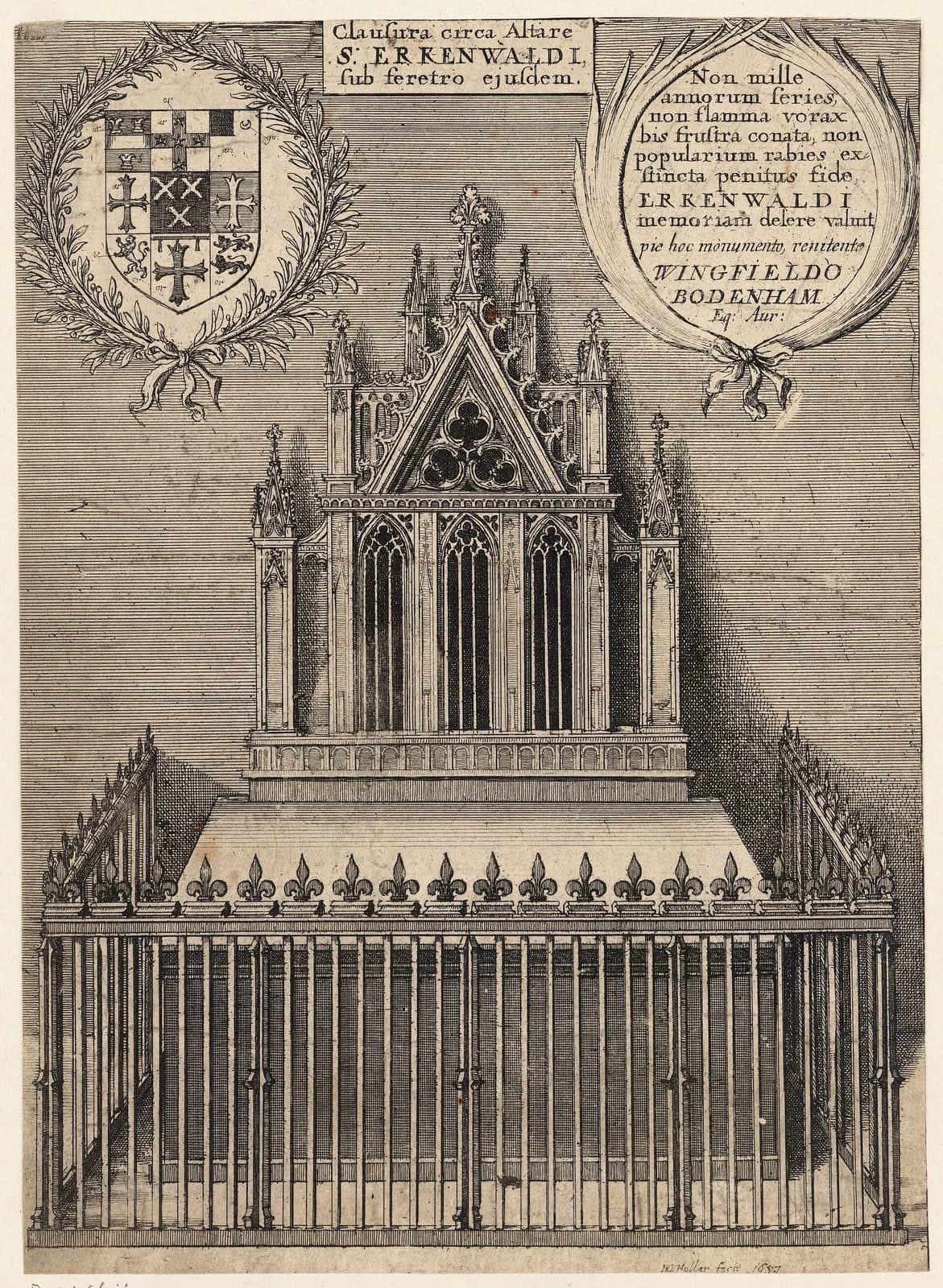
When the cathedral burned in 1087, it is related that his shrine and its silk coverings came through untouched. 12 On November 14, 1148, his body was solemnly moved to a new shrine raised above, or east of, the high altar. 12 A nephew of an earlier bishop wrote a Life and a book of miracles for that occasion, and it is these twelfth-century texts that first make him the son of a king called Offa, born at "Stallington" in Lindsey. 2 There was another translation on February 1, 1326, and over the next century canons and London merchants kept adding to the shrine until it was one of the treasures of the cathedral. 2 The encyclopedia notes that in 1386 Bishop Braybroke ordered both his death day and the translation kept at St. Paul's as feasts of the first class. 1 In the sixteenth century the shrine was stripped of its jewels, and his bones are said to have been buried at the east end of the choir. 12
The cult produced stories as well as jewels. The strangest, as katolsk.no tells it, has workmen rebuilding St. Paul's uncover a perfectly preserved body wearing a crown and holding a scepter. The dead man tells the bishop that he was a just judge of pagan London, shut out of heaven because he died unbaptized. Erconwald weeps and wishes he could baptize him in the name of the Trinity; a tear falls on the judge's face, the judge cries out in joy that he has been set free, and the body crumbles to dust. 2 It is a legend, and it is told here as one.
What is Saint Erconwald the patron saint of?
Saint Erconwald is the patron saint of London. The Diocese of Brentwood calls him "the patron saint of London and the secondary co-patron of our Diocese of Brentwood." 4 katolsk.no adds that he is invoked against gout, the illness of his last years, and calls him the most important bishop of London between Mellitus and Dunstan and the city's chief saint in the Middle Ages. 2 In art he is shown as a bishop carried on a litter, sometimes with a woman touching it, or together with his sister Ethelburga. 2
Saint Erconwald's feast day
Saint Erconwald's feast day is April 30, the day of his death, under which the Roman Martyrology enters him: at Barking in England, the passing of Saint Erconwald, bishop, who founded two monasteries, one for men that he governed himself and one for women led by his sister Saint Ethelburga. 23 In England he is kept on May 13 in the Archdiocese of Westminster, the Archdiocese of Southwark and the Diocese of Brentwood. 24 The 1909 encyclopedia gives the date then observed by English Catholics as November 14, the day of the 1148 translation. 1 The translations of February 1 and May 13 are also recorded. 2
Praying with Saint Erconwald
Very little of Erconwald survives in his own words or in anyone's eyewitness account. What does survive is a pattern: a rich man who gave his inheritance to found houses of prayer, put his sister in charge of one of them, and kept her close for the rest of his life. 12 He did not leave the world so much as spend himself on it, as abbot, bishop and counselor to kings. 12
His last years were spent in pain, carried from place to place because he could not walk well, and the litter that carried him became the thing people remembered. 2 Bede's sick did not touch his hand or his vestments. They touched the chair of an old man with gout, and were healed. 12
London took him to itself so thoroughly that three communities fought over his body, and the city kept him at the heart of its cathedral for more than eight hundred years. 2 The shrine is gone now, and nobody is sure where his bones lie. 12 The Church still names him on April 30 and his own country keeps him in May, which is a kind of fidelity to a man who is mostly known by what he built and whom he served. 234
Saint Erconwald of London, pray for us.
Sources
- 1.Columba Edmonds, "St. Erconwald," The Catholic Encyclopedia, Vol. 5 (New York: Robert Appleton Company, 1909).
- 2."Den hellige Erkenwald av London," Den katolske kirke (katolsk.no), Catholic Diocese of Oslo (in Norwegian).
- 3.Roman Martyrology, entry for April 30, "Sant'Erconvaldo, vescovo," as printed in "Santo del giorno," Conferenza Episcopale Italiana (in Italian).
- 4."Feast of St Erconwald: 13th May," Looking Forward 59, Diocese of Brentwood Education Service, May 8, 2022.
- 5."St. Erconwald: 13th May," Walking the Path 19, Diocese of Brentwood Education Service.
Saints to turn to next
Others in this collection who are turned to for some of the same things.
- Saint Aelred of Rievaulx1109 - January 12, 1166 (or 1167)Work and vocationSuffering and illness
- Saint Alphonsus Rodriguez1532 or 1533 - October 1617Work and vocationSuffering and illness
- Saint André BessetteAugust 9, 1845 - January 6, 1937Suffering and illnessWork and vocation
- Saint Andrew Kim TaegonAugust 21, 1821 - September 16, 1846Suffering and illnessWork and vocation