Saint Cassian of Imola
c. 240 - c. 304
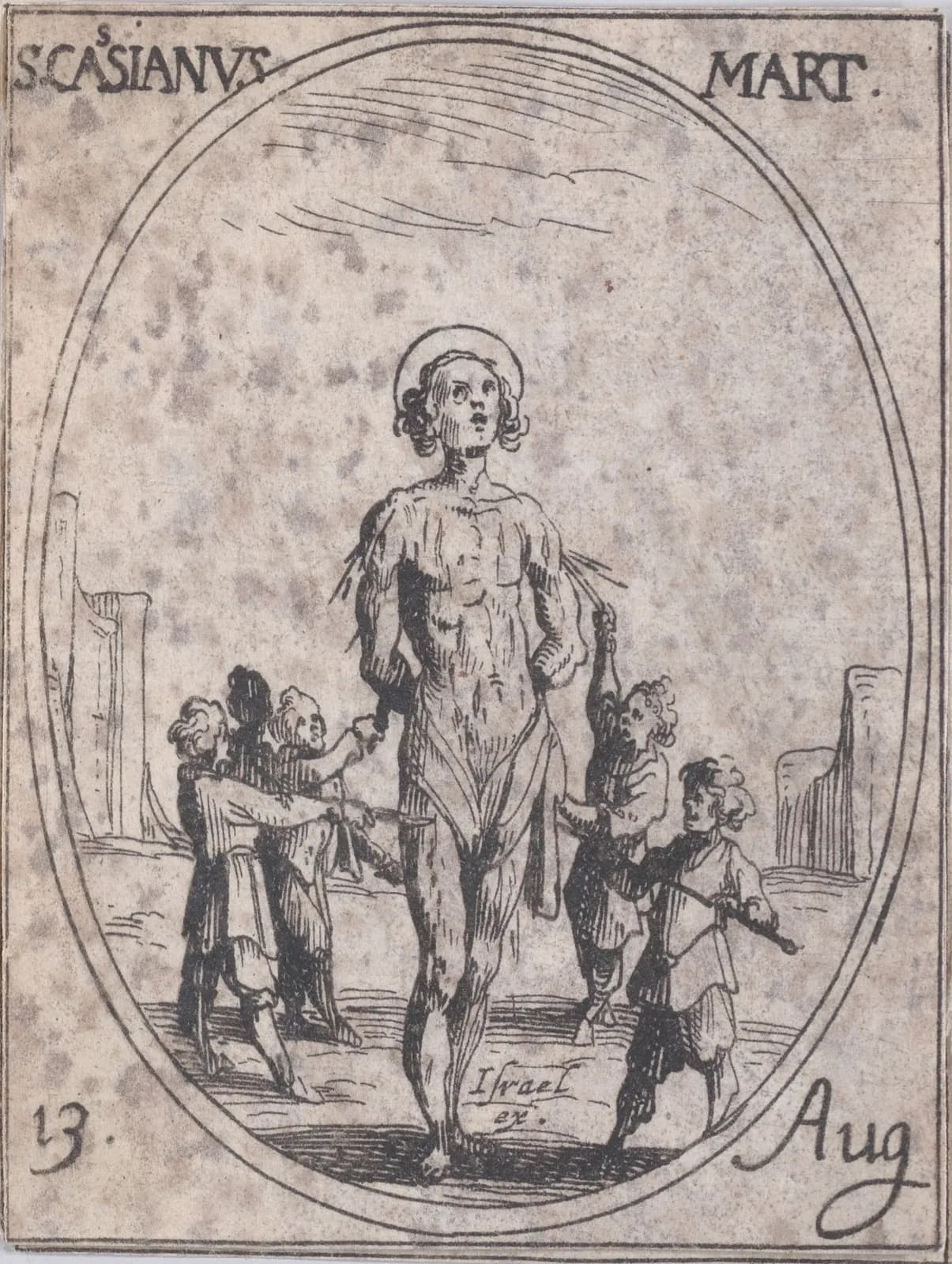
- Also called
- Cassianus in Latin, Cassiano in Italian 1
- Born
- About 240, at Rome, says katolsk.no 1
- Died
- Killed by his pupils with their styluses, probably about 304 under Diocletian 14; under Julian if he was the bishop of Sabiona 5
- Relics
- His arm and the column of his martyrdom 1
- Patron of
- The diocese of Bozen-Brixen, with Ingenuin and Albuin 1
Saint Cassian of Imola was a Christian schoolmaster in the Roman town of Forum Cornelii, now Imola in northern Italy, who refused to worship idols and was handed over to his own pupils to be stabbed to death with their writing styluses. 23 He probably died in the persecution of Diocletian, about 304. 14 Nearly all that is known of him comes from the poet Prudentius, who prayed at his tomb about a century later and wrote a hymn about the picture he found there. 13
A martyr known from one poem
The Norwegian bishops' saints database (katolsk.no) is plain about the evidence: there is no doubt that an early martyr named Cassian was buried at Imola, but his traditional biography looks doubtful. 1 It dates his birth to about 240 at Rome and his death to about 304, in the persecution of Diocletian. 1 Johann Peter Kirsch, in the 1910 Catholic Encyclopedia, calls him "without doubt an historical martyr, who probably suffered in the persecution of Diocletian." 4
The oldest report is a hymn. Prudentius, whom katolsk.no calls the most important early Christian poet of the West (348 to about 405), wrote a collection of poems on the martyrs called the Peristephanon, "On the Victor's Crown," and the ninth is the passion of Cassian. 13 Umberto Benigni, writing on the diocese of Imola for the same encyclopedia, counts the martyrdom as certain on the strength of that poem. 5
Prudentius at the tomb
The poem opens as a traveler's account. Prudentius says Sulla founded Forum Cornelii and named it after himself, and that he stopped there on his way to Rome, lay prostrate at the tomb of the martyr, and wept as he thought over his own wounds and troubles. 3 When he lifted his eyes he saw, facing him, an image of the martyr painted in colors, his skin torn by a thousand small punctures, with children all around him stabbing at him with styluses. 3
The sources do not quite agree on what he saw. Prudentius's own words are picta imago, a painted image. 3 Benigni speaks of "pictures seen by him in the cathedral of Imola." 5 katolsk.no says the relics were kept in a sarcophagus carved on top with scenes from the martyrdom. 1
Prudentius asked the sacristan what the picture meant. The answer fills most of the poem. It was no idle old wives' tale, the man told him, non est inanis aut anilis fabula; the picture tells a true history, historiam pictura refert, handed down in books. 3
The schoolmaster and his pupils
Cassian had been in charge of boys' studies and sat as their master among a large class. 3 In Prudentius's account he was expert in shorthand, catching every word in brief signs and following speech with quick points. 3 His lessons were sometimes harsh, and the boys feared and resented him; the poet adds that no teacher seems pleasant to a schoolboy. 3 katolsk.no's prose version has him teaching grammar and literature, the pagan classics with Christian doctrine alongside, which displeased the pagan parents, and giving some boys lessons in shorthand. 1
When persecution came he was taken from among his pupils for refusing to sacrifice. 3 The official in charge of punishments asked what trade so defiant a man followed, and was told that he taught a crowd of small boys to write words in signs. 3 So he ordered him handed over to the children, so that the master who had beaten them might be their sport. 3 katolsk.no adds that he was examined by the provincial governor and bound naked to a marble column before two hundred pagan boys. 1
Death by stylus
Prudentius spares nothing. Cassian's hands were tied behind him and he was stripped, and the boys came at him with their sharpened styluses. 3 Some threw their wax tablets in his face and broke them on his forehead. 3 Others used the iron points of the styluses, the end that cuts letters into the wax, and the flat end that smooths it out again. 3
The poet dwells on a cruel detail that the Martyrology keeps: the small hands hurt more than the strong ones, because they could wound but not kill. 3 The Martyrology puts it in a sentence: the weaker the hand, the more painful the martyrdom. 2
The boys mocked him with the language of the classroom. In the poem one of them tells him he cannot complain, since he gave them the iron and armed their hands; they are only returning the thousands of notes they took down from him, and they are not even asking for the holidays he refused them. 3 At last, Prudentius writes, Christ took pity and released his soul, and his life ran out through all the wounds at once. 3
Bishop of Sabiona?
A second tradition grew up north of the Alps. katolsk.no says a Life, probably written by a canon of Brixen about 1240, made Cassian the first bishop of Sabiona, now Säben in South Tyrol, then the seat of the diocese of Brixen; driven out, he was said to have preached in Bavaria, and a tower at Säben is still shown as his prison. 1 It notes an anonymous Tyrolean Vita et gesta of Cassian, Ingenuin and Albuin, which made him the apostle of Sabiona, captured by pagans and exiled to Imola, where he was forced to teach school and died as Prudentius tells. 1
katolsk.no suggests why: the diocese's other two patron saints, Ingenuin and Albuin, were bishops, so Cassian was assumed to have been one too, and as the oldest of the three he was made the founder. 1 Benigni adds a problem of dates. Some identified him with Cassian of Sabiona, "said to have been transferred to Imola, but this would place the martyrdom in the time of Julian." 5
Relics at Imola and Brixen
katolsk.no says his chief relics are his arm and the column at which he died. 1 In 1085 a column was found by chance a few meters from the praetorium where he was killed, with traces of blood on it, on land belonging to the parish of Croce Coperta, which still exists and kept the relic for centuries. 1 In 1684 four fragments of the column were sent to Brixen, and the relics were last examined on May 13, 2003. 1
What is Saint Cassian the patron saint of?
katolsk.no names Saint Cassian as one of the three patron saints of the diocese of Bozen-Brixen, in South Tyrol, together with Saints Ingenuin and Albuin. 1 None of the sources consulted names a patronage of a trade or a cause.
Saint Cassian's feast day
Saint Cassian's feast day is August 13. 12 The current Roman Martyrology commemorates him that day at Imola in Romagna, as the martyr handed over for refusing to adore idols to the boys he had taught, to be tortured to death with their pens. 2
He shares the date with Saint Hippolytus. katolsk.no says Cassian's feast was joined to Hippolytus's on August 13 in the fifth century, and that the 1969 calendar reform removed it from the universal calendar and left it to local and particular calendars. 1 Kirsch notes that Hippolytus was commemorated with Cassian, "with whom he had no connection whatsoever." 4 In the diocese of Bozen-Brixen he is kept as a solemnity, and his translation is celebrated on December 3. 1
Praying with Saint Cassian
Prudentius does not make Cassian a gentle teacher. He was strict, his pupils were afraid of him, and when the chance came they took it. 3 The poem lets that stand beside his faith without trying to reconcile them.
He was given to the children he had spent his days with, and they killed him with the tools he had put in their hands. 23 The Martyrology still remembers the detail that the weakness of their hands made it worse. 2
The poem ends with the poet himself. Prudentius embraced the tomb and prayed about the home he had left behind and the uncertain business ahead of him; he went on to Rome, came home again, and wrote that he had been heard. 3 For him Cassian was a saint to go to with one's own troubles, and he finished the hymn by saying he proclaims him. 3
Saint Cassian of Imola, pray for us.
Sources
- 1."Den hellige Kassian av Imola (~240-~304)," Den katolske kirke (katolsk.no), Catholic Diocese of Oslo (in Norwegian).
- 2.Roman Martyrology, entry for August 13, "San Cassiano, martire," as printed in "Santo del giorno," Conferenza Episcopale Italiana (in Italian).
- 3.Prudentius, Peristephanon IX, "Passio Sancti Cassiani Forocorneliensis," Latin text, The Latin Library (in Latin).
- 4.Johann Peter Kirsch, "Sts. Hippolytus," The Catholic Encyclopedia, Vol. 7 (New York: Robert Appleton Company, 1910).
- 5.Umberto Benigni, "Imola," The Catholic Encyclopedia, Vol. 7 (New York: Robert Appleton Company, 1910).
Saints to turn to next
Others in this collection who are turned to for some of the same things.
- Saint Aelred of Rievaulx1109 - January 12, 1166 (or 1167)Work and vocationSuffering and illness
- Saint Alphonsus Rodriguez1532 or 1533 - October 1617Work and vocationSuffering and illness
- Saint André BessetteAugust 9, 1845 - January 6, 1937Suffering and illnessWork and vocation
- Saint Andrew Kim TaegonAugust 21, 1821 - September 16, 1846Suffering and illnessWork and vocation