Saint Omer of Thérouanne
c. 595 - c. 670
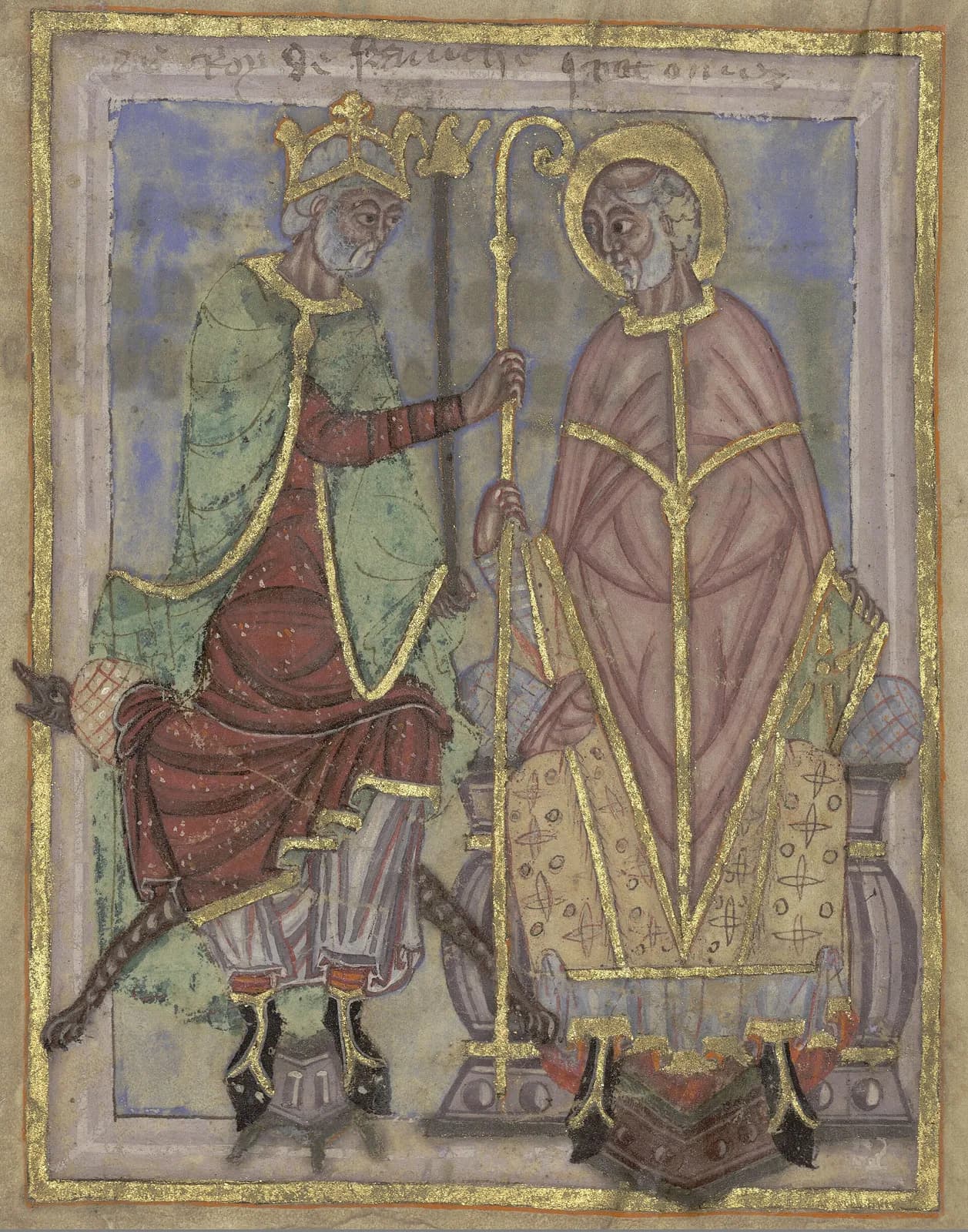
Saint Omer was a monk of Luxeuil whom King Dagobert made bishop of Thérouanne in 637, among a people in the far north of Gaul who had almost entirely lost the faith. 12 With monks sent from his old monastery, among them Saint Bertin, he rebuilt the Church there, and the town of Saint-Omer grew up around the monastery they founded. 124 He went blind in his last years and kept on working. 2
Luxeuil
Francis O'Boyle, in the 1911 Catholic Encyclopedia, says Omer was born into a distinguished family toward the close of the sixth century or the beginning of the seventh, at Guldendal. 1 The Norwegian bishops' saints database (katolsk.no) puts his birth about 595, at Guldindal or at Orval near Coutances in Normandy, and says he may have been an only child, since his parents gave all their energy to his upbringing. 2
His mother died while he was still young, and he and his father entered the monastery of Luxeuil together, probably about 615. 12 The abbot then was Eustace, Columban's successor, and O'Boyle says that under his direction Omer studied the Scriptures, "in which he acquired remarkable proficiency." 1 katolsk.no says he spent some twenty years as a monk there. 2
Bishop of the Morini
About 637 King Dagobert I asked for a bishop for Thérouanne, the chief town of the Morini, a people living along the northern coast of Gaul. 12 katolsk.no says it was Saint Acharius, bishop of Noyon and Tournai, who proposed Omer, and that he was very unwilling to leave his monastery but obeyed. 2 He was consecrated in 637. 1 His diocese took in what is now the Pas-de-Calais and part of Flanders. 2
The faith had been preached there before. O'Boyle says the Morini had received it from Saints Fuscian and Victoricus and later from Antmund and Adelbert, but that "nearly every vestige of Christianity had disappeared." 1 katolsk.no says earlier dioceses had been swept away by the barbarian invasions of the fifth century, that Saint Walaric and Irish monks had begun to undo the damage, and that Omer found a diocese in decay, confused in its teaching, with many people fallen back into paganism. 2
He went at it, says katolsk.no, with great energy, and his method seems to have been to revive the faith of those already baptized before trying to convert anyone new. 2 He preached well and insisted on unselfish service and on reconciliation. 2 He also asked for help. The abbot of Luxeuil sent him several monks, and O'Boyle names three of them: Bertin, Mommolin and Ebertran. 1 Michael Ott, in the encyclopedia's article on Bertin, calls Omer Bertin's "friend and kinsman," and says the three set out about 638. 3 O'Boyle says Omer had the satisfaction of seeing the faith firmly established in a short time. 1
Sithiu and the church of Our Lady
A wealthy convert named Adroald gave Omer an estate called Sithiu, on the river Aa. 23 Ott says Omer turned the whole tract over to the missionaries, who built a monastery on it. 3 O'Boyle gives the foundation to Omer himself, about 654, and calls it the abbey of Saint Peter, "now Saint Bertin's," which soon rivaled Luxeuil for the number of learned and zealous men it trained. 1 katolsk.no says it was established by Omer and the monks together, and that the town that later took his name grew up around it. 2
Some years later Omer built a church of Our Lady at Sithiu, with a small monastery beside it, and handed it over to the monks of Saint Bertin. 1 katolsk.no's entry on Bertin dates the church to 663 and says the two men built it together; it later became the cathedral of Saint-Omer. 6
Blindness and death
Little is known of the rest of his life, katolsk.no says, except that he was completely blind by 663 at the latest, and that the blindness did not lessen his care for his people. 2 It adds that several miracles were attached to him, none of them very convincing in its judgment, among them the story that he briefly recovered his sight during the translation of the relics of Saint Vedast at Arras. 2
The date of his death is not known. O'Boyle says he is believed to have died about 670, and katolsk.no gives about 670, with a query beside 699. 12 Where he was buried is also uncertain. O'Boyle thinks it most probable that he was laid in the church of Our Lady, now the cathedral of Saint-Omer. 1 katolsk.no says he was buried in the monastery, and that, as so often, there was a struggle over his relics. 2 Georges Goyau, writing on the diocese of Arras, says the town's Gothic cathedral of the fourteenth century "was built over the saint's tomb." 4
His cult spread quickly. 2 The town around the abbey took his name, and so did Pont-Audemer, between Caen and Rouen. 24 Goyau calls him "the apostle of the Morini," though he places him in the sixth century rather than the seventh, and notes that Saint-Omer was a diocese in its own right until the Revolution. 4 katolsk.no says several Lives of him survive; the least unsatisfactory was written at Saint-Bertin early in the ninth century, as one work with the Lives of Bertin and Winnoc. 2
What is Saint Omer the patron saint of?
Saint Omer's feast day
Saint Omer's feast day is September 9. 12 O'Boyle adds that when and by whom he was raised to the altars "cannot be ascertained." 1 katolsk.no says his name is in the Roman Martyrology, that November 1 is also given, and that Saint-Omer keeps the translation of his relics on June 8 and their recovery on October 21. 2 The Archdiocese of Madrid's santoral lists him among the saints of September 9 as a bishop. 5
Praying with Saint Omer
Omer did not want to be a bishop. He had spent twenty years in a monastery studying the Scriptures, and katolsk.no says he was very reluctant to leave it when the king sent for him. 12 He went, and he took Luxeuil with him in the form of the monks he asked for. 13
The work he was given was repair more than conquest. The Morini had heard the gospel before and lost it, and katolsk.no says he began with the baptized, trying to bring back those who had drifted before looking for new converts. 12
For the last years of his life he could not see. 2 The sources record that he went on caring for his people anyway. 2 They also record that the monastery he gave away and the church he built lasted, and the town around them still carries his name. 14
Saint Omer of Thérouanne, pray for us.
Sources
- 1.Francis O'Boyle, "St. Omer," The Catholic Encyclopedia, Vol. 11 (New York: Robert Appleton Company, 1911).
- 2."Den hellige Audomarus av Thérouanne (~595-~670)," Den katolske kirke (katolsk.no), Catholic Diocese of Oslo (in Norwegian).
- 3.Michael Ott, "St. Bertin," The Catholic Encyclopedia, Vol. 2 (New York: Robert Appleton Company, 1907).
- 4.Georges Goyau, "Arras," The Catholic Encyclopedia, Vol. 1 (New York: Robert Appleton Company, 1907).
- 5.Santoral for September 9, Oración y Liturgia, Archdiocese of Madrid, 2025 (in Spanish).
- 6."Den hellige Bertinus av Sithiu (~615-~698)," Den katolske kirke (katolsk.no), Catholic Diocese of Oslo (in Norwegian).
Saints to turn to next
Others in this collection who are turned to for some of the same things.
- Saint Aelred of Rievaulx1109 - January 12, 1166 (or 1167)Work and vocationSuffering and illness
- Saint Alphonsus Rodriguez1532 or 1533 - October 1617Work and vocationSuffering and illness
- Saint André BessetteAugust 9, 1845 - January 6, 1937Suffering and illnessWork and vocation
- Saint Andrew Kim TaegonAugust 21, 1821 - September 16, 1846Suffering and illnessWork and vocation