Saint Anno of Cologne
c. 1010 - December 4, 1075
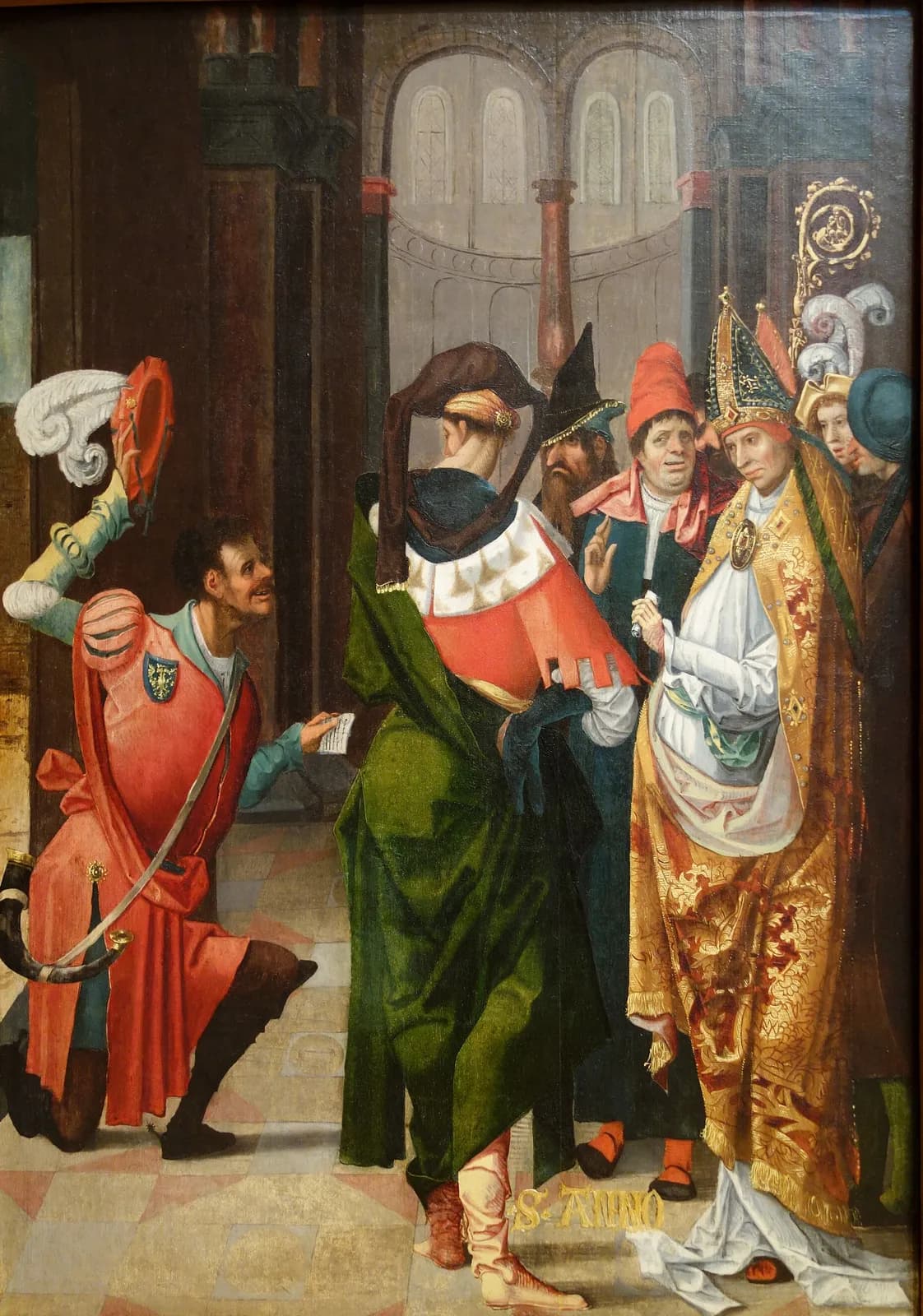
- Born
- About 1010, at the castle of Steusslingen in Swabia 2
- Archbishop of Cologne
- From 1055, says the Catholic Encyclopedia 1; named and consecrated in 1056, says katolsk.no 2
- Canonized
- "Shortly afterwards," says the Catholic Encyclopedia 1; in 1183, by Pope Lucius III, says katolsk.no 2
- Patron saint of
- Invoked against gout 2
Saint Anno was archbishop of Cologne for twenty years in the eleventh century, and for a time he governed the Holy Roman Empire in the name of a boy king he had taken from his mother. 12 He helped end a papal schism, founded monasteries across the Rhineland, and made enemies of his own city, the young Henry IV and the people of Trier. 12 He spent his last year doing penance in the abbey of Siegburg and died there on December 4, 1075. 2
From a Swabian castle to the imperial court
According to the Norwegian bishops' saints database, Anno was born in 1010 at the castle of Steusslingen, near Hohentwiel in Swabia, the son of a poor knight of the lesser nobility. 2 He was educated at the cathedral school of Bamberg and was a religious boy, but he thought about a life as a soldier. 2 The 1907 Catholic Encyclopedia says he "had formerly adopted the profession of arms," and that an uncle who was a canon of Bamberg guided him into the Church while he was still very young. 1
After his ordination he became provost of Goslar in 1044. 2 There the Emperor Henry III noticed him. 2 Thomas Campbell, who wrote the encyclopedia article, says his learning "both in sacred and profane" subjects and his "unusual virtue" drew the emperor's attention, and that he "is said to have been a man of remarkably handsome presence and of rare eloquence." 1 Henry made him a personal adviser, and Anno went with him on his campaigns in Hungary in 1051 and 1052. 2
Archbishop of Cologne
The sources differ by a year on his appointment. Campbell gives 1055. 1 katolsk.no says Henry III named him archbishop in 1056, shortly before the emperor's own death and against Anno's will, and that he was consecrated the same year. 2 Both agree that he did not want it. Campbell says his consecration was a scene of great splendor, "though very trying to him, as he accepted the office with the greatest repugnance." 1
Cologne did not take to him. katolsk.no says the people and clergy thought he was not well born enough for so high an office, and that he was soon surrounded by enemies. 2 It puts much of the trouble down to his quick temper and his strongly developed sense of justice, and calls him a man who followed the law strictly and made no compromises. 2 Under him the archdiocese grew considerably, in territory and in power. 2
Kaiserswerth and the regency
When Henry III died in 1056, his widow, the Empress Agnes, ruled for their young son, the future Henry IV. 12 katolsk.no describes her as very devout but anxious and timid, and says a conspiracy of secular and spiritual princes formed against her, with Anno at its head. 2 In 1062 they carried out what katolsk.no calls a kind of coup d'état at Kaiserswerth, on the Rhine. 2 The twelve-year-old king was shut up on a ship; he jumped into the river and nearly drowned, and was brought to Cologne to be raised in the archbishop's palace. 2 Agnes withdrew to a convent. 2
Campbell tells the regency more gently. In his account Agnes made Anno regent and entrusted him with the education of the prince, "who had already been corrupted by the flatterers who surrounded him." 1 Both sources agree that the boy came to dislike him. 12 katolsk.no says Anno had to share power with Archbishop Adalbert of Bremen, handing him the regency after a year, and that Anno was regent until 1066, when Henry came of age at sixteen and kept him away from public affairs. 2
The two accounts part again over 1072. Campbell says the injustices of Henry's favorites became so unbearable that "in 1072 Anno again resumed the reins of government." 1 katolsk.no says that in 1072 Anno laid down all his offices in the government of the realm and gave himself entirely to Church reform in his own diocese. 2
The schism of Cadalus
His great service to the Church was in the papal schism of 1061-1064. Cadalus, bishop of Parma, was set up as antipope against the lawful pope, Alexander II, with support from the German court. 12 Campbell says Anno "joined with Hildebrand and St. Peter Damian in the work of order and reformation," and spoke for Alexander at an assembly at Augsburg in 1062. 1 katolsk.no says he was the decisive figure at the Pentecost synod of Mantua in May 1064, where his support for Alexander brought the schism to an end. 2
Neither source makes him a simple reformer. katolsk.no says he did not belong to the party of the later Pope Gregory VII, though he was reform-minded and prepared the way for the Church's renewal. 2 Campbell quotes the historian Hergenröther on "the discontent of the court of Germany because of the frequent sharp reprehensions addressed to the powerful Anno by Pope Nicholas II," and passes on Hergenröther's charge that Anno shared the "autocratic nepotism of prelates" common in his time. 1
Siegburg, St. Gereon and the other foundations
He was a great builder. Campbell says he reformed all the monasteries of his diocese and founded five new ones for canons regular and Benedictines. 1 katolsk.no names them: the abbey of Siegburg near Cologne, founded in 1064, St. George in Cologne, Saalfeld in Thuringia, Stoppenberg in Essen and Grafschaft in the Sauerland, as well as the church of Maria ad Gradus in Cologne. 2 It also says that a dream moved him to rebuild St. Gereon, the Cologne church of the "golden saints," which had stood half abandoned since the Normans wrecked it in 882; the church he raised in Romanesque splendor still stands. 2
The Roman Martyrology remembers him chiefly for this. It calls him a man of strong intelligence, held in great honor in the Church and in civil affairs in the time of Henry IV, who set his hand to founding many churches and monasteries to increase faith and devotion. 3
A riot, a murdered nephew and a last year of penance
His last years were hard. katolsk.no says that on April 23, 1074, Cologne rose against him, angry at his unbending manner; the archbishop's palace was stormed and wrecked and Anno had to flee. 2 He put the revolt down and, katolsk.no says, punished the leading citizen families with extreme severity, including executions. 2
At Trier he had placed his nephew Konrad as archbishop over the protests of Count Theoderich, although the people of Trier had the canonical right to choose their own bishop. 2 When Anno sent Konrad there with an armed guard, he was imprisoned and later murdered. 2 Campbell, following Hergenröther, gives the nephew as "Cunon" and says he "was assassinated shortly after his appointment," adding, "Whether or not this be true, it is certain that the cares of state did not prevent Anno from fulfilling his duty as a bishop." 1
Tired of the conflict, Anno withdrew to Siegburg and spent the last twelve months of his life there in strict penance. 2 katolsk.no says he had suffered for years from several illnesses, gout among them, and from another serious disease, possibly diabetes; in the end he could neither walk nor stand for pain. 2 He died on December 4, 1075, and was buried at Siegburg. 12 Early in the next century a Siegburg monk wrote the Annolied, an epic poem on his life that calls him the flower and light of Germany. 2
What is Saint Anno the patron saint of?
katolsk.no names Saint Anno as a patron against gout, the illness that crippled his last years. 2 He is shown as a bishop or archbishop wearing the pallium, with a staff, a book, a sword or a model of a church. 2 His relics lie in a gold shrine more than a meter and a half long, set with enamel, filigree and precious stones, made by the school of Nicholas of Verdun and kept in a chapel in the crypt of St. Michael's at Siegburg. 2
Saint Anno's feast day
Saint Anno's feast day is December 4, the day of his death. 23 katolsk.no notes that December 5 is also given. 2 The Roman Martyrology enters him on December 4, at the monastery of Siegburg in the Rhineland. 3 Campbell says only that he "was canonized shortly afterwards"; katolsk.no dates the canonization to 1183, under Pope Lucius III. 12
Praying with Saint Anno
Anno is not an easy saint to like. The same sources that praise his eloquence and his foundations tell of a boy king taken from his mother, a nephew imposed on an unwilling city, and a revolt punished without mercy. 12 The Church did not canonize him because he was gentle.
What his sources set against the politics is a life of prayer that never stopped. Campbell sums it up in one sentence: "His prayer was continuous, his austerities extreme, his preaching incessant, his charity inexhaustible." 1 He founded houses of prayer wherever he governed, and the Martyrology remembers him for that above everything else. 13
His last year is the part of his life most people can recognize. A man who had ruled an empire went back to the monastery he had founded, too ill to walk, and spent the time he had left in penance. 2 The sources do not record what he prayed about in that year, only that he chose to spend it there, among the monks he had brought together, rather than at court.
Saint Anno of Cologne, pray for us.
Sources
- 1.Thomas Campbell, "St. Anno," The Catholic Encyclopedia, Vol. 1 (New York: Robert Appleton Company, 1907).
- 2."Den hellige Anno II av Köln (1010-1075)," Den katolske kirke (katolsk.no), Catholic Diocese of Oslo (in Norwegian).
- 3.Roman Martyrology, entry for December 4, "Sant'Annone, vescovo," as printed in "Santo del giorno," Conferenza Episcopale Italiana (in Italian).
Saints to turn to next
Others in this collection who are turned to for some of the same things.
- Saint Aelred of Rievaulx1109 - January 12, 1166 (or 1167)Work and vocationSuffering and illness
- Saint Alphonsus Rodriguez1532 or 1533 - October 1617Work and vocationSuffering and illness
- Saint André BessetteAugust 9, 1845 - January 6, 1937Suffering and illnessWork and vocation
- Saint Andrew Kim TaegonAugust 21, 1821 - September 16, 1846Suffering and illnessWork and vocation